
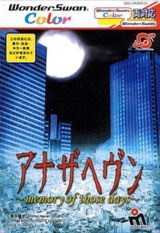
A horror sound novel set in the world of the Another Heaven film and TV drama, following two Tokyo detectives through a new case with more than twenty endings.
Screenshots
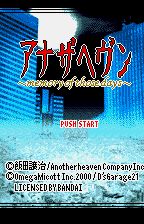
Title screen 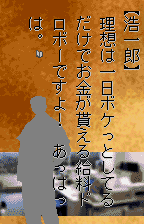
In play 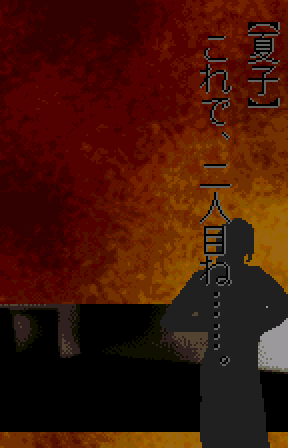
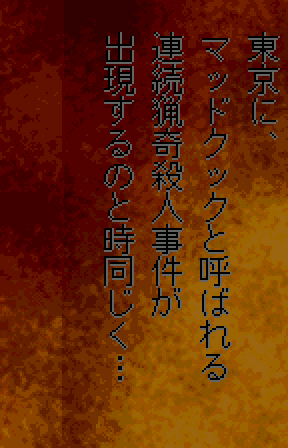
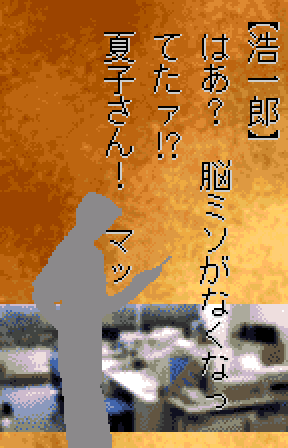
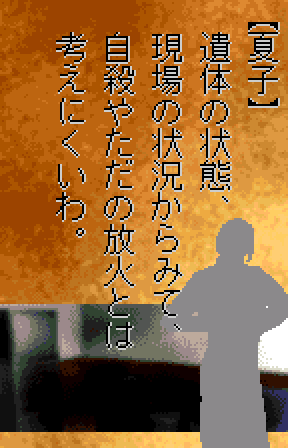
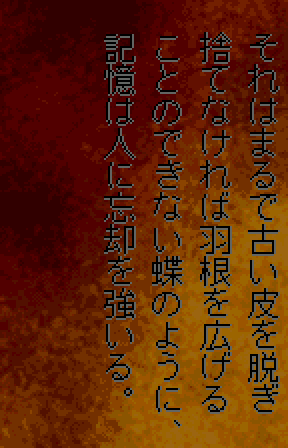
Another Heaven: Memory of those Days is a horror sound novel for the WonderSwan Color, made by Omega Micott, published by Bandai and released in Japan on 21 December 2000, twelve days after the Color went on sale. Another Heaven began as a novel co-written by Joji Iida and became a horror film, directed by Iida, in April 2000, as well as a television drama. The game is a side story in the same world, with its own original plot and appearances by characters from the film and drama.
The scenario was chosen through an open call for entries on the television programme D’s Garage 21 and written by its winner, with Iida supervising. It follows two Tokyo detectives through a pair of serial-killer cases, over a script of around 900 manuscript pages that leads to more than twenty endings.
Omega Micott called the game a “novel theater”, after the earlier WonderSwan sound novels Ring Infinity and Terrors, though the system and screens here are new. The cartridge plays in colour on a WonderSwan Color and also runs on the original black-and-white WonderSwan.
The story
The game is set in Tokyo in the early summer of 2001, the first summer of the new century about half a year after the cartridge went on sale. The city is already shaken by the Mad Cook case of the film, a run of killings in which the victims’ brains are cooked and eaten. While that hunt goes on, a second series of murders begins more quietly: men are found burned to death from the inside, while their clothes are barely scorched. The police come to call it the Pyromania case, and they keep it from the public for fear of panic.
The narrator is Koichiro Hasegawa, a young police sergeant at Suginami precinct who is put on the Pyromania investigation. He is paired with Natsuko Nishitani, a lieutenant sent from the First Investigation Division at police headquarters, who was his classmate at university and joined the police in the same year. Koichiro tells the story in the first person, looking back on it. He is tall, thin, forgetful, trusting and quick to feel ashamed of himself, and his narration is light and full of jokes about himself and his bald, publicity-hungry chief. Natsuko is sharp-tongued, bossy and brave, and much of the early comedy comes from the two of them. The jokes sit against scenes of horror written in a darker, more lyrical voice.
Outside work, Koichiro trades e-mail on his mobile phone under the handle Koichi. One correspondent, UG, is a crime buff who listens in on police radio and runs an underground website; another, Makoto, is a shy friend from an internet mailing list. The story opens on a weekend when Koichiro has arranged to meet Makoto for the first time. As the burnings spread, Koichiro and Natsuko find an unexpected link between the Pyromania killer and the Mad Cook case, and the investigation draws in the people around Koichiro’s own online life.
Characters from the film and the television drama appear alongside the new leads and help with the case. The film’s young detective Manabu Hayase has a sizeable part, and other detectives from the film and the drama pass through the first days. The game’s case runs in parallel with the film’s, so the two stories touch without one retelling the other. The story unfolds day by day, each day opened by a title card, and its central theme is memory and forgetting: a short prologue, read before the first day, asks where forgotten memories and unfulfilled feelings go.
How it plays
The WonderSwan is held upright, and the text runs in vertical Japanese columns beside pictures of the scenes. Reading is the whole of the game. Pages are turned with a button, and every so often the story stops at a choice of two or more actions, such as where to go next or what to say to someone; there are 103 choices in all, and they decide which of the story’s chapters comes next. Over 6,000 pages of text make up the script.
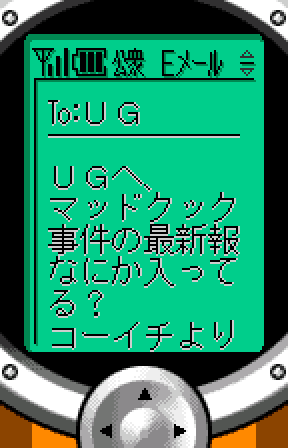
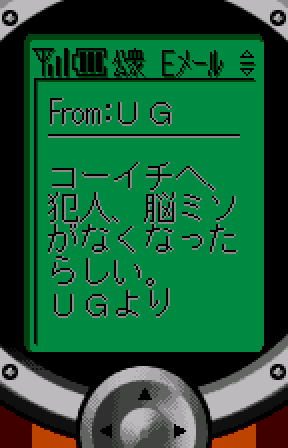
Koichiro’s phone is part of the story. E-mails from his correspondents arrive during play and are shown in a drawing of a mobile phone, with a few characters to a line, and are scrolled through with the Y buttons. There are 223 e-mails in the script. In the options the player can change the phone’s ringtone and choose the model and colour of the phone frame the mails appear in.
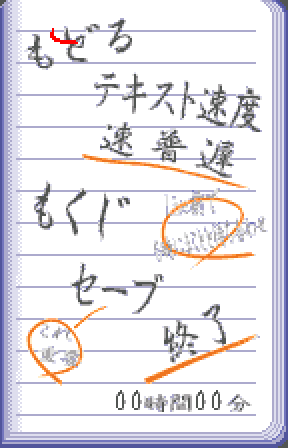
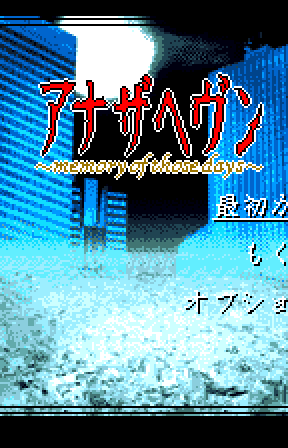
The title menu offers New Game, Continue, Index and Options. Pressing START during the story opens a menu drawn as a notebook, from which the game is saved to its case notes, loaded or quit, and the Index can be opened. The Index is a route chart: it lists the chapters by name, shows how much of the game has been completed as a percentage, and lets the player move straight to a chapter already reached instead of reading the story again from the start. There is no way to scroll back through text already read, so a missed line is gone until the chapter is played again.
Many choices lead quickly to a bad ending, often a violent one, and the main ending is reached only by keeping Koichiro on the case to the end of the investigation. Endings are recorded on the cartridge from one play to the next, and reaching the main ending once adds new options to earlier choices on later plays, which open further lines of the investigation and lead towards the true ending. The conditions for each branch are hard to work out, and seeing all of the more than twenty endings takes many plays. Reaching an ending also opens an epilogue that can be read afterwards, and the options also have a Bonus entry which, once unlocked, plays a short comic scenario of its own.
The game also has a hidden start-up menu, opened by holding all eight direction keys while switching on, which can start the game in black-and-white mode on a WonderSwan Color or erase all save data.
Development and release
The scenario came out of D’s Garage21, a late-night TV Asahi programme that ran on Wednesdays from April 1999 to March 2001 and set out to find new digital creators by inviting viewers to send in computer graphics, game scenarios and other work. The winning script was written by a novelist and screenwriter, and Joji Iida, the author of the original story, supervised it himself. Bandai sold the game under the code SWJ-BANC05, at a price of 3,980 yen before tax, on a 32-megabit cartridge with 16 kilobits of EEPROM for saves, played with the console held upright. The copyright line names Iida and the Another Heaven production company, then Omega Micott together with D’s Garage21. This differs from Omega Micott’s two earlier WonderSwan games, the Uzumaki tie-ins, which Omega Micott sold itself under its own codes; here Omega Micott was the developer, while Bandai handled the release.
Modes and features
There is a single story mode for one player. The game supports the WonderGate, but its only use is to send the player’s clear time to an online ranking of fastest finishes, which showed the five best times in Japan. The ranking is reached from the options, by dialling out through a mobile phone connected to the WonderGate.
Reception
Players have found the story well written and better than expected, but the WonderGate feature unimpressive, and the package has been likened to Ring Infinity, an earlier WonderSwan horror sound novel that also used the WonderGate. The game is considered hard to complete in full, because the conditions for its branches are complicated.
Ports and other versions
Memory of those Days was written for the WonderSwan, and it was never ported, remade or re-released on another system; it is the only game in the Another Heaven franchise. Its relatives are not other games but the novel, the film and the television drama it borrows its world and characters from, and unlike them it tells a case of its own written by an outside winner. Among games, its nearest neighbours are the earlier WonderSwan horror novels whose format it follows.
Notes
Omega Micott is sometimes given as the publisher as well as the developer, but the game was sold by Bandai under a Bandai product code. It works on both the original WonderSwan and the WonderSwan Color, for one player, with no link-cable play.