
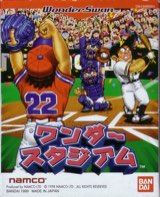
Namco's Famista baseball reworked for the WonderSwan, with licensed Japanese pro teams, a team-building mode and two-player games over the link cable; a launch-window title.
Screenshots
Title screen 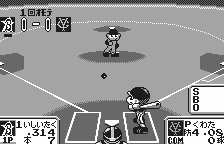
In play 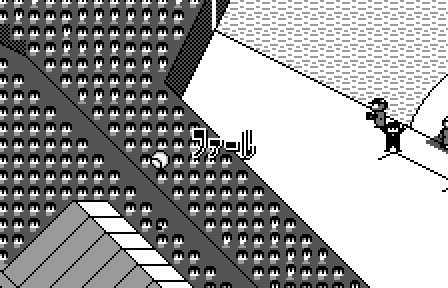
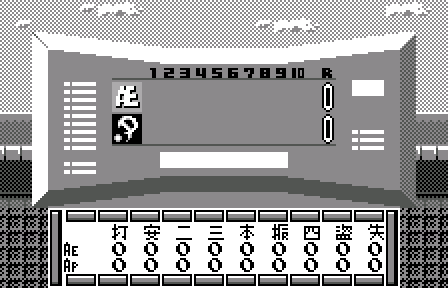
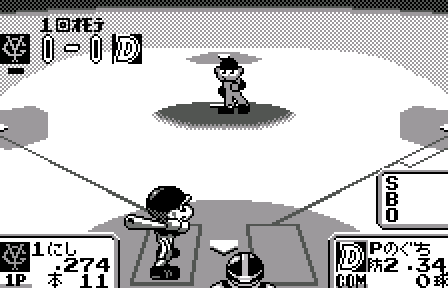
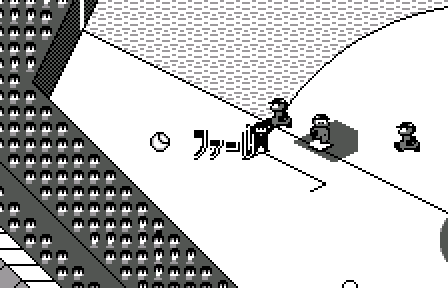
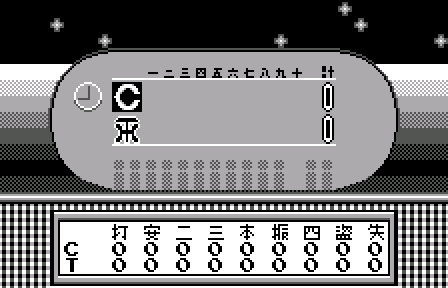
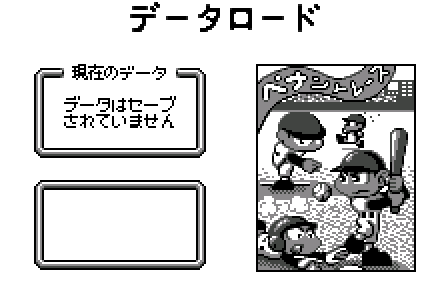
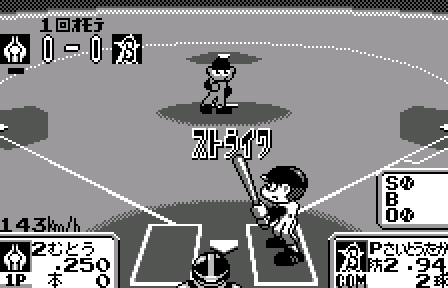
Wonder Stadium is the WonderSwan entry in Namco’s Famista (Family Stadium) baseball series. Namco planned and developed it and Bandai published it on 11 March 1999, one week after the console went on sale. It was the series’ first handheld release in several years. The twelve Japanese professional clubs are officially licensed, with player data from the end of the 1998 season.
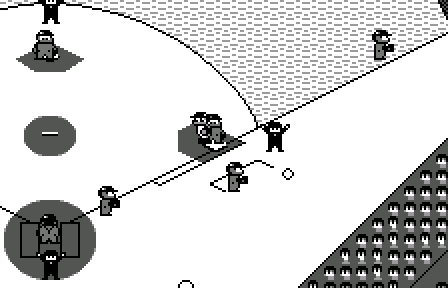
The WonderSwan screen lets the field from first to third base be shown at once, which Bandai presented as a first for the series and as an aid to fielding and base-stealing. The main mode offers exhibition games, a pennant race and an all-star game, and a second mode has the player build and raise an original team. There is also a home-run contest and a scorebook of records, and winning exhibition games unlocks hidden teams and a hidden stadium.
Two players can play against each other with two consoles joined by the link cable. An update with 1999 season rosters, Wonder Stadium ’99, followed in September of the same year.
The story
Wonder Stadium has no story. Its setting is a season of Japanese professional baseball: the six Central League and six Pacific League clubs, under their real names and with their real players as they stood at the end of the 1998 season. In the pennant race each club plays its home games at one of the game’s three ballparks, so the Chunichi Dragons, the Giants, Daiei and Nippon-Ham share the dome, Yokohama, Yakult, Orix and Lotte the seaside park, and Hiroshima, Hanshin, Seibu and Kintetsu the park in space.
The fourteen teams at the start are the twelve clubs, the Namco Stars and the player’s own original team. The Namco Stars are made up of characters from Namco games and Namco’s own publicity. Techno from Techno Drive is a left-handed third baseman who bats third, Gunbaaru from Gunbullet catches and bats fifth, Haron from Final Furlong plays shortstop, the pitcher R4 from R4 Ridge Racer throws side-arm and Wagyan comes on in relief. The bench holds the second baseman Anthology, the outfielder Anri from Smash Court, a switch-hitting outfielder from Italian Tomato and a catcher from Namco’s publicity magazine.
The three ordinary parks each have their own character. Shell Dome is a large stadium with a retractable roof and artificial turf, 146 metres down the lines and 135 to centre. Island Stadium has artificial turf and a view of the sea, at 100 and 120 metres. Tsukimi Stadium floats in space on natural grass and is the smallest, at 92 and 112 metres, so home runs come easily there. After each game a results programme styled as Namco Sports News reports the score, and the original team and its players can be given any names the player likes.
How it plays
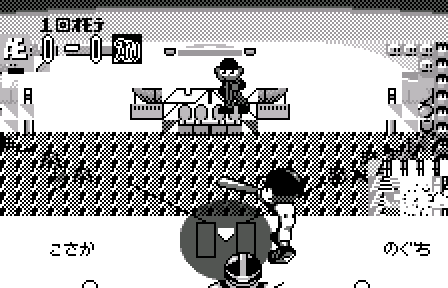
The console is held horizontally. On the field, the A button swings, pitches, throws, makes a diving or jumping catch and sends a runner back, and it confirms in the menus; the B button sends runners on, tags a base, switches the view for a pickoff throw and cancels. The X pad moves players and picks bases, pitches and pitch locations, and in the menus it moves the cursor. Start begins a game and calls time, and A, B and Start together reset the game. Pitching and batting are shown in a large close view with the score, the count, the batter’s average and home runs and the pitcher’s earned run average and pitch count. Fielding, base-running and steals switch to a smaller view of the whole field that shows the runners.
At the plate, the X pad moves the batter about in the box and A swings. Letting go of A at the right moment in mid-swing turns the swing into a bunt, and the bunt can be aimed. Holding up on the X pad while swinging gives an upper-cut swing and holding down a downward chop. The pitcher sets his position on the mound with left and right, starts his motion with A, and chooses the pitch during the motion: up for a fastball, down for a fork or change-up, and left or right at the release to throw inside or outside. Pressing left or right after the ball has left his hand bends it into a curve or a shootball. The B button switches to the small view for a pickoff, then the X pad chooses the base and A throws; with no base chosen the throw goes to first.
In the field the fielder nearest the ball is the one under control, and the others move with him. When the ball is hit the four infielders cover their bases by themselves. Pressing A with the X pad towards the ball makes a fine play, a jump with up and a dive with the other directions, although pitchers cannot make one. A throws to the base chosen with the X pad, first base if none is chosen, and pressing the two together throws harder; B instead sends the fielder running to tag the chosen base, and the target can be changed on the way. Runners set off by themselves on a hit. The X pad picks the next base and B sends the runner, while X with A brings him back, which is no longer possible once he has touched the next base.
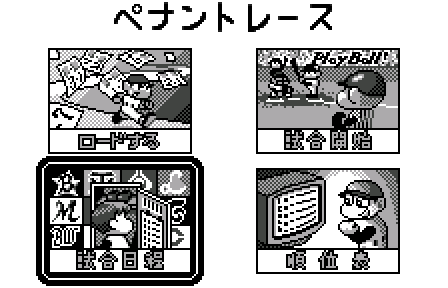
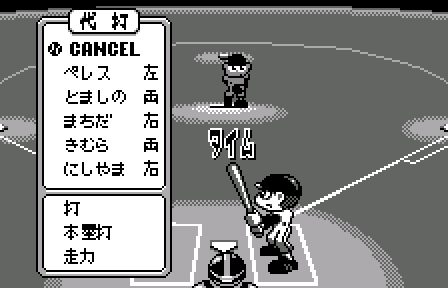
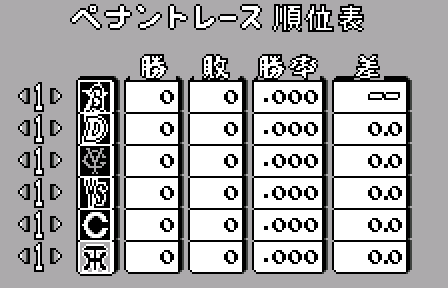
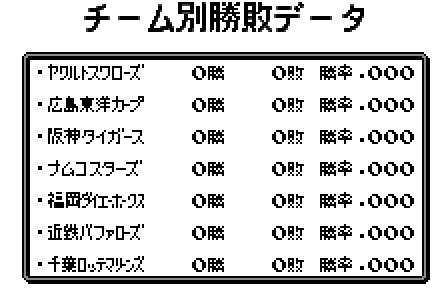
The main mode, Tokoton Yakyu, offers exhibition games, the all-star game and the pennant race. Before an exhibition or all-star game the player picks a team, the length of the game, the stadium, the starting pitcher and the batting order, which is rearranged by swapping pairs of players. A pennant season is 135, 60, 30 or 10 games long, and its menu holds the fixture list and the league table with wins, losses, winning percentage and games behind. Progress can be saved to one of three files after each game, and only the pennant race can be saved. During a game, calling time with Start lets the player send in a pinch hitter or a relief pitcher from the bench.
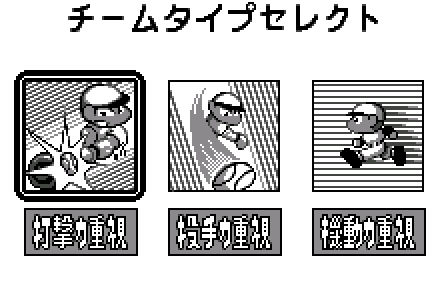
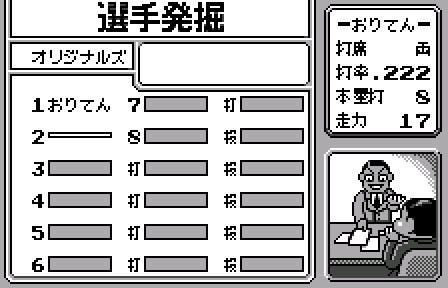
The team-building mode, Tokoton Ikusei, holds a single original team, so starting a new one means deleting the old. The player chooses whether the team leans towards hitting, pitching or speed, and the players are then made automatically; the team’s record, the players’ figures, the batting order and every name can be looked at and changed. The team then plays a pennant season in which results change the players’ abilities, with good games raising figures such as batting average and home runs and poor games lowering them. After all the set games are played the team signs one rookie, chosen from a list, in place of one current player who is released. This mode has one save slot.
In the home-run race the player picks any batter from any team and faces ten pitches from the computer, needing to hit a set number of them out. Each round cleared raises the pitcher’s level, the game ends at the first round failed, and good records are entered under the player’s name. The scorebook shows team records, batting figures and fielding figures, and can be wiped, home-run race records included. Over the link cable, with two consoles, only exhibition and all-star games can be played, and the player who pressed Start is player one. Batting can feel unreliable and many hits end as ground-outs. Keibunsha published a strategy guide for the game in April 1999.
Development and release
Bandai published the game, with planning and development by Namco; most of Namco’s WonderSwan games reached the shops through Bandai in this way. It was the first portable Famista in about three and a half years, after the Game Gear’s Gear Stadium Heisei-ban of 1995, although a Game Boy collection from Namco had included Famista 4 in 1996. The cartridge holds 8 megabits with 64 kilobits of save memory and was announced at 3,600 yen before tax; the copyright line carries Namco’s name with the year 1998, together with the licence of Japan’s professional baseball organisation.
Modes and features
Games can be shortened to one, three, five, seven or nine innings, the batting order can be rearranged before a game but not with bench players, who come on only as substitutes during play, and there is no designated hitter. The all-star game offers four squads: all-Central, all-Pacific, and eastern and western selections drawn from both leagues. In the home run contest the batter has to reach a set number of home runs in each round of ten pitches. Three ordinary stadiums are available, each with its own size: a large domed park with a retractable roof, a park looking out over the sea and a small ballpark floating in space where home runs come easily. Besides the twelve professional clubs, Namco’s own team, the Namco Stars, is on the roster from the start.
Secrets and extras
Four hidden teams appear as exhibition opponents in the team-building mode, and beating one adds it to the teams available in the other modes. They are a boys’ little-league side, a team whose players are named in girls’ slang, a team made up of characters from Namco’s shooting game Phelios, and a team from Namco’s war game King of Kings. A win in an exhibition game also opens a fourth ballpark named after and modelled on Namco Wonder Eggs. In that park a snatch of the ending music of The Tower of Druaga plays at the change of sides, the Namco Stars bat to the Sky Kid theme, and King of Kings bats to music from its own game.
Ports and other versions
Wonder Stadium was made for the WonderSwan rather than converted from an earlier game. Namco took the PlayStation game World Stadium EX of 1996 as its base instead of the black-and-white Game Boy Famista, which is why its players are drawn slimmer and with clearer eyes. The two also differ widely in content: World Stadium EX has its own guest sides, such as a team of famous historical figures and a robot team, and a Xevious-themed ground beside versions of real stadiums, while the WonderSwan game has its own hidden teams and four ballparks of its own. The game was sold only in Japan and was never ported or re-released on another system; the only other edition is the roster update Wonder Stadium ’99 on the same console.