
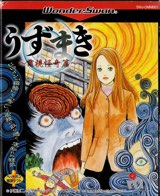
A sound novel based on Junji Ito's horror manga Uzumaki, made as a tie-in with the 2000 film and featuring the film's lead actress, Eriko Hatsune.
Screenshots
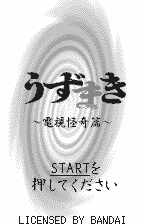
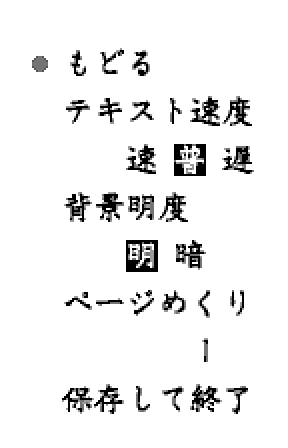
Title screen 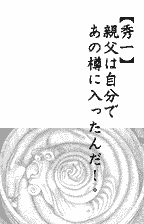
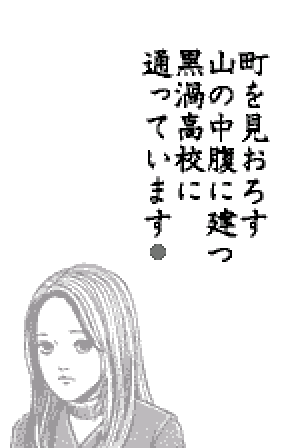
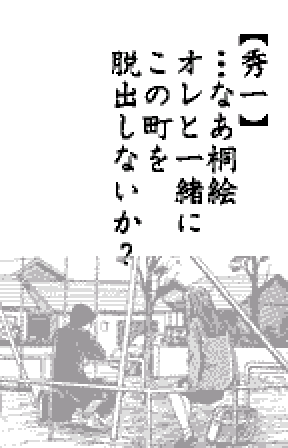
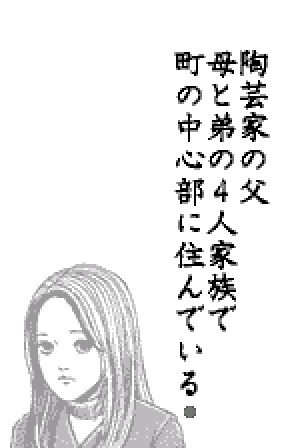
In play 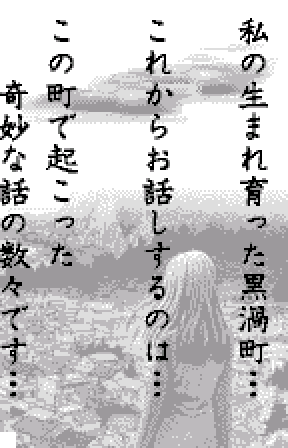
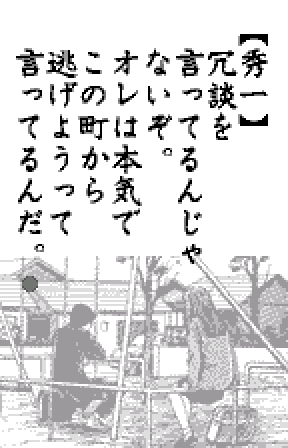
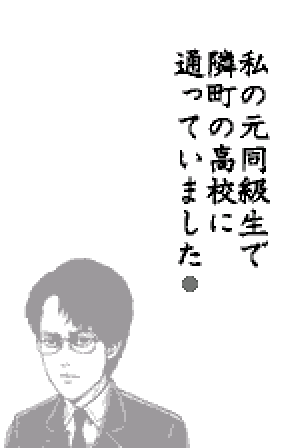
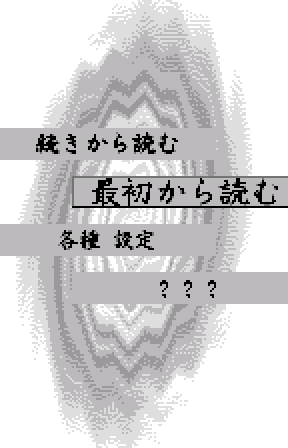
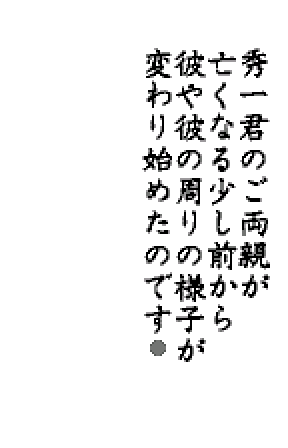
Uzumaki: Denshi Kaiki Hen is a sound novel for the WonderSwan based on Uzumaki, Junji Ito’s horror manga about a town haunted by spirals, which ran in Shogakukan’s Big Comic Spirits from 1998 to 1999. Omega Micott released it on 3 February 2000 as a tie-in with the live-action film of the manga, produced by the Omega group, the company behind the hit films Ring and Rasen. It was the first of the company’s two Uzumaki games for the system; Noroi Simulation followed in March.
The game was made together with the film’s staff, and Eriko Hatsune, who plays the heroine Kirie in the film, makes a special appearance in it. It retells the manga as an illustrated story told mainly through text, aiming to bring the mood of the film to the small screen.
The story
The game is set in Kurouzu, a small town hemmed in by the sea and the mountains, where strange happenings connected with spirals keep breaking out. It opens with a monologue by Kirie Goshima, now grown up, who looks back on what happened in the town while she was a high-school student, and the rest of the story is told as her recollection.
Kirie’s boyfriend Shuichi Saito wants the two of them to leave for a nearby city. She learns that he believes the town is under a curse, and he tells her about his family, where his father has become obsessed with spirals and has started collecting anything with a spiral shape. When Kirie goes back to her ordinary school life, the everyday spirals around her begin to take on a threatening look, and a creeping madness takes hold of the families of both Kirie and Shuichi.
The game follows the manga closely, although the order of some events is changed slightly, and it does not cover the whole manga: the story stops at the episode with the typhoon. The tone is that of the original, a slow-building horror in which a schoolgirl and her boyfriend try to get away from a town that is turning unreal, with many grotesque scenes along the way.
How it plays
The WonderSwan is held upright, and the game is for one player. It is essentially an interactive manga: each screen shows a black-and-white picture drawn in the style of the manga together with text, and the player reads through the scenes one after another.
At points in the story the player makes choices on Kirie’s behalf, and these steer her through the events. How many branches or endings the choices lead to is not certain. Beyond reading and these decisions there is very little to do.
The presentation carries most of the weight. Eerie pictures fill the whole display, and the stereo sound makes heavy use of the console’s PCM playback; the typhoon scenes, for instance, have a sound effect in which the storm seems to call out Kirie’s name.
Progress is saved to the EEPROM in the cartridge. Because the game covers only part of the manga, it ends abruptly at the typhoon episode and leaves the story unfinished; the exact play time is not certain.
Development and release
The game reached shops on 3 February 2000, about a week before the film opened in Japanese cinemas on 11 February, so it served as part of the film’s promotion. When it was first announced, both this title and the follow-up carried provisional names, and the second game was already announced for March. The cartridge sold for 3,500 yen before tax under the model number SWJ-OMM001.
The staff list in the game credits the development to Akagumi-dan, with Omega Micott in charge of planning and production, and the copyright line names Omega Micott together with Junji Ito and Shogakukan’s Big Comic Spirits. Omega Micott was best known as a film company. Among the people thanked for their support is Higuchinsky, the director of the film.
Modes and features
The cartridge holds 16 megabits of data with a small 1-kilobit EEPROM for saving, and the sound is in stereo. Link play is not supported.
Reception
It is treated more as a curiosity for fans of the manga than as a game: players have enjoyed details of the sound, such as a sound effect in the typhoon scenes, but have felt that reading the original comics would serve just as well, and have been left unsatisfied by how suddenly the story breaks off.
Ports and other versions
Denshi Kaiki Hen was made for the WonderSwan as part of the promotion for the 2000 film, and it was never ported, remade or re-released on any other system. The only other Uzumaki video game is its stablemate Noroi Simulation, which came out on the same console a month later and is a separate game with different rules rather than a version of this one. The story itself has been retold on screen instead, in the live-action film the game was tied to and in a four-part anime series broadcast in 2024, but neither of those is a game.