
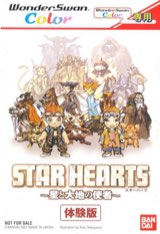
A trial version of Bandai's WonderSwan Color action RPG Star Hearts that was never sold in shops but given away as a prize in a Famitsu prize draw.
Screenshots
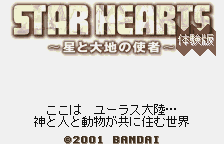
Title screen 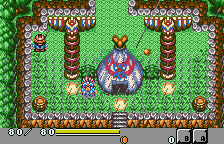
In play
Star Hearts: Hoshi to Daichi no Shisha Taikenban is a trial version of Star Hearts: Hoshi to Daichi no Shisha, the action role-playing game that Bandai released for the WonderSwan Color on 27 September 2001. “Taikenban” is the Japanese word for a trial or demo edition. It was not sold in shops: it is one of the system’s non-retail items, handed out to winners of a prize draw run by the game magazine Famitsu.
The full game it previews is an original action RPG set on a continent sealed off by an ancient curse. The hero, a boy or a girl chosen by the player, fights in real time from a three-quarter view and gains strength by freeing fairies instead of by earning experience.
The story
The trial introduces the world of the full game, the continent of Uras, a land shared by people, animals and gods. Long ago the Emperor Zorg of the Geist Empire ruled it through powerful magic and cruelty and built a floating fortress that drew the power of nature into itself. The hero Gladis defeated him, the fortress fell into the southern sea and Zorg was sealed away, but his last curse closed the continent inside a barrier that no one can cross. Several hundred years later the barrier still stands, and each of the twelve countries of Uras has grown its own culture.
The hero is the boy Danda or the girl Tama, a silent youngster from the forest village of Inde who can understand the speech of animals. The game opens on the day of the trial for becoming the village leader, the Author. The trial takes the hero to a holy temple, but while the hero is talking with Tirawaka, messenger of Lady Chachamimi, monsters attack and set the village on fire, and a villager named Indy Kid sends the hero away down the river hidden in a barrel. The hero wakes in the country of Alchemia beside Radruce, a mysterious old sage.
From there the full game sends the hero across the continent through the twelve zodiac palaces, the main dungeons, in search of the seven devils whose curses spread the deadly sins among the people. How far into this story the trial goes is not certain.
How it plays
The trial is a preview of the full game, which is held sideways and seen from a three-quarter view above the ground, with fights in real time in the manner of the Zelda games. The X buttons move the hero, A attacks, talks and, held down, guards, B uses the selected item or magic, Y1 saves once the hero has the village’s save drum, Y3 opens the menu and Start shows the world map. The opening village teaches the systems through three short events, in which the hero is given the village treasure, a tomahawk, along with the drum.
Beating monsters gives no experience. The hero grows stronger by freeing the fairies imprisoned around the continent, 160 of them in four types, each raising one of four statistics: strength, defence, wisdom or speed. Talking to animals gives the hero their abilities, such as running, diving, flying and climbing, and later in the game a pet joins as a partner.
Weapons, of which the full game has more than sixty, include ranged ones for enemies a sword cannot reach, and charms called talismans can be fitted to them. Magic is cast by equipping rings, in twelve elements with four levels of strength. Dungeons hold traps to jump over, and their bosses have attack patterns of their own.
The trial makes use of scaling and rotation effects. The WonderSwan Color has no hardware for these, so they are drawn by the program itself; whether the retail cartridge uses them in the same way is not certain.
Development and release
Bandai began previewing the full game in a special corner of its WonderSwan website in mid-2001, when it was still billed as a major release due that summer. It reached shops on 27 September 2001 as a Color-only cartridge of 32 megabits with 256 kilobits of SRAM, priced at 4,980 yen before tax and supporting the link cable and the WonderGate. How much of the game the trial contains, when it was given away and whether it differs from the retail cartridge in other ways are unknown.
Ports and other versions
The trial comes from a game made for the WonderSwan Color: the full Star Hearts is a Colour-only cartridge of its own and was never released on any other system. The only other edition of it is therefore the retail cartridge sold in September 2001, on the same console, and neither the full game nor this prize copy was ever ported, remade or released for download. It also has no series on other systems; what marks it out within the WonderSwan Color library is that it was handed to prize winners rather than sold.