
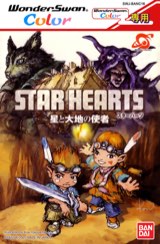
An original action RPG by Bandai for the WonderSwan Color, set on a continent sealed by an ancient curse, in which the hero grows stronger by freeing 160 fairies.
Screenshots

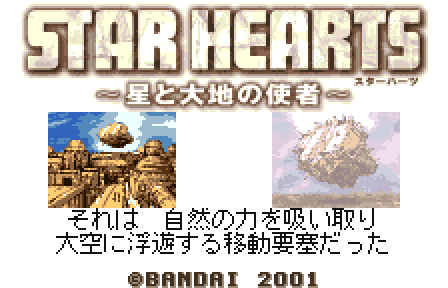
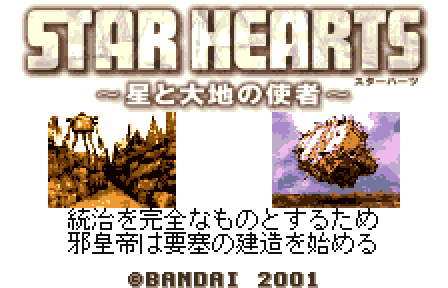
Title screen 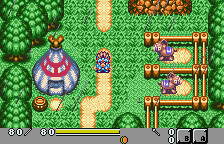
In play 

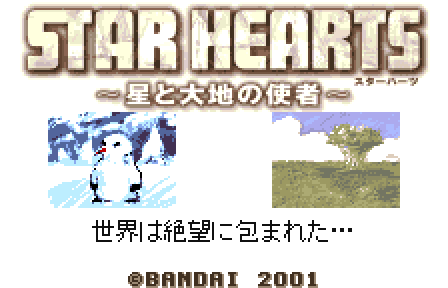
Star Hearts: Hoshi to Daichi no Shisha is an action role-playing game that Bandai released for the WonderSwan Color on 27 September 2001. It is an original game rather than an adaptation, and it was made for the Color only: the cartridge does not run on the black-and-white WonderSwan. A trial version of the game was also given away to winners of a prize draw run by the magazine Famitsu.
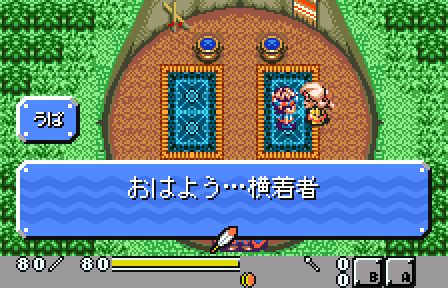
The game is set on Uras, a continent sealed off from the rest of the world by an ancient curse, and follows a young villager who can understand the speech of animals. It plays in real time from a three-quarter view above the ground, in the manner of the Zelda games, and its least usual feature for the genre is that the hero never earns experience points: strength comes instead from freeing 160 fairies hidden around the continent.
The story
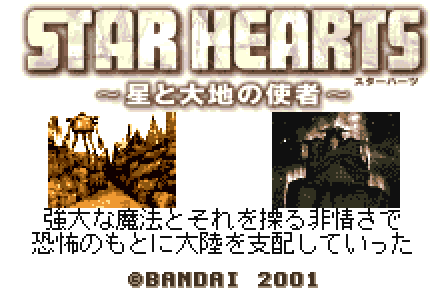
Uras is a land shared by people, animals and gods. Long ago the Emperor Zorg of the Geist Empire ruled it through powerful magic and cruelty, and built a floating fortress that drew the power of nature up into itself. The hero Gladis rose against him and won: the fortress fell into the southern sea and Zorg was sealed away. With his last strength, though, Zorg cursed the continent and closed it inside a barrier that no one can pass. Several hundred years later the barrier still stands, and the twelve countries of Uras, among them Alchemia, Ogreland and Big Blank, have each grown a culture of their own.
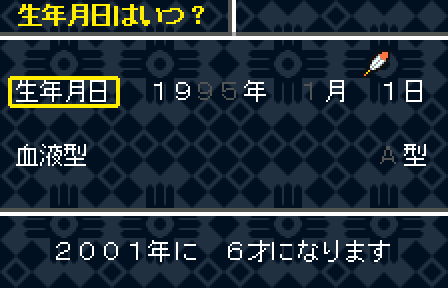
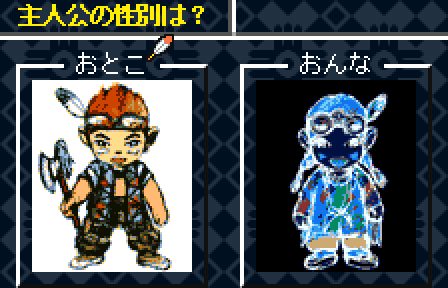
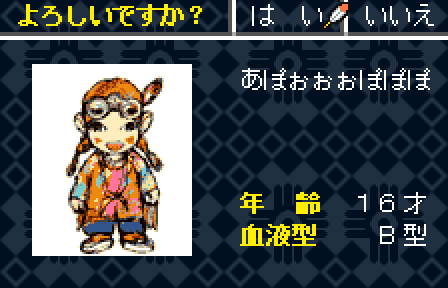
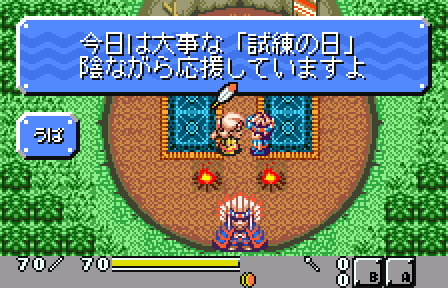
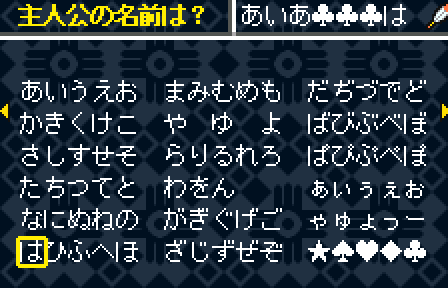
The hero lives in Inde, a forest village whose people live close to nature, and is either the boy Danda or the girl Tama; the player picks one and gives a name, a birthday and a blood type, and the hero’s sex and age change some of the dialogue. The hero does not speak. On the day the game opens the hero is to go through the trial for becoming the village leader, the Author, and the village fortune-teller warns that the day looks ominous. The trial leads to a holy temple in the north-west of the village, but while the hero is speaking with Tirawaka, the messenger of Lady Chachamimi, monsters fall on the village and set it ablaze. A villager named Indy Kid hides the hero in a barrel and holds back the pursuers, and the barrel carries the hero away downstream.
The hero comes to on the riverbank in Alchemia beside Radruce, a mysterious old sage and fortune-teller who points the way north. The first stretch of the journey leads through Kazos, where people framed by the regent Yubes are held, and to a meteorite that crashes to the north and has a dungeon inside it. From there the hero sets out across the continent, borrowing the strength of its people, its animals and the imprisoned fairies to confront the source of the evil.
The adventure is built around the twelve zodiac palaces, one in each country, which are the main dungeons and hold the strongest bosses. Seven devils named after the deadly sins, Satan, Belphegor, Lucifer, Mammon, Leviathan, Asmodeus and Beelzebub, hide in seven regions of Uras, and their curses spread wrath, sloth, pride, greed, envy, lust and gluttony among the people; each one defeated frees the people under its spell and moves the story on. The goals change often along the way, and the tone is that of an old-fashioned fantasy quest, with talking animals, fairies who each have a name and a personality, and creatures and items designed by Kow Yokoyama.
How it plays
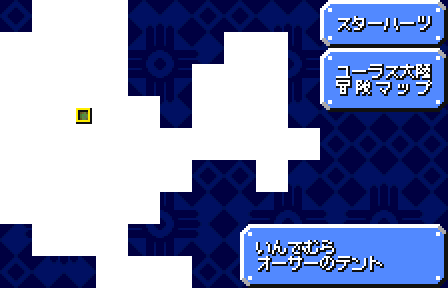
The WonderSwan is held sideways and the hero walks with the X buttons. A swings the equipped weapon, talks and confirms, and holding A raises a guard; B uses the selected item or magic and cancels. Y1 saves, Y2 and Y4 are shortcuts to the equipped animal heart and to magic, Y3 opens the menu and Start shows the world map. With an orb equipped, guarding and pressing B releases a special technique. Holding A, B and Start resets the game. Diagonal movement is possible but awkward on the split buttons, and there is no dash.
Play follows the Zelda pattern: the hero explores towns and open fields, talks to people to move the story along and clears dungeons that end in a boss. The opening village works as a tutorial, with three short events that teach the systems, and the game explains itself well for its time, but nothing shows where to go next, and the story often waits until the hero has spoken to one particular person, so it is easy to lose the way. Dungeons have traps to jump over, pitfalls that drop the hero a floor, and rooms whose stairs open only once every enemy is beaten. Bosses have their own attack patterns: the first, Little Savage at the top of the five-floor meteorite dungeon, can be hit only while its fangs are open, and it is an easy fight. Saving inside a dungeon and loading again puts the hero back at its entrance.
Beating monsters gives no experience. Instead the 160 fairies, divided into the four types Human, Gnome, Spirit and Creature, are imprisoned around the continent, and each one freed raises one of four statistics: strength, defence, wisdom or speed. A statistic only changes how the hero performs when it reaches a new level. Defence reduces damage, speed makes the hero walk faster, wisdom affects magic, and strength at level 3 lets the hero break the white rocks that block some paths. Finding every fairy is hard, and the fairy king rewards a full set of 160 with the Reflect spell.
There are more than sixty weapons, close-range ones and ranged ones for enemies a sword cannot reach; the halberd, fast and with a long reach, is a common recommendation. Weapons and armour wear out: durability falls with each critical hit and with traps, stamina items from treasure chests restore it one point at a time, and there is no blacksmith to repair anything until the desert country of Perzipt, so players save often and reset after a costly fight. Talismans fitted to equipment raise statistics, and the answers the hero gives in some conversations decide whether the fairy Piaz, who brings helpful talismans, or Lydia, who brings cursed ones, appears. Monsters mostly drop potions, magic potions, quivers of arrows, bombs and money, counted in yul, with equipment and talismans as rare drops, and a bestiary records each kind of monster once it has been beaten.
Magic is cast by equipping rings. Spells come in twelve elements, wind, earth, fire, space, light, time, heart, water, ice, thunder, darkness and great spirit, each with four levels of strength, and some event items open stronger magic still. The Dig spell turns up potions, bombs and other items from the ground, and digging up bombs in the desert to sell is a known way to raise money. Talking to animals gives the hero their hearts, equipped like items, which grant abilities such as running, diving, flying and climbing; the monkey and the mole are among the first, and the puma’s heart makes the hero walk faster. Partway through, a mysterious egg hatches into the hero’s pet, one of four kinds decided by how the hero has behaved, a reliable partner who matters to the story. The pet’s statistics and elements can be raised to 99 with items called Monchips, and Westaria has a Monster Tower.
Once the drum from the start of the game is in hand, progress can be saved anywhere with a single button. The game is long: the world map in the manual is large, power dungeons wait in five regions, and travel becomes easier later on through warps and transport. Only four of the zodiac palaces are required. Several side elements were left incomplete, so collecting every monster, piece of equipment or talisman is impossible and some side events lead nowhere. Leaving the name blank gives the hero the default name Danda or Tama, joke names are replaced, and the name Vジャンプ starts the game with 140 life and every statistic at 7. Playing again as the other sex means collecting the fairies all over again.
Development and release
Bandai first presented the game on its WonderSwan website as a title due in the summer of 2001; it reached shops at the end of September instead, at 4,980 yen before tax. The company gave it a special section of its own on that site, with pages on the story, the world, the characters and the systems, and after release it added an official walkthrough of the opening areas. Kow Yokoyama, the illustrator known for his work on Front Mission, served as overall visual director: he designed the characters, monsters, items and promotional art, and his name appears in the game’s copyright line. In November 2001 the Famitsu books division published an official guidebook for the game.
Modes and features
The game is for one or two players, using the link cable between two consoles, and the cartridge also supports the WonderGate mobile phone adapter, which Bandai advertised for a virtual market in which players across Japan could buy and sell items with one another. The cartridge supports Bandai’s Hyper Voice sound playback, used for surroundings such as rain, the seashore and jungle birds, and stereo sound.
Reception
The game drew little attention in the Japanese press. It is remembered fondly for its world and setting, and some players would like to see it remade, though progress can stall when the player has not spoken to exactly the right people, and moving diagonally is awkward with the WonderSwan’s buttons. Trial cartridges were handed out, and unsold copies later turned up in bargain bins.
Ports and other versions
Star Hearts was made for the WonderSwan Color and is not drawn from a game on another system; Bandai launched it on its WonderSwan site as a new title with a world and cast of its own. It was never ported, remade or re-released for download. It is not part of a series on other consoles. Its structure, in which the story moves on only once the hero has found the right people to talk to, has been likened to the Zelda games, while its least usual feature for the genre remains the fairy hunt that takes the place of experience points.