
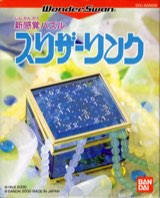
Bandai's WonderSwan version of Nikoli's loop-drawing logic puzzle, with 90 puzzles supplied by Nikoli and the handheld held upright.
Screenshots
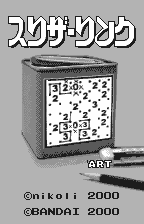
Title screen 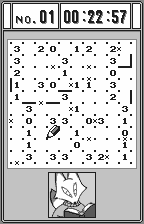
In play 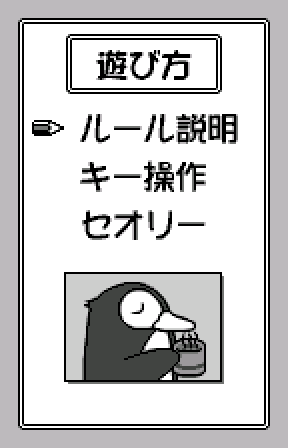
Slither Link is a pencil puzzle game published by Bandai for the WonderSwan on 20 April 2000. The puzzle itself comes from the Japanese puzzle publisher Nikoli, whose editors reworked an older two-player line-drawing game into it; it first appeared in Nikoli’s magazine in the summer of 1989. The WonderSwan version was developed by Tomcat System, a Tokyo studio that also made Bandai’s Detective Conan games for the console.
The cartridge holds 90 puzzles provided by Nikoli across six difficulty levels, plus a free mode that builds new puzzles, and it is played with the WonderSwan turned to its vertical position. The player draws a single closed loop through a grid of dots so that it agrees with the numbers printed in the squares.
The story
Slither Link has no story, no world and no cast to follow. It is a collection of logic puzzles, and its framing is that of Nikoli’s pencil puzzles: puzzles meant to be solved with nothing more than paper and a pencil, quick to learn and slow to master. Bandai presented the cartridge as a way into that kind of puzzle for people who had never heard the term, and as a way to do the tedious part of the paper version, drawing and rubbing out lines, on the console instead.
Nikoli worked with Bandai on the game, and the presentation shows it. The package and the title screen follow the look of Nikoli’s own puzzle books, and characters standing for Nikoli appear in the game. Beyond that the presentation is plain: the graphics and sound are simple, the screen is monochrome, and clearing a puzzle is marked with little fanfare.
The puzzle’s name comes from the English word for moving like a snake, which suits the single winding line the player draws. It grew out of a two-player game called Slither, in which players took turns adding lines and the one who closed a loop or made a branch lost. Nikoli’s editors turned that into a puzzle for one person and printed it in issue 26 of their magazine in the summer of 1989.
How it plays
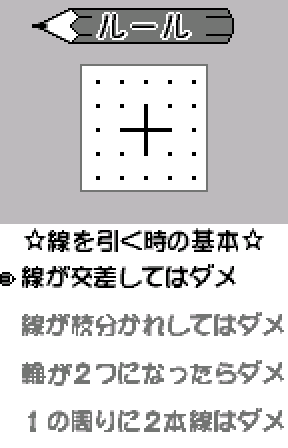
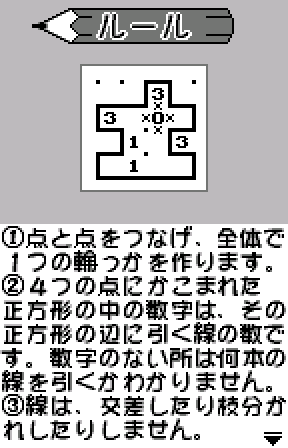
The WonderSwan is held upright, so the tall grid fits the screen. Each puzzle is a grid of dots with numbers in some of the squares. The player joins neighbouring dots with horizontal and vertical lines, never diagonal ones, to make one closed loop. The loop may not branch or cross itself, so every dot ends up with either no line or exactly two, and there may be only one loop on the grid. A number tells how many of the four sides of its square the loop uses, so a 0 rules out all four sides at once, while an empty square says nothing. A puzzle is solved when the loop is closed and every number is satisfied.
Lines are drawn and erased with the buttons, and the controls are ordinary to handle. A button switches to a provisional mode, in which the player can place trial lines to test a guess and then confirm or wipe them all at once. The game does not notice a finished grid on its own: the player presses a button to have the answer checked. On the easiest level the provisional mode cannot be used, because the game marks any wrong line as a mistake and corrects it straight away; this stops on the higher levels, where the provisional mode becomes available. The rules and controls can be read from the in-game menu, so the manual is not needed.
The stage mode holds the 90 fixed puzzles, more than the 60 announced before release. Most are on a 10 by 10 grid, and taller 10 by 14 grids appear from stage 51 onwards; there are no smaller grids for beginners. Cleared stages are saved automatically to the cartridge, but a puzzle cannot be saved part-way through, so one that is put down unfinished has to be started again.
The free mode opens only after the player has solved the stage mode up to a certain level. In it the computer builds a fresh puzzle each time, always on a 10 by 10 grid and with no choice of difficulty. These generated puzzles give many hints and are fairly easy, which makes the mode a way to keep playing after the stage puzzles are done. Because the unlock is kept in the save, losing the saved data means working through the stage mode again to reopen it.
With so few rules, a beginner can stare at the first grids without knowing where to start, and many give up early. The way in is to learn the standard patterns, small arrangements of numbers whose lines can be settled for certain. Once they start to show, as with Minesweeper, one deduction leads to the next until the route of the loop is fixed, and the game becomes hard to put down, though reaching that point takes a while.
Development and release
Slither Link was Tomcat System’s first game from 2000 onwards, released in April 2000 with Bandai as publisher, and the game is credited to Bandai, Tomcat System and Nikoli together. The studio followed it three months later with the second Detective Conan adventure. Bandai set the planned price at 3,000 yen before tax. The game comes on a 4-megabit cartridge with a small EEPROM for saved progress, has stereo sound and has no link-cable play. Bandai’s copyright line for the game names only Nikoli and Bandai.
Bandai’s description of the game introduced pencil puzzles to readers who might not know the term, stressed how few rules this one has, and likened its habit-forming quality to Minesweeper and the console’s own Gunpey.
Reception
Players have found the puzzle slow to get into, since its few rules leave a beginner unsure where to start, but compulsive once the standard patterns begin to show, much as happens with Minesweeper. The monochrome, high-resolution screen is thought well suited to puzzles of this kind, and the plain graphics and sound are not much held against it. The main complaint is the lack of a mid-puzzle save, a poor fit for a handheld played in short sessions; the manual answer check, the automatic error correction on the first level and the lack of a difficulty setting in the free mode have also been criticised.
Ports and other versions
This cartridge was made for the WonderSwan and was never ported or re-released on another system. Slither Link the puzzle has had several other computer versions, each a separate product from a different company: one for the PC-9800 series around 1993 built from puzzles Nikoli had already printed, a Windows release by Success in 2001, a Nintendo DS game from Hudson in 2006 and a Nintendo Switch game from Hamster in 2022, the last two in those publishers’ Nikoli puzzle lines. They share the rules and Nikoli’s involvement rather than this game, which stands apart as Bandai’s upright handheld edition with its own 90 puzzles and a free mode that builds new grids.