
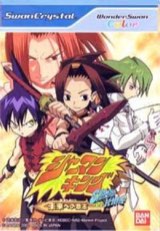
A WonderSwan Color role-playing game based on the Shaman King manga, in which Yoh Asakura enters the Shaman Fight, fights in teams of three and recruits allies on a growth map.
Screenshots
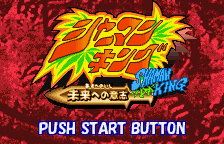
Title screen 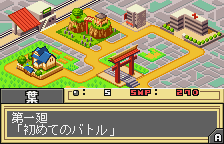
In play 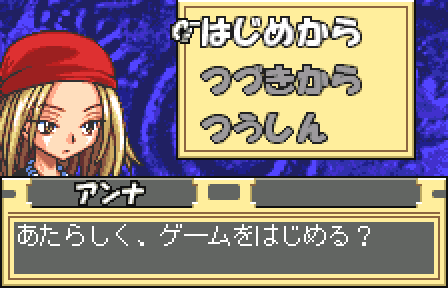
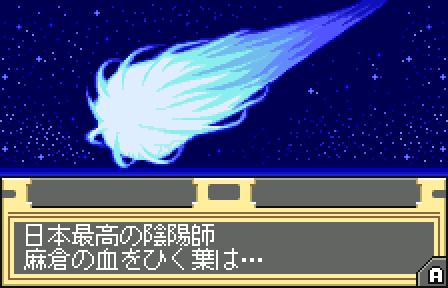
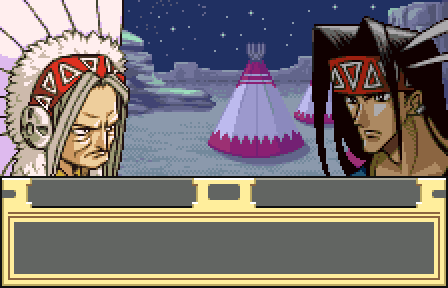
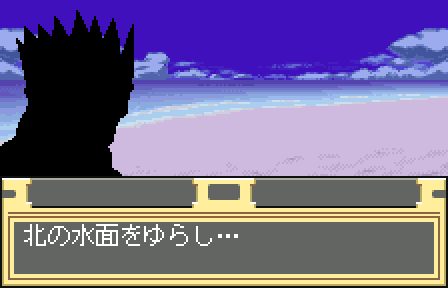
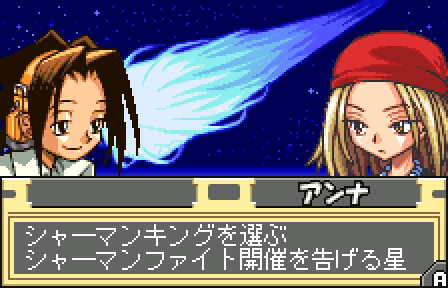
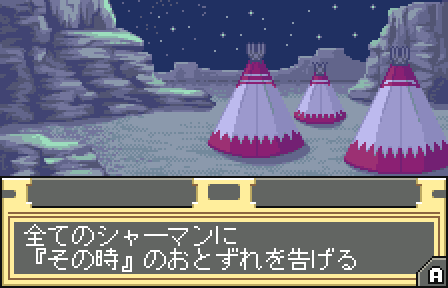
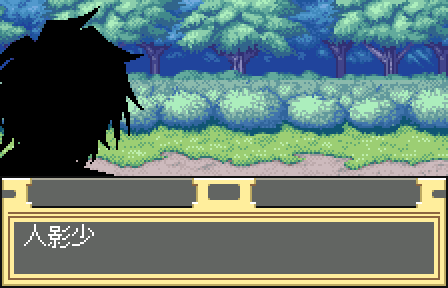
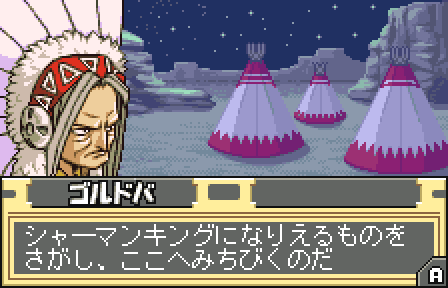
Shaman King: Asu e no Ishi is a role-playing game based on Hiroyuki Takei’s manga Shaman King, which was being serialised in Weekly Shonen Jump when Bandai released the game on 29 August 2002. It was developed by Graphic Research. The player takes the part of the hero, Yoh Asakura, who enters the Shaman Fight with the aim of becoming the Shaman King.
The game moves forward through a cycle of exploring, talking and fighting. Battles are fought between teams of up to three on each side, and the type of attack decides how quickly it comes into effect. Instead of earning experience, the characters grow on a separate board-like map paid for with Spiritual Pieces, and the people met there can join the team and change how later scenarios play out, so characters who are enemies in the manga can end up fighting on the same side.
The cartridge is made for the WonderSwan Color and SwanCrystal and does not run on the original black-and-white WonderSwan. Up to two people can play, and the game supports the link cable. Early copies came with a strap shaped like the bear claw Yoh wears around his neck.
The story
The game is set in a world where shamans can speak freely with the spirits around them: the wandering souls of the dead, the spirits of forests and the earth, and even gods and buddhas. Most people cannot see any of this, and a shaman is someone who stands between this world and the next.
It opens at night in a graveyard, where the schoolboy Manta Oyamada runs into Yoh Asakura, a new transfer student at Shinra School who turns out to be a shaman. Yoh is thirteen and very relaxed, and his reason for wanting to become Shaman King is that it would let him live an easy life. His guardian spirit is Amidamaru, a samurai who died six hundred years ago and who was the strongest warrior of the Warring States period; their fateful meeting is what starts Yoh on his way. Manta, Yoh’s first friend in Tokyo, can see spirits and has a habit of landing in danger.
Yoh is soon joined by other faces from the manga. Anna Kyoyama is his fiancée, an itako of Osorezan who can call the souls of the dead into this world; she is strict and seems to keep Yoh firmly under her control, but she trusts him deeply. Ren Tao, eldest son of a family that has worked in the shadows of Chinese history since ancient times, is Yoh’s destined rival, and his spirit is the Chinese general Bason. Other shamans such as Ryu with his wooden sword and HoroHoro also appear, and the shaman Silva turns up both as an opponent and as someone who gives Yoh hints.
The inciting event is the appearance of two great comets in the night sky. They tell shamans all over the world that the Shaman Fight has begun, the contest that decides who becomes the Shaman King, the one able to turn great destruction into great rebirth. Rivals from many places gather to take part.
The story is told in chapters, each called a kai, and runs to at least twenty-six of them. It does not follow one fixed line: who Yoh has befriended, and the result of certain key battles, change which allies join him and how the following chapters unfold, and some side scenarios only open if the player meets particular conditions.
How it plays
The console is held horizontally, and the controls are the same on the WonderSwan Color and the SwanCrystal. On the field the X buttons move Yoh, A confirms and START opens the menu. On the growth map A shows a character’s status, B cancels or switches to an overview of the map, and START brings up the menu for leaving it. In battle the X buttons choose a command or a target, A confirms, B goes back, and START switches the display between the characters’ faces and a chart of the elements. The title screen offers a new game, continue and the link mode, and there are two save slots.
Each chapter follows the same loop. Yoh walks around a town map seen from an angled overhead view, talks to people and triggers events, then fights the battles those events lead to, and spends the Spiritual Pieces he earns on the growth map, which he can enter at any time from the field. A target marker on the map shows where to go to move the story on. A help marker explains battles and growth, but leaning on it too much cuts the Spiritual Pieces and other bonuses awarded when the chapter’s events are cleared.
From the menu the player forms a party of up to three, always including Yoh, who cannot be left out; a newly recruited ally does not fight until added to the party here. Each character has a Shaman Power value, which makes attacks stronger, three stats called heart, skill and body, a home element, a spirit power value that is also the strength of the Over Soul, and a rank that climbs from eighth to first. The rank sets how many furyoku orbs the character has in battle. Every character can hold one piece of equipment, and the menu also lists each special move with its cost. Heart raises emission attacks and defence and helps dodge, skill raises accuracy and critical hits and lowers damage taken, and body makes the character act sooner.
The growth map works like a board game. Every Spiritual Piece moves a character one square, with no undo, and the whole party shares one map, so a square taken by one character is left empty for the rest, though empty squares can be crossed again for free. Squares raise Shaman Power or a stat, give items, or give Materials, which are traded in fives on the element squares of wood, fire, earth, metal and water to raise an element level by one. Some squares stay sealed until a story event opens them, and other squares hold characters, whose positions change from chapter to chapter and who can join the team or change the story when spoken to. The manual’s advice is to look over the map with B before moving and to grow the whole party evenly, since later fights need more than Yoh.
Battles run on a time bar. Ally markers in blue and enemy markers in red slide along it, and a command is carried out when its marker reaches the end, so faster characters act more often. There are four commands: a plain attack on one enemy; a change of element to any element the character has at level one or higher; spirit techniques, which cost spirit power and include group attacks, special moves and support moves, split into striking moves and emission moves that grow with Shaman Power and heart; and soul techniques, which cost furyoku orbs. Among the soul techniques is Charge, which piles orbs onto the Over Soul to raise its attack and allow moves that would otherwise cost too much spirit power. Each side’s orbs are its life: a side loses when all of its orbs are destroyed.
The five elements are the heart of the fighting. They follow the generating and overcoming cycles of the five phases. An attack along the generating cycle does no damage at all, but a critical hit made that way shatters the target’s Over Soul at once, while the overcoming cycle raises or lowers damage. Every element also has its own bonus that grows with its level: wood restores spirit power on a plain attack, fire raises body, earth makes spirit techniques cheaper, metal strengthens striking moves and water strengthens emission moves. Stacking every orb on one Over Soul with Charge is risky, because a single critical hit along the generating cycle can wipe them all out. As the story goes on there are also team battles in which the player controls characters other than Yoh, and support moves and forcing enemies to change element become important.
Items come from item squares on the growth map, often behind seals: headphones, a yukata and toilet sandals that raise heart, skill and body, one item for each element that raises its level, five scrolls that lower one element level for every enemy, and a pentagram that raises a character’s rank. Some hidden scenarios open only under conditions, such as keeping Yoh’s Shaman Power low at certain chapters, and the result of one mid-game battle changes which allies join. In the link mode two players, each with a console and a cartridge, pick characters from their saved games to form one team and take on stages chosen by the host. Clearing them earns Spiritual Pieces and rare items that cannot be found in the main game. The difficulty is generally felt to be somewhat high.
Development and release
Graphic Research handled the planning, specification, programming, sound and graphics, so the whole game was made in-house before Bandai published it. The studio had already made several licensed games for Bandai on the WonderSwan, among them SD Gundam Gashapon Senki Episode One, the two Senkaiden role-playing games based on the Houshin Engi anime, and the One Piece Treasure Wars games.
The copyright line names TV Tokyo, Xebec and NAS alongside the manga’s author and publisher, which ties the game to the television anime. That series ran on TV Tokyo from July 2001 to September 2002, so the cartridge appeared in its final weeks. Bandai sold the game at 4,500 yen before tax, on a 32-megabit cartridge with 256 kilobits of S-RAM for saved games and stereo sound. A strategy guide, Shaman King Asu e no Ishi Saikyou Team Kessei Guide, was published in the V Jump Books line.
Modes and features
The field is shown from an angled overhead view and the hero cannot walk diagonally, and characters grow by spending Spiritual Pieces rather than by earning experience points. The link cable is used for a cooperative mode in which two players combine characters from their saved games into one team.
Reception
Players have been mostly favourable: they liked the freedom to build a team and the way the scenario branches depending on who joins, and felt the game could be enjoyed without knowing the manga or anime. The complaints are that the maps do not allow diagonal movement and that the board-game style of the growth map will not suit everyone.
Ports and other versions
Asu e no Ishi was made for the WonderSwan Color and was never ported, remade or re-released. It was one of several Shaman King games released in Japan in 2001 and 2002, alongside King Records’ Chou Senjiryakketsu role-playing games for the Game Boy Color and Game Boy Advance and Bandai’s Spirit of Shamans for the PlayStation, all of them separate games. What sets the WonderSwan cartridge apart among them is its growth map, on which allies are recruited and the story branches.
Notes
The word mirai in the subtitle is given the reading asu, which is why the title is romanised Asu e no Ishi. The last word is sometimes written with a different kanji, as 未来への意思, but Bandai’s own spelling is 未来への意志.