
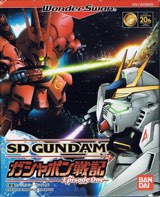
A war game in the SD Gundam Gachapon Senshi line: one of four armies builds units, moves on a hex map and settles each clash in a one-on-one action battle.
Screenshots
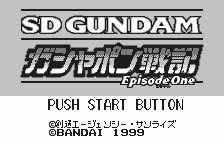
Title screen 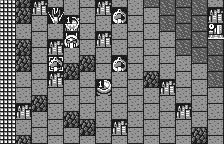
In play 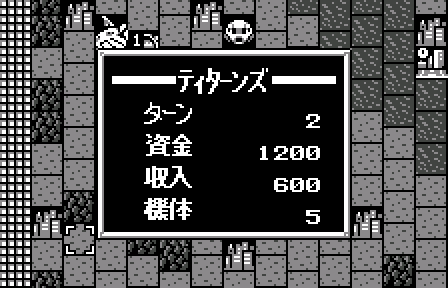
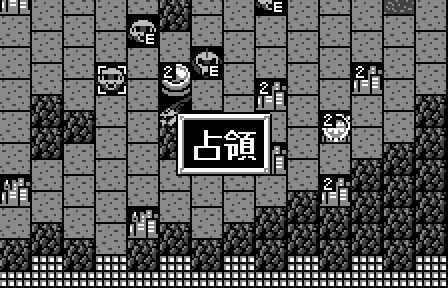
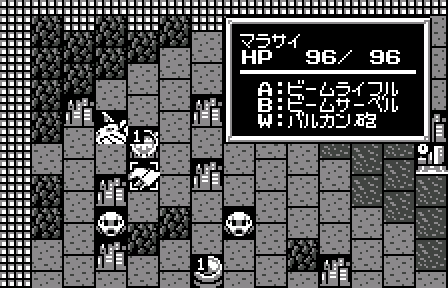
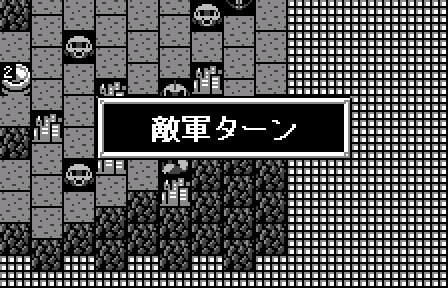
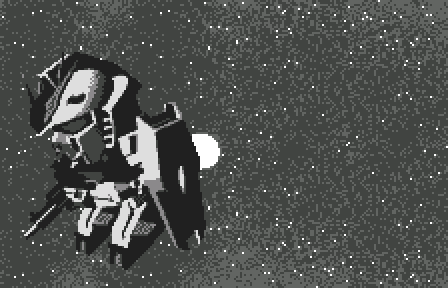
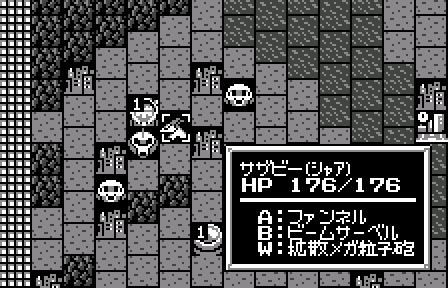
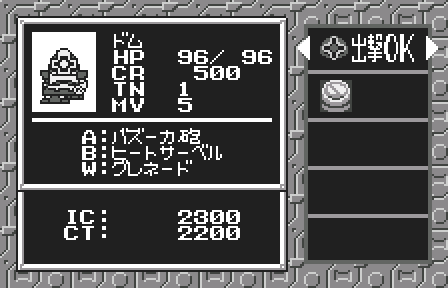
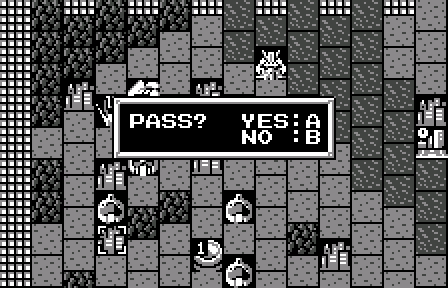
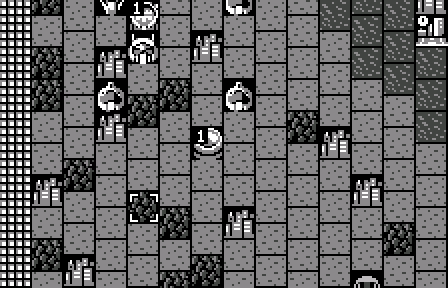
SD Gundam Gashapon Senki: Episode One is a war simulation game that Bandai released for the WonderSwan on 29 December 1999, developed by Graphic Research. It belongs to the line of SD Gundam World Gachapon Senshi games, in which super-deformed versions of the Gundam robots fight it out on a map, and Bandai presented it as a return of that original SD Gundam style with simple rules and familiar characters.
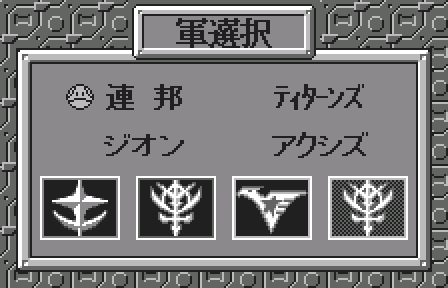
The player chooses one of four forces, the Earth Federation, Zeon, the Titans or Axis, builds mobile suits and warships at its bases and sends them out across a hex map to capture the enemy’s capital. Moves are made in turns, but each clash between two mobile suits is fought out as a short one-on-one action battle. The cast is drawn from the Gundam series running from the first television show to the film Char’s Counterattack.
The cartridge has battery-backed memory for saves and is played with the console held horizontally. It is for one or two players and supports the link cable, which joins two WonderSwans.
The story
Episode One has no story in the usual sense. The manual calls the campaign the story mode, but its ten stages are separate battles with no scenes, dialogue or plot between them. What the game offers instead is a meeting of the four armies of the Universal Century on maps that range from the ground and the sea to the atmosphere and outer space, with mobile suits from the first Gundam series, Zeta Gundam, Gundam ZZ and Char’s Counterattack. The opponent in each stage depends on the side the player chose, and the player never fights their own army.
The manual introduces each side in a few lines. The Federation is the Earth force that built the first Gundam to fight back against Zeon’s war of independence, and it fields the line of Gundams up to the Zeta and the ZZ, with Amuro Ray in the Nu Gundam as its ace. Zeon is the army of Side 3, the colony farthest from Earth, which built the first mobile suits and started the One Year War; its large mobile armours such as the Alpha Azieru are its own, and its ace is Char Aznable in the Sazabi. The Titans are a special Federation unit formed after the war to hunt down what was left of Zeon, which then turned to serving its own ends; it has the feared Psyco Gundam, and Paptimus Scirocco leads it in The O. Axis is the Zeon remnant that fled to the asteroid belt, with psycommu weapons, the anti-ship Hamma Hamma and the giant Quin Mantha, and Haman Karn’s Qubeley at its head.
These four aces are the only named characters. Each is its army’s strongest unit, every other machine is an unnamed rank-and-file unit, and before an ace fights, its pilot speaks a short line, often no more than a rival’s name called out. The tone is the plain one of a war game: a won battle or stage brings up a results screen and the next map.
How it plays
The console is held horizontally. On the map the X buttons move the cursor, faster while B is held, A confirms and B cancels or shows the details of the unit under the cursor. Holding Y3 hides the units to show the terrain beneath them, Y2 and Y4 jump to units that have not yet moved, and Start shows each army’s turn count, funds, income and number of units. Pressing A and B together opens a save window, and A, B and Start together reset the game. The title menu has four entries: New Game, Continue, VS Game and VS Continue.
Play goes in turns, the player’s army and the enemy’s taking theirs in turn, and every unit can be given one order per turn. The map is made of hexes, and each kind of ground costs a different amount of movement depending on whether a unit is a general type, a flyer, an amphibious unit, a space unit, a ground unit or a warship. Mountains are closed to everything but warships, and atmosphere hexes let any unit cross only one hex a turn, which slows every attack that has to pass through it. Moving a mobile suit or mobile armour onto a neutral city, a factory or a base takes it, and each holding pays funds at the start of every turn: 500 for the main base, 300 for a city or space colony, 200 for a base and 100 for a factory. The stage is won by taking the enemy’s main base and lost if the player’s own falls. A turn can be ended at any time, whether or not every unit has moved.
Units are built at the main base and at captured factories, one at a time at each. The production screen shows each machine’s hitpoints, its price, the number of turns it takes to build, its movement and its weapons, and orders can be sent to every factory from one screen. Each army has twelve mobile suits and one warship to choose from, and some can be built only on the ground or only in space; on maps that join the two, units built in space cannot go down to the ground and ground units cannot go up, except Titans’ Asshimar, which is built on the ground but can fly into space. The ace’s machine is limited to one on the map and can be rebuilt only after it is destroyed, at three turns and 5,000 to 6,000 in funds. Warships carry mobile suits across the map and can then launch them. Damaged units recover part of their hitpoints at the start of each turn while they wait on the main base or a factory, base, city or colony, from 10 to 20 per cent depending on the place, provided they did not fight or fire that turn; warships recover 20 per cent.
Moving a unit onto an enemy starts a battle. When two mobile suits or mobile armours meet, each side chooses MANU to fight by hand or AUTO to leave the fight to the computer, and the battle becomes a one-on-one action scene against a time limit. The X buttons move the machine, A fires its long-range weapon, B uses its close-range weapon and A and B together its special weapon, and every weapon but beam sabres and the like has limited ammunition that is refilled after the battle. Machines that can transform turn into their faster flying form with A and B. The unit that loses all its hitpoints is removed from the map; if the attacker wins on a city or factory it takes it, and if the time runs out the attacker is put back on another hex. Battles between warships, or between a warship and a mobile suit, play out automatically in a side view. Units with artillery can fire once at an enemy in range before moving, wearing it down before a fight, though the shot can miss depending on terrain and unit type. Armour works as a cut in damage, from 16 per cent on a GM to 70 per cent on the Alpha Azieru.
The ground a battle is fought on matters. On land the fight is seen from above, and in cities the buildings block movement and shots. In space, among asteroids and around colonies, machines drift on after the buttons are let go; at sea they float upward unless they are amphibious; and in the atmosphere gravity pulls them down until they take damage from friction at the bottom, except the Zeta Gundam in its flying form. Items float across the field during a fight: P stops a machine moving for a while, a white S speeds it up and a black S slows it down, a white T adds time and a black T takes it away, H restores energy and M adds funds. Haro drifts through as an obstacle.
The campaign is ten stages played in order with one army, chosen at the start and fixed for the whole run. After each stage a results screen appears and the game offers to save. Funds carry over to the next stage up to a limit set for each stage, and the number of turns the stage took changes how many units the next one starts with. A lost stage can be tried again from Continue, and the retry starts with more funds and more units than before. The VS Game mode uses any stage already cleared in the campaign, so at first only the first map is open, with the armies, their scale and their funds set freely, against the computer or against a second player over the link cable; the console that starts the session makes the choices, and only it can save. VS Continue resumes a saved match.
There is a single pattern of computer play and it is not demanding. In action battles the computer tends to stand and fire, holds back and is easy to hit, but it is dangerous at close range, so attacking from range is the safest way to beat it; on the map it decides its moves almost at once. The enemy capital has no guard units, and a map takes about ten to thirty minutes. Fighting by hand gets better results than AUTO for a skilled player, and building up a force patiently, for instance with steady production of Jegans, wins more than rushing. Axis’s cheap flying suits such as the Gaza C, Ga-Zowm and Zusa take ground quickly, the Bound Doc stands out among the Titans, the Gundam Mk-II is strong for a one-turn unit, and the ZZ Gundam’s high mega cannon has only two shots but hits hardest. Zeon’s best machines can mostly be built only in space, which is a handicap on ground maps.
Development and release
Graphic Research developed the game. The cartridge is SWJ-BAN020 at 3,200 yen before tax, and the package holds the cartridge with a 48-page manual, a case and a reader survey card. The title spells ガシャポン rather than the ガチャポン of the Famicom games for trademark reasons. A complete guide in The WonderSwan Books series, from the publisher now named SB Creative, appeared in February 2000 with maps of all ten stages, strategy for each faction and data on every unit.
Modes and features
There are ten stages and forty-eight mobile suits plus four warships, twelve suits and one ship for each faction, and each side can build only its own units. Among the machines that can be built is the Gundiver, which until then had appeared only in design materials and which looks rather like a GM wearing a Gundam face.
Secrets and extras
Holding A, B and two of the Y buttons while switching the console on brings up a hidden download item. Ten stages were distributed this way through the WonderGate service, but only three could be obtained, and the stage data was never on the cartridge itself. After the tenth stage the game shows a picture of the Earth and a warship rather than a staff roll, and the picture can be viewed again from the continue option.
Reception
The game is generally given modest marks. The short clash animation before each battle and the self-contained design are liked, but the monochrome screen, the weak computer opponent, the lack of challenge, the plain victory scenes and the missing scenario disappoint. Players also enjoyed the detailed sprites made possible by the screen’s resolution and hoped for a sequel, which never came despite the Episode One subtitle.
Ports and other versions
Episode One was made for the WonderSwan and was never ported or re-released. It is a new entry in a series that began on the Famicom Disk System in 1987 with Scramble Wars, not a conversion of any one earlier game, although it is tied closely to the older entries in different ways. It is seen as a revival of Scramble Wars, and as in effect a new series game built on a return to the simple early rules. It is closest to the Famicom game Gachapon Senshi 2: Capsule Senki, sharing its basic system and its cut-off at Char’s Counterattack, and the project may have begun as a plain port.
It differs from Capsule Senki in its monochrome screen, on which shading tells the sides apart, its production lists that differ by faction, its single pattern of computer play, and battle music nearer to Scramble Wars. Unlike the first Famicom game, where every side fielded the same machines, Episode One divides the units between the factions.
Notes
Besides the save offered after each stage, pressing A and B together on the map brings up a save window in the middle of a stage.