
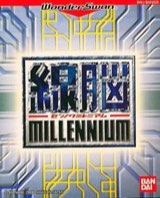
Bandai's second line-connecting falling-block puzzle after GunPey, which adds the idea of surrounding stranded blocks to clear them; played with the console held upright.
Screenshots
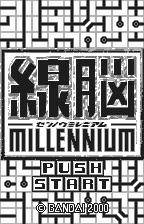
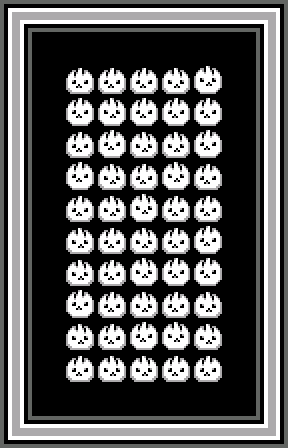
Title screen 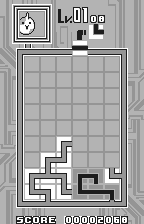
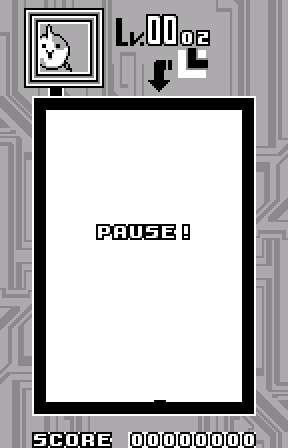
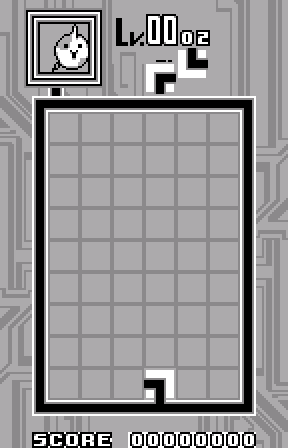
In play 
Sennou Millennium is a puzzle game that Bandai released for the WonderSwan on 16 March 2000. Bandai presented it as the second in its series of falling-block games about connecting lines, following GunPey, the puzzle game that had been one of the WonderSwan’s best-known titles since the console’s launch. It was developed by the game studio Kouyousha.
As in GunPey, the player links pieces of line to clear blocks from the field, but Sennou adds a second way to clear them: surrounding blocks that have been cut off. The game is played with the WonderSwan held vertically.
The story
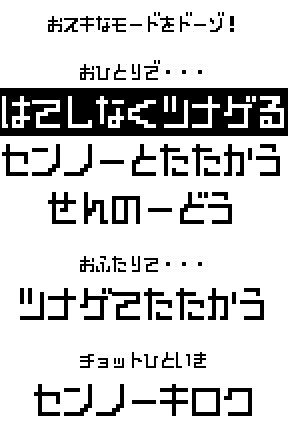
Sennou Millennium has almost no story. The only narrative sits in the mode called Sennou to Tatakau, roughly “fight Sennou”, where a series of opponents appears one after another inside a story and each has to be beaten in a puzzle match before the next one comes. Who those opponents are and what the plot is about are not known.
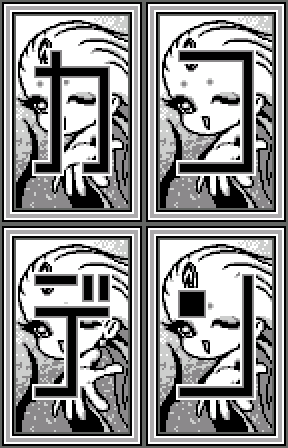
The rest of the game is framed by its theme rather than by characters. Bandai sold it as the second entry in a family of line-connecting falling-block games that began with GunPey, and the mode names lean on that idea of connecting: the endless mode is called Hateshinaku Tsunageru, which means connecting without end. The title screen has a look that recalls Chiku Taku Ban Ban, although what follows is a falling-block game.
The other two modes have no framing at all. The endless mode is simply play that goes on level after level, and Sennou-dou, the “way of Sennou”, is a set of puzzles to be solved one by one.
How it plays
The console is held upright, and panels marked with pieces of line drop from the top of the field. While a panel falls it can be turned and moved. The design is a cross between a pipe-laying game and falling blocks. There are several kinds of piece, including straight pieces and crosses, but most of what falls is a corner piece, so the connections that form most often are U-shaped.
A run of line that reaches from one side of the frame to the other disappears and scores, and so does a closed loop made of panels alone or a link that joins up with the outer frame to close a ring. Blocks that are stranded inside a ring of others can be cleared by surrounding them. When one clearance sets off another, a chain bonus is added, though chains tend to happen by accident rather than by planning. The manual points to clearing many panels in one go as the way to high scores.
A badly placed panel is hard to put right. It stays where it landed, and after a while a countdown appears on it and it vanishes by itself. Each time the player reaches a new level the outline of the field changes, for example into a T shape or a field cut to about half its height. The new shape is picked at random, and it can throw away a stack that was built with care.
The endless mode can go on more or less forever unless the fall speed becomes extreme. In the story mode and in two-player matches over the link cable, play turns into a contest of attacks, and this is the weakest part of the game: it is hard to see when you are attacking, and the effect of the special attack is hard to make out on the screen.
Sennou-dou is the puzzle mode. In each problem the blocks on the field have to be cleared using only the pieces provided. It is the best-made part of the cartridge. Clearing lines in the action modes gives little sense of satisfaction, and the action side of the game feels short of polish.
Development and release
Kouyousha handled the whole of the game’s development for Bandai. The studio also made an arcade puzzle game called Sennou, described below.
Bandai listed the game at a planned price of 3,600 yen before tax, on an 8-megabit cartridge with stereo sound, under its own copyright alone. It presented the game as the follow-up to GunPey in a family of line-connecting falling-block games, without naming the developer.
Modes and features
There are three modes: the endless Hateshinaku Tsunageru, the story mode Sennou to Tatakau against a series of opponents, and the puzzle mode Sennou-dou. Up to two people can play, and the game supports the link cable. The cartridge carries a small EEPROM for saved data, and the sound is in stereo.
Reception
The game has had a middling reception. It is so close to GunPey in look and concept that comparison is hard to avoid, and as an action puzzle it is thought unfinished: there is no way to repair a badly placed panel except to wait for it to expire, the changing field shape throws away carefully built stacks, and in the versus mode it is hard to tell who is attacking whom. The Sennou-dou puzzle mode, on the other hand, is considered very well made, good enough to carry the whole cartridge.
Ports and other versions
Sennou Millennium has a namesake in the arcades. Sennou is a coin-operated game published by Kaneko for one or two players with simultaneous head-to-head play, a cross between a pipe-laying game and falling blocks. It is variously dated to April 1999 or to 1998. Kouyousha developed it for an arcade board before the WonderSwan game. Whether the cartridge is a conversion of the arcade game or a new design that reuses its name is unknown, and Bandai did not mention an arcade original.
The name also reached personal computers. In early 2001 Kouyousha gave away a Windows version of Sennou, numbered 1.22, to visitors to its website who answered a questionnaire. How it compares with the WonderSwan cartridge or the arcade game is not known. Sennou Millennium itself was never released on another system.
Later history
Kouyousha kept using the Sennou name after the WonderSwan release. By 2002 it had developed Sennou Doujou, a puzzle game for NTT DoCoMo’s i-appli phones of the 503 series.
Notes
The title is sometimes spelled Sennou MILLENIUM with a single N, while Bandai and Kouyousha use the usual spelling. At the time, Kouyousha’s main work was planning and developing software for game consoles and computers, and it had earlier experience with arcade action, sports and puzzle games.