
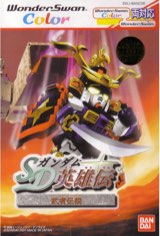
The warrior half of a pair of Bandai RPGs from the SD Gundam Eiyuuden multimedia project, released on the same day as its companion Kishi Densetsu.
Screenshots
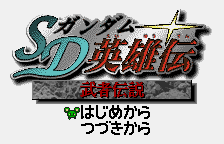
Title screen 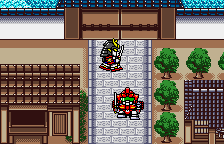
In play 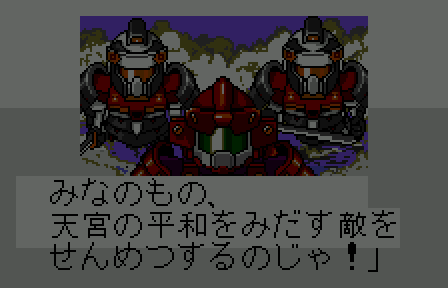
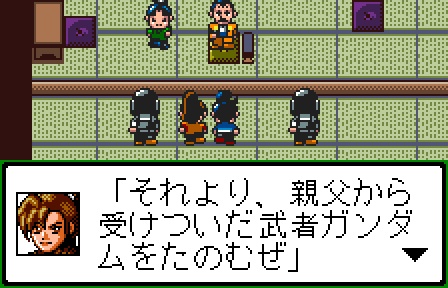
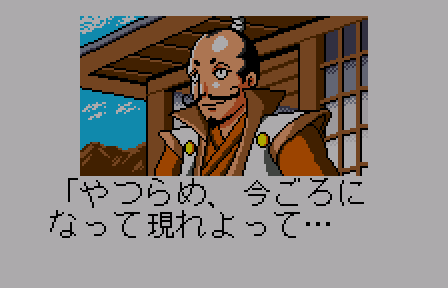
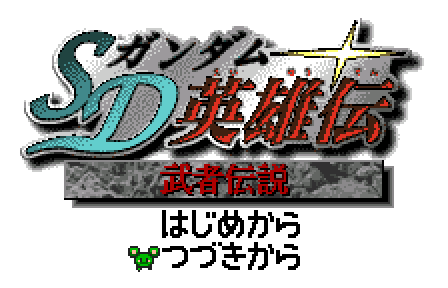
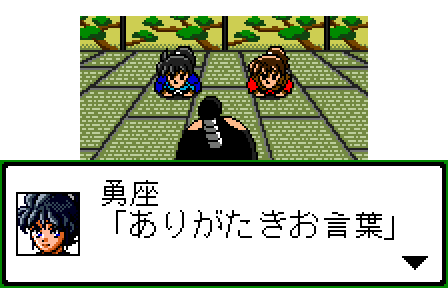
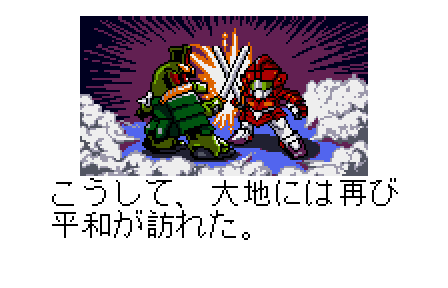
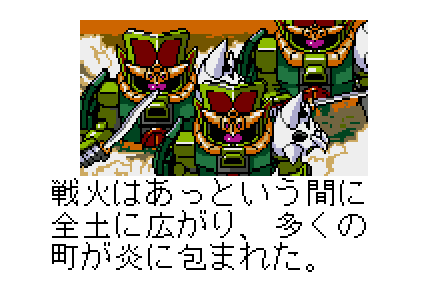
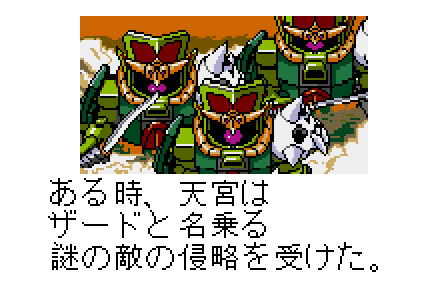
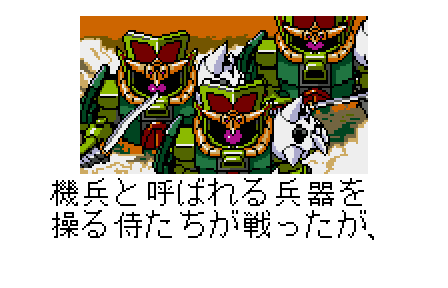
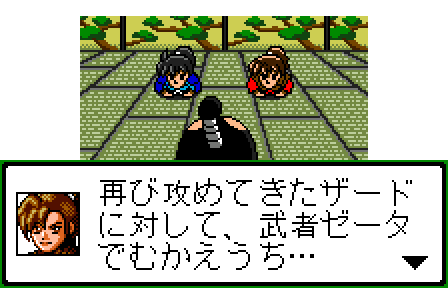
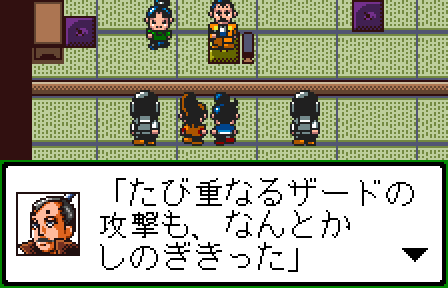
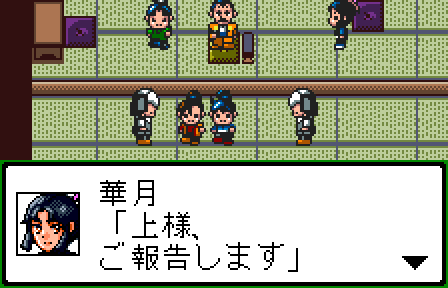
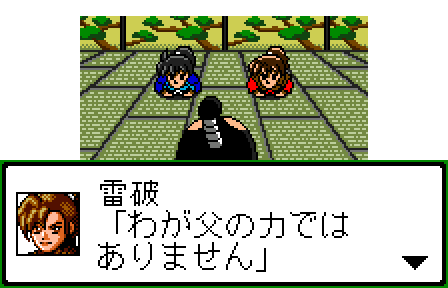
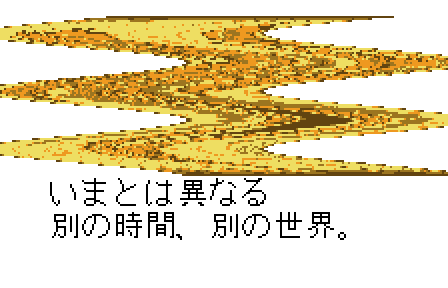
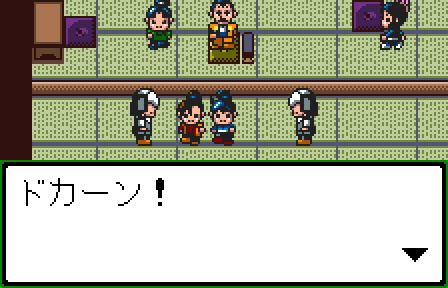
SD Gundam Eiyuuden: Musha Densetsu is a role-playing game developed by BEC and published by Bandai on 15 March 2001. It comes from SD Gundam Eiyuuden, a 2001 project counted as the tenth entry in the Knight Gundam line and told as a new story instead of a continuation. Alongside the games it ran as a Comic BomBom manga drawn by Kouichi Tokita and through cards, capsule toys, model kits and a PlayStation game. Bandai divided the WonderSwan release into two cartridges that went on sale together: this one, built around musha, the samurai-style warriors, and Kishi Densetsu, built around knights.
The story starts in the warrior land of Tenmiya and later moves into the empire of Zard, while Kishi Densetsu begins in another land. Each version has its own world and its own storyline, and they are designed as a pair.
The cartridge supports both the link cable and the WonderWave infrared adapter. It is in colour on the WonderSwan Color and also plays on the original black-and-white WonderSwan.
The story
In this world the giant robots called kihei are machines that people climb into and pilot, and they are treated as everyday weapons; there are no mobile suits as such. Ten years before the game, Tenmiya, the land of the musha, fought alongside the knight kingdom of Lacroa against the Zard empire in the south. Two hero machines, Tenmiya’s Musha Gundam and Lacroa’s Knight Gundam, led them to victory, and Zard was believed to be gone.
The game begins in Tenmiya, which is guarded by Tenpou Shogun and his warriors Yuza and Raiha. The Zard army suddenly comes back to life and attacks, and the young warriors only just manage to hold it off. Yuza has inherited the Musha Gundam and has grown strong enough to overpower Zanshu, the leader of the four generals of Zard’s eastern invasion army. The player controls Yuza from the start.
Musha Densetsu is a side story to the knight tale of the multimedia project. It covers events in the musha country that the manga does not show, and it follows hidden threads such as the rivalry between Yuza and Raiha. Other warriors such as Gazan fight at Yuza’s side, and the musha machines of the game include Musha Gundam, Musha Wing Gundam, Musha Shining Gundam and Musha Zeta Gundam. The characters’ backgrounds are drawn more clearly than in the PlayStation game, and the tone is a plain heroic adventure aimed at children.
The first half is set in Tenmiya and the places around it, such as the castle town, the ninja village and the town of Sagain. The second half moves into Zard, which both cartridges share. Kishi Densetsu meanwhile follows Mine of Lacroa against Zard’s western army, and as the end draws near the two stories meet, so that the heroes of both lands can fight together.
How it plays
The WonderSwan is held horizontally, and the game is a traditional menu-driven RPG. The player walks a small world map, talks to people in towns for information, passes through short dungeons and fights random battles by picking commands. The map begins as a single small island and gains a second one later, vehicles cannot cross mountains, and most dungeons are only one or two floors with few treasure chests.
Every attack is a technique, and techniques come from the weapon a machine holds, up to three per weapon. Yuza starts with the Amekirimaru blade and Raiha with a short sword, each teaching its own set. Techniques and the magic learned from helmets spend the machine’s EN; without EN, techniques draw on HP and fail if there is not enough. Machines and techniques carry one of four elements, earth, fire, wind and water, with light reserved for the hero machines, and hitting a weakness is the heart of the game: the right element usually ends an ordinary fight in one blow and a boss fight in about two turns. Some techniques add effects such as confusion, paralysis, freezing or a stop, and a special finishing move such as Yuza’s Gekiretsu Kyuushuu-zan appears when the party is in danger.
Each machine equips a weapon, a shield, legs and a helmet. Gear is marked musha-only, knight-only or common, and each piece has a rarity of one to four stars, so Musha Densetsu has its own blades, shields and helmets that the knight version lacks. Weapons level up with use, but the level is not shown, many stats are hidden, and wearing gear before reaching a certain level brings a hidden risk of the machine going berserk. Armour pieces are stat items that raise all of one machine’s stats by 10 and can be used once per character.
Levels come quickly and go up to 100, and each level-up restores HP and EN in full. HP and EN grow by random amounts while the other stats are fixed, and reserve members earn about half the experience. Enemies drop equipment at random, often early on, but never money, so selling items is the way to earn it. Shops carry repair kits, EN tanks and cures for each status effect, and in Tenmiya and the nearby towns the stock is replaced in stages as the story advances, rising to repair kits that restore 50 or 100 HP and, in Zard, one that restores HP in full.
The menus are clumsy. The equipment screen shows a single item at a time, cannot sort and does not say who can equip what. Equipment storage holds 40 pieces, nothing can be thrown away, and a full bag stops enemies from dropping equipment. The album records about 200 kinds of kihei, items and parts with short descriptions, and a few entries only appear on a second playthrough.
Some gear comes from outside the cartridge: ten items only from the PlayStation game and 44 from passwords on the tie-in trading cards, including a 170 percent weapon and a set of armour for each hero machine. Passwords are entered at a shop in a port town and on a small island in the north-east of Zard, and can be used again.
There is one save slot, and after the ending the game starts over with items carried over. The game takes a little over six hours. It is not hard on the whole, but a few battles can wipe out the party, such as the Gerbera at Sagain and the Sazabi at the arena. Techniques with full accuracy, such as Tsukikuzushi, Iai-giri, Mega Crush and Accel-giri, and spells such as Thunder, Ice, Flame and Quake are the usual tools, and the official guidebook gets many technique names wrong.
Development and release
Bandai’s preview pages called the pair a renewal of SD Gundam for the new century. The two games start out in separate worlds, and their stories are drawn together as they near the end, so a player who has both can see the same events from either side. The WonderSwan games came first, and their story was handed to Kouichi Tokita in stages as development progressed, with his manga built on it. The same developer, BEC, made the PlayStation game SD Gundam Eiyuuden: Daikessen!! Kishi vs Musha, released by Bandai on 1 March 2001, two weeks ahead of the cartridges. Musha Densetsu was sold as model SWJ-BANC0B for 3,980 yen before tax, on a 32-megabit cartridge with save memory. Each copy came with a trading card, in this version one showing the Musha Gundam.
Modes and features
The game shows a strong Pokémon influence, with an album of collected units and trading between versions. Some areas use the other version’s music. As Gather Beat had done with the PlayStation’s G Generation F, the WonderWave connects both WonderSwan games and the PlayStation game, so that parts and items can move among all three, with some special parts available only through this link. Joining the other version’s game over the link cable adds five of its party members with their levels and equipment, shares the album and allows six combination techniques that cannot be used otherwise. The link opens once the story reaches Zard, the merged party makes the game much easier, and joining leaves the other cartridge’s save untouched. Items can also be sent to the PlayStation game through a PocketStation, though only a few kinds can be sent. Passwords on cards from the tie-in card game unlock items.
Secrets and extras
Some helmet techniques are missing from the official guidebook, some items seem impossible to equip, and four orbs from the PlayStation game open dungeons that turn out to be empty. Some items in this version are displayed incorrectly, and card passwords can be reused without limit.
Reception
Fans have been mostly critical of the game. It is thought roughly put together, with tiny dungeons, a single small world map, repetitive battle effects and a clumsy equipment menu, and this version can be finished in a little over six hours. Players also found the linking and item menus a chore and the rewards for linking small.
Ports and other versions
Musha Densetsu was made for the WonderSwan and was never ported, remade or re-released on another system. It stands beside its knight-themed twin Kishi Densetsu, which tells the other side of the story in its own world, and beside the PlayStation game Daikessen!! Kishi vs Musha. Although that game comes from the same project and developer and can exchange items with the cartridges, it is an action game, so it is a different title rather than a version of this RPG.