
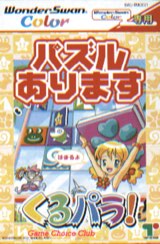
A puzzle game from Tom Create for the WonderSwan Color in which panels on a five-by-five field are lined up to flip them over, then lined up again to clear them.
Screenshots
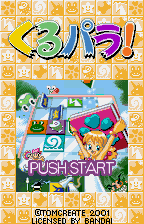
Title screen 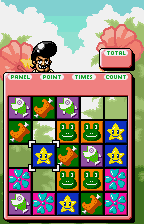
In play 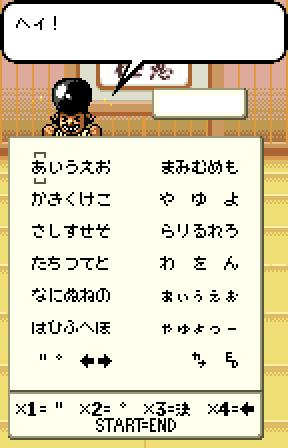
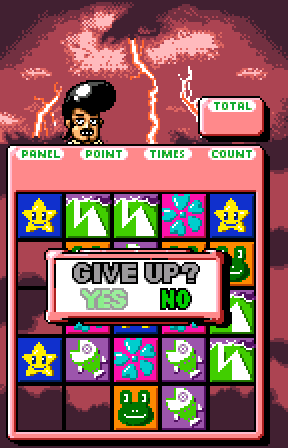
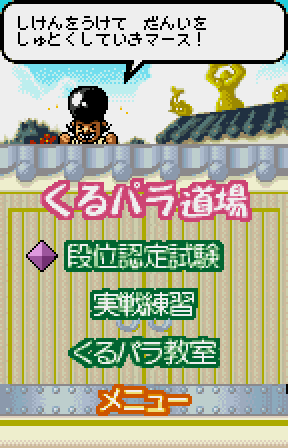
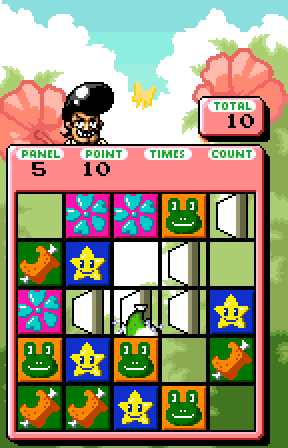
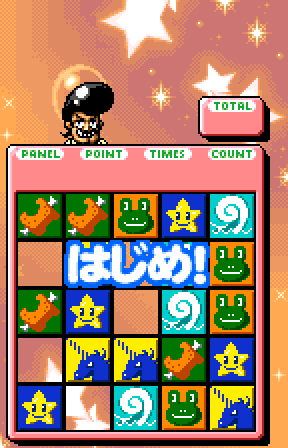
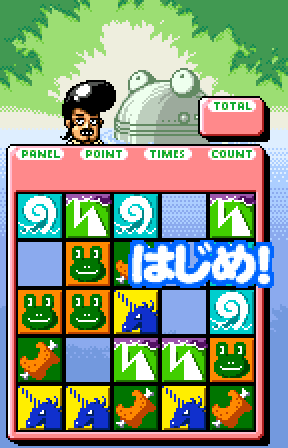
Kurupara! is a puzzle game released by Tom Create for the WonderSwan Color on 14 June 2001. Its publisher described it as a new kind of rotating chain puzzle, built around panels that flip over to set off large chains. It came out about six months after the WonderSwan Color went on sale.
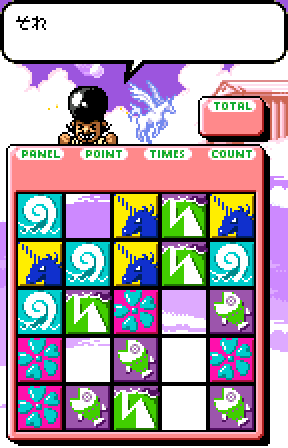
The field is a grid of five by five panels with a picture on each side. Lining up three or more matching pictures flips the panels over, lining up their reverse sides removes them for good, and a stage is cleared when every panel is gone. There are four modes: a grading exam, a book of 80 set puzzles, a match mode and a story mode. Two players can also play against each other with two consoles joined by the link cable. The cartridge works only on the Color.
The story
Kurupara! has only a light story, and most of the game has none at all. Its cast lives on Kurupara Island, a small island where the weather is always fine. There are nine characters with similar-sounding names: the heroine Kurupara, Keropore, Koropuri, Kiri-Piri, Kuropero, Karuparu, Kirapuru, Kerepere and Koruporo. Among them are a witch girl and a wild man.
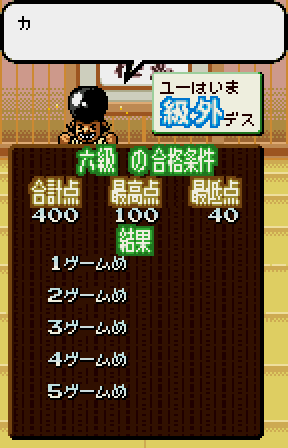
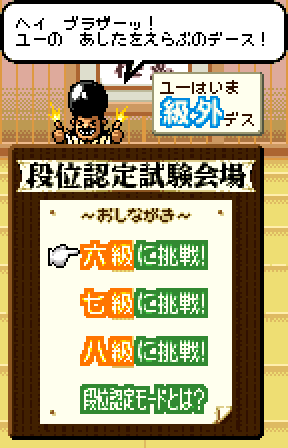
The game itself is framed as a training hall for the puzzle, the Kurupara Dojo. Flipping panels is treated as a discipline with ranks like those of a martial art, and the main mode is an examination in which the player climbs from the lowest grade towards the full master’s licence. The dojo also has a classroom where the rules and techniques are taught.
The story mode is where the cast comes in. Kurupara plays her way through eight rivals one after another, each with a pattern of attack of their own. Eight of the characters, Kurupara included, also have a symbol panel, a picture with a motif that suits the character, such as Kurupara’s flower and Keropore’s frog. Who waits at the end of the run is kept as a surprise. Tom Create’s website added a good deal around the cast: a 24-episode four-panel comic, a serialised comic story in 14 parts and extra strips about everyday life on the island, from a big wave and a thunderstorm to a fishing trip. They are light gag strips.
How it plays
The console is held upright. There are only three actions: grab a panel, move it, and flip it over. Lines of three or more count across, down and diagonally. When three matching pictures line up, any touching panels with the same picture are taken along with them, and when the flipped sides then form lines of their own, the panels vanish in a chain, up to ten steps long.
A few rules make the board predictable. The two sides of a panel always carry different pictures, and only two sets of panels have exactly the same combination of front and back. In any one game there are at most eight panels of each picture, so eight is the most that can be cleared at once. Flipping a panel to look at its back is the usual way to lose one by accident, since it can complete a line and vanish, so the common advice is to check backs only where no line of three can form, for instance by gathering four identical panels in a square or by flipping a panel just short of a line and moving it on. A chain is built by placing two matching panels and a third panel whose back shows the same picture, then repeating the pattern in a spiral and starting it from the last piece placed.
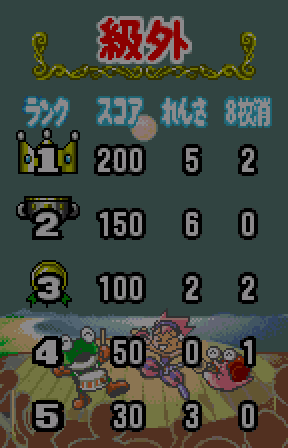
The grading exam has 17 grades, from 8th kyu up to 1st kyu, then shodan, 2nd to 8th dan and finally the full master’s licence. Each grade has a pass mark in points, and the player can try for any grade up to three above the current one, though skipping grades makes the conditions harder. Dropping below the minimum score even once means failing on the spot. Passing a grade gives a password, which could be entered in a ranking on Tom Create’s website. The exam mode also has a practice game for high scores, where clearing the whole board shows a special picture and where the player can try to clear it in fewer moves.
The puzzle book has 80 problems, each with a set goal such as clearing every panel with a five-step chain, in four moves or in three goes. The first problems are very easy, and working through them teaches unexpected ways of clearing and chaining. The game remembers which problems are solved, so play can pick up where it stopped. The suggested way in is the classroom first, which covers everything from the basics to advanced techniques, then the puzzle book; the title screen also runs a demonstration if left alone.
In the match mode, against the computer or a second player over the link cable, clearing four or more panels at once or making a chain sends obstacle panels to the opponent, while clearing only three does not. Frozen panels are frozen versions of the eight basic designs and cannot be moved, though they can be flipped; skull panels can be moved freely. Clearing a basic panel next to an obstacle, directly above, below or beside it, clears the obstacle too: a skull disappears, and a frozen panel thaws back into a basic one. Clearing all eight of one’s symbol panels sends four frozen panels to the rival. Each match uses only five of the eight designs, the two players’ symbols and three others.
Attacks are not sent straight away but held in a stock of two turns. If the same player fills both, the opponent receives the total; if each player fills one, the attacks cancel and only the difference is sent, so the usual strategy is to stock two attacks quickly and press the advantage. The X2 button adds panels to the field, up to 20 in a match. A player loses when the opponent’s panels push the field past what it can hold, but a full field of 25 panels is not yet a loss: finding a panel that can still be flipped into a line may turn the game around, and a hopeless match can be given up. Some characters fill their field with panels early to prepare their attack, and steady attacks work well against them. Being able to make a three-step chain at will is a sign of a good player. The story mode uses the same rules, with the next rival waiting each time the opponent’s field overflows.
Development and release
Tom Create was a Tokyo development studio that mostly made games for other companies, above all the SD Gundam G Generation series for Bandai. Kurupara! was the first game it put out under its own name; in the same year it developed the WonderSwan Color game Ultraman: Hikari no Kuni no Shisha for Bandai, which came out a week later. At the time its handheld work, the WonderSwan games included, was done by a second development room of about fifteen people.
Tom Create ran an official site for the game with rules, mode guides, a page of playing tips, a question-and-answer page, character profiles and a serialised comic story. Its special corner also offered a playable browser version of the puzzle. The password ranking for the grading exam closed on 14 December 2001. Two players reached the full master’s licence with the same score of 4,970 points, and the company sent them a folding bicycle and a portable MiniDisc player as prizes.
Ports and other versions
Kurupara! was made for the WonderSwan Color and was never ported or re-released on any other system. The only other form of the game was a free trial on the official website, written for the Shockwave browser plug-in, in which the player grabbed panels with the space bar, moved the cursor with the arrow keys and flipped panels with the B key; the trial ended once no more panels could be cleared, and it offered none of the cartridge’s modes or the link-cable match. The game started no series, and Tom Create’s later titles under its own name, for WiiWare and DSiWare, were different games.
Notes
There are eight basic panel designs, among them a flower, a frog, a fish, a unicorn and a piece of meat, plus a frozen version of each and the skull, for seventeen kinds in all. Only five designs appear in any one match: the symbols of the two players and three others.