
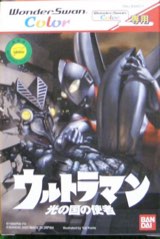
A WonderSwan Color remake of Bandai's 1991 Ultraman fighting game, with story, training and versus modes and monsters from the 1966 television series.
Screenshots
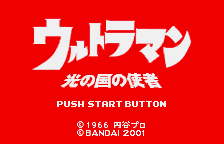
Title screen 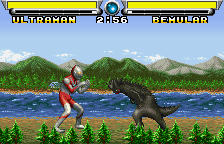
In play 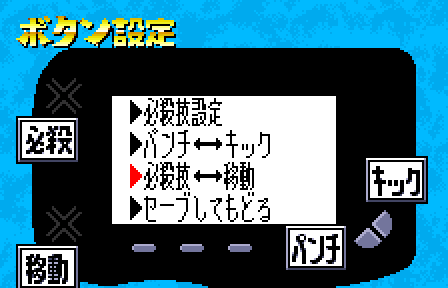
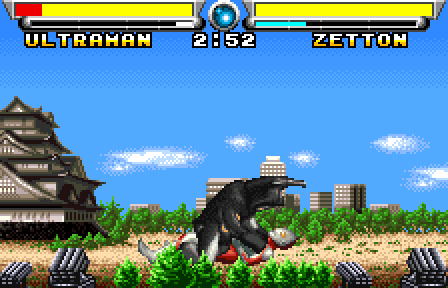
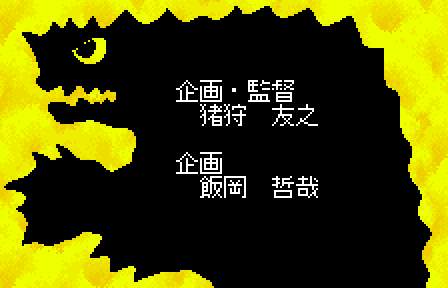
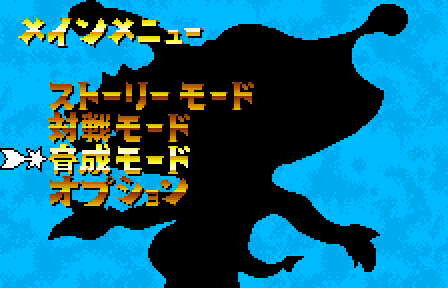
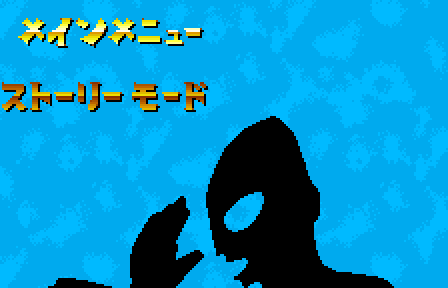
Ultraman: Hikari no Kuni no Shisha is a fighting game for the WonderSwan Color based on Ultraman, the tokusatsu television series first broadcast in 1966. Bandai released it in June 2001 and promoted it as a game marking a hundred years since the birth of Eiji Tsuburaya, the special effects director behind the series. It is a remake of the Ultraman game Bandai released for the Super Famicom in 1991.
As in the original, Ultraman fights one monster at a time in a side-on duel and has three minutes to win, but the WonderSwan Color version was reworked a great deal, with redrawn graphics, story scenes, a changed cast of monsters and new rules. Beside the story there are training and versus modes, and two players can fight each other over the link cable. The cartridge needs a WonderSwan Color.
The story
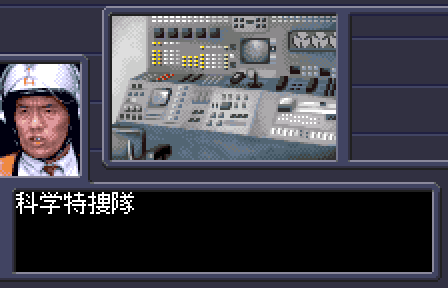
The game retells the 1966 television series rather than inventing a plot of its own. Story mode follows the episodes of the show, with Ultraman taking on the monsters and aliens he met on television, one per stage. The opening film recreates the show’s title sequence closely, almost all of the music comes from the series, and the backgrounds show places that fans of the show recognise at a glance. Three members of the Science Patrol, Captain Muramatsu, Ide and Arashi, appear in digitised photographs taken from the series.
There are thirteen stages. Ultraman starts against the space monster Bemular and then meets the space ninja Baltan, the invisible monster Neronga, the magnetic monster Antlar, the first Red King, the uranium monster Gabora, Baltan again in a return match, the fake Ultraman, the poison-gas monster Kemular, Jamila, the ancient monster Gomora and the alien Mefilas, before the space dinosaur Zetton in the last stage. Fourteen characters appear in all, counting Ultraman and the hidden Zoffy, and the cast leans toward four-legged monsters, which are hard to put in a game, as well as the famous names.
The fights try to play out the way the episodes did. Some monsters, such as Antlar and Jamila, can be beaten the way they were beaten on television. Throwing Neronga wrecks the power station behind him, under some conditions the Science Patrol joins in with a supporting attack as it did in the show, and the fake Ultraman now and then shows his true form, the alien Zarab. The story is short, it does not cover every episode, and the episodes it does use are cut down in places.
How it plays
The console is held horizontally. The basic rules are those of a one-on-one fighting game: the player walks, punches and kicks, and guards by holding the direction pad away from the opponent. Under each character’s health bar is a special gauge, and once it has filled, a special move can be spent from it. Each character has up to four fixed special moves, each set to one of the Y buttons, so a special takes a single press instead of a joystick motion. There are no combos and movement is slow, and most monsters cannot jump, which makes playing as a monster harder than playing as Ultraman.
Every fight has a three-minute limit, and if time runs out Ultraman loses. Ultraman no longer has to finish a monster with the Specium Ray; a punch or kick will do. A monster explodes, as on television, only when the Specium Ray finishes it off.
Story mode has three difficulty settings, Kids, Normal and Hard, with Kids made for young children. After each stage the player can save or retry, and a saved game can be continued later or deleted. After each win the game gives an Ultraman score of up to 100, worked out from remaining health, the hit rate, time left and special conditions, and beating a monster the way the show did raises it. Each monster beaten in story mode becomes playable, and Ultraman and Bemular can be used from the start.
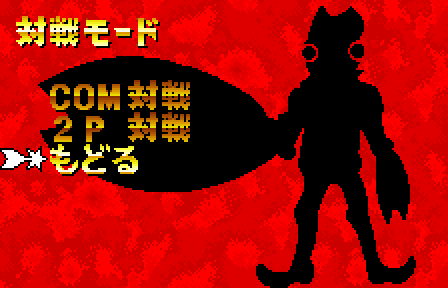
Versus mode can be played against the computer or a second player, so it works for one person as well as two. One side must always be Ultraman. The Ultraman player picks first, then the monster is chosen, then the stage and a handicap. Ultraman can also fight Ultraman; if time runs out in that match it is declared a draw, while in any other match time out means a loss for Ultraman.
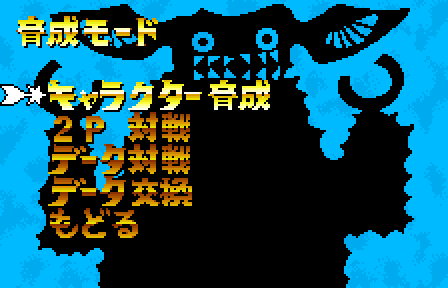
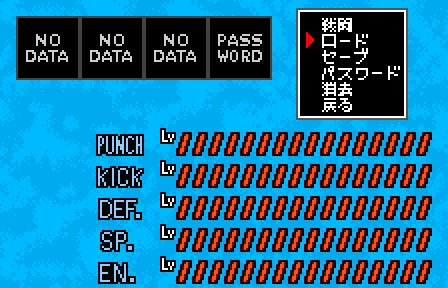
Training mode raises six characters, Ultraman, Zoffy, Baltan, the fake Ultraman, Mefilas and Zetton, and each grows differently according to how the player fights with it. Besides training, the mode offers fights against a second player, fights between sets of trained data and swaps of that data. A trained character can be kept on the cartridge or written down as a password, and since a password can be entered on another cartridge, players far apart could trade fighters this way.
Modes and features
The game has three modes, story, versus and training, and is for one or two players. Story progress is saved on the cartridge in 256 kilobits of SRAM, and training data can also be kept as passwords. Two consoles can be joined by the link cable for versus play, the sound is in stereo, and the cartridge works only on the WonderSwan Color.
Secrets and extras
Beating a monster in story mode makes it playable, so clearing the story once, even on Kids, unlocks every character except one. The exception is Zoffy, who appears only after story mode has been cleared on Hard. The difficulty must be Hard for the whole run, since changing it partway through does not count.
Reception
It is regarded as a well-made character game and one of the better cartridges made only for the WonderSwan Color. Its faithfulness to the series, from the recreated opening to the music, is widely praised. The usual criticism is that it works less as a fighting game than as an action game: there are no combos, movement is slow and most monsters cannot even jump, so playing as a monster is hard work. Some fans feel the game deserved more attention than it received on a less popular console.
Ports and other versions
The game Bandai remade here came out in April 1991, on the Super Famicom on 6 April, developed by Beck, and in arcades from Banpresto. Several more versions came before the remake: a Game Boy version from Beck at the end of 1991 and a Mega Drive version developed by Human and published by Marva in 1993, followed in 2006 by mobile phone versions for i-appli and S!appli. Those versions differ from one another as well. The arcade game has thirteen stages against ten on the Super Famicom and Mega Drive, with some monsters found only there; the Game Boy version is heavily simplified to nine stages and lets monsters be used in link battles; and the Mega Drive version keeps the Super Famicom content but changes the colours, the transformation scene and some music, with harsher voice samples. The phone versions keep the Super Famicom system and roster with changed voices, a hard difficulty and no closing credits.
The WonderSwan Color game keeps the basic duel of the original but is a far looser remake than any of those conversions. Besides the new graphics, modes and story scenes, the cast changed: Gabora, Kemular and the fake Ultraman were added and Zoffy can be unlocked, Neronga and Antlar return from the arcade version, the first Red King takes the place of the second, and Telesdon, Bullton and Geronimon were left out. Among the home versions only the Game Boy and WonderSwan Color games let two players fight each other. The remake dropped several rules of the original, such as damage from merely touching a monster, a gauge that filled only with time and the need to finish every monster with the Specium Ray, and Ultraman can now guard. Only four characters have recorded voices.
The remake is almost a different game that shares the original’s devotion to the series, and its controls are generally thought much better than those of the Super Famicom game, though the arcade-based system still feels dated. Famitsu scored the earlier versions 30 out of 40 for the Super Famicom game, 22 for the Mega Drive and 18 for the Game Boy, and the Mega Drive reviewers found that its fully drawn backgrounds made Ultraman look smaller than on the Super Famicom.