
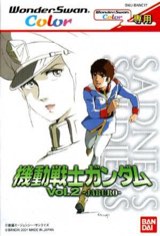
The second part of Bandai's WonderSwan Color retelling of the first Mobile Suit Gundam, covering episodes 13 to 30 and carrying over progress from Vol. 1.
Screenshots
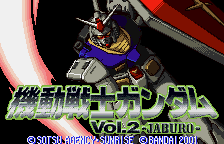
Title screen 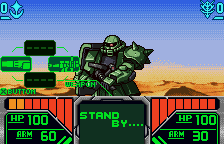
In play 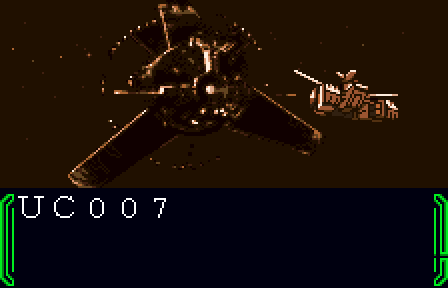
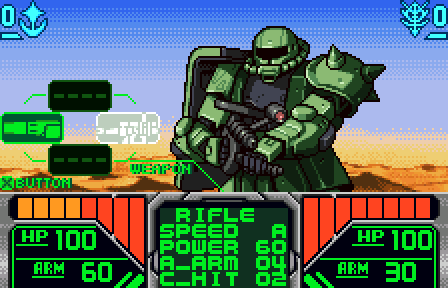
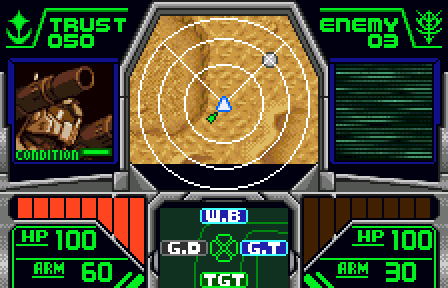
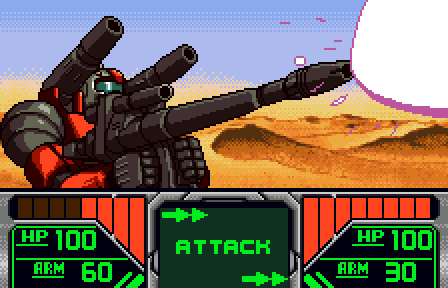
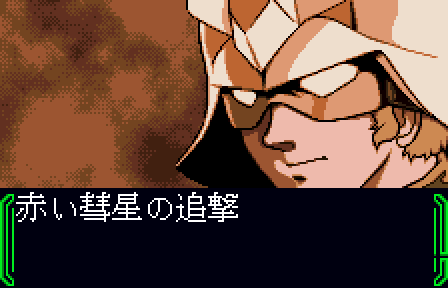
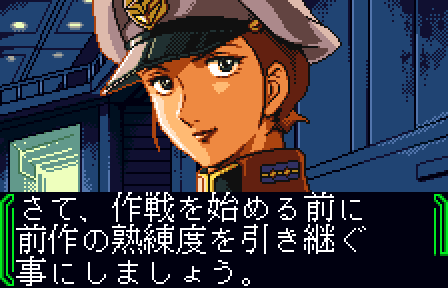
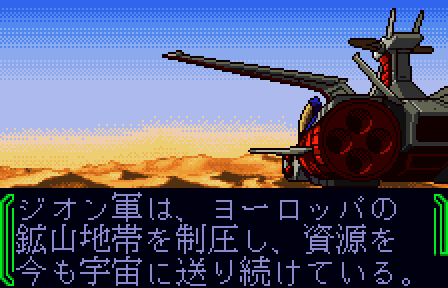
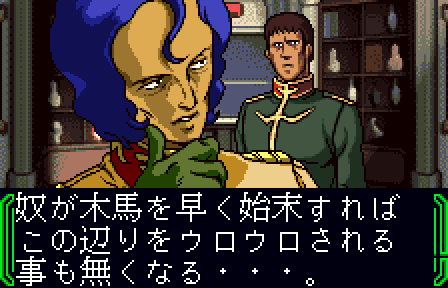
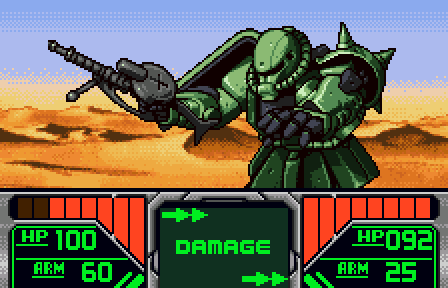
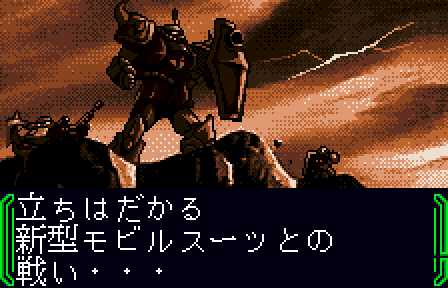
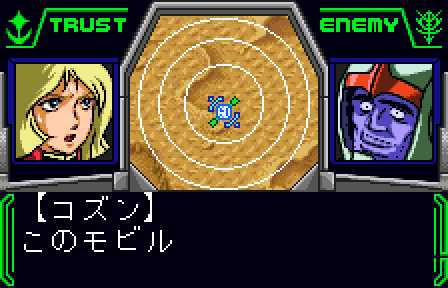
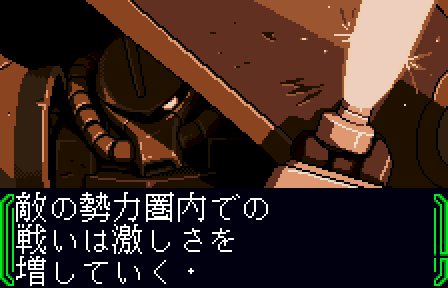
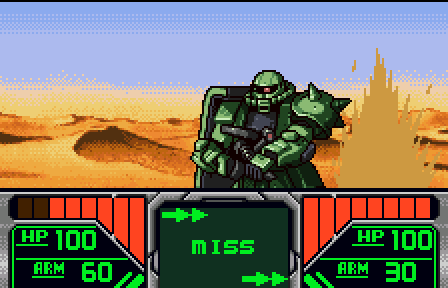
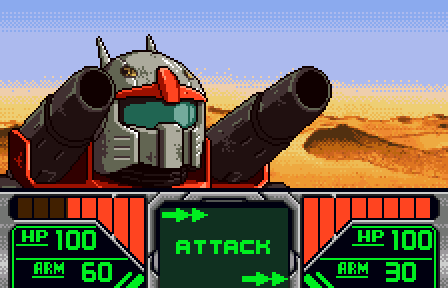
Kidou Senshi Gundam Vol. 2: Jaburo is the middle part of Bandai’s three-game retelling of the original Mobile Suit Gundam TV anime on the WonderSwan Color. It follows on from Vol. 1: Side 7 and takes the story from episode 13 to episode 30. It went on sale on 16 August 2001, six and a half months after the first part.
Like the rest of the series, it is built from two halves: novel-style adventure scenes that tell each episode from Amuro’s point of view, and command battles in which the mobile suits move in real time. The structure is the same as in the first game, but the battle sections were reworked to make choosing weapons simpler and their effects clearer. In return, new elements were added: accidents that happen in the middle of a fight, battles under water, fights against several enemies at once, and an energy system that now applies to enemies as well. There are also many more mobile suits and events than before.
The story
Vol. 2 picks up the One Year War between the Earth Federation and the Principality of Zeon with White Base already on Earth. The ship’s goal is Jaburo, the Federation’s headquarters, built by widening a huge network of limestone caves under the jungle on the upper Amazon and holding the high command, docks for spaceships and a range of factories. The fifteen main episodes follow the route there on four maps: the area around the Caspian Sea for episodes 16 to 21, the Odessa region for 22 to 25, Europe from Belfast across the Atlantic for 26 to 28, and finally the approach to Jaburo itself.
Amuro Ray is now a Federation soldier who first climbed into the Gundam by chance, and under the strain of combat he starts to show signs of being a Newtype, a new kind of human whose awareness has widened through life in space. Sayla Mass, until now on the communications desk, is picked for her aptitude to fly the G-Parts, the components of a multipurpose fighter built to support the Gundam, which she crews with Hayato Kobayashi. Ryu, the ship’s one regular pilot cadet and its older-brother figure, takes the controls of the Guntank. Katsu, Kikka and Letz, three small children who lost their parents in the evacuation of Side 7, travel with the crew. Lieutenant Matilda Ajan supports the ship under orders from General Revil, bringing supplies and the G-Armor, and Amuro looks up to her.
On the Zeon side the opponents are drawn from these episodes of the anime. Ramba Ral, a guerrilla commander known as the Blue Giant, comes down to Earth with his unit and clashes with White Base again and again. Kycilia Zabi, eldest daughter of the Zabi family that rules Zeon, commands the forces sent to take the Earth’s resources, and her cold, calculating aide M’Quve runs the mining base at Odessa, the target of the Federation’s great counteroffensive under Revil. Char Aznable, the Red Comet, serves under Kycilia, and the Black Tri-Stars, Gaia, Ortega and Mash, attack in a three-machine formation called the Jet Stream Attack.
The story is again told only from Amuro’s side, with almost every character of the broadcast appearing, down to minor figures such as the spy Judak and the cook Tamura. Some scenes go beyond the anime with episodes of Amuro’s life that the television series never showed, made under Sunrise’s supervision. Three extra episodes, 13 to 15, cover the ship’s time near Japan between the first volume and this one; they are told purely as story scenes without any fighting.
How it plays
The console is held sideways and the cycle is the same as in Vol. 1: a map, a story scene, a battle, a report and a save screen. New Game starts at episode 16. If the console holds clear data from Vol. 1, a transfer screen appears first and a tenth of each proficiency carries over, so the 9,900 maximum of the first game becomes 990 here. In story scenes A advances the text and confirms, X1 and X3 move the choice cursor and START skips the conversation. Choices change the crew’s trust in Amuro, and the Sudden Select, a short test in which three buttons have to be pressed in time with arrows on screen, also appears in story scenes. Failing a choice or a Sudden Select can lead to a bad ending on the spot, though each bad ending is counted as an event seen.
Battles still begin on the optical radar, where the Gundam turns and moves forward or back in real time with the X buttons. This is also where weapon energy recovers and where both sides search for each other, so moving slowly invites the enemy to strike first. Enemy lights are white when they have not noticed the Gundam and red when they have, and an enemy outside the field of fire can attack without any chance to reply. The screen shows the trust level, the pilot’s condition (red when fired up, green when normal, blue when rattled), the Gundam’s armour, HP and energy, the number of enemies left and, for the first time, the enemy’s own energy gauge.
Pressing A with a target in the field of fire opens the command screen, which replaces the menus of Vol. 1. An ACT gauge runs across the top: one cursor starts from the player’s side and one from the enemy’s, and whoever reaches the centre first acts first. Each distance offers a fixed set of four attacks, and the weapon window rates each one for speed from A to E, power, damage to armour and critical chance. Speed depends on the distance, so melee works best up close and shooting at range, and choosing the right move can let a slower start overtake the enemy. Under attack the Gundam can raise its shield but can no longer simply dodge, and guarding no longer restores energy. The Bull’s-eye is no longer chosen freely: it triggers at random during long-range shots, and the shot is more accurate the closer the moving sight is to the centre when A is pressed within the time limit. Damage figures are not displayed.
Energy matters on both sides now. Melee strikes and missiles drain the enemy’s energy, and an enemy whose gauge hits the red zone overheats and cannot act, while taking hits drains the Gundam’s energy too. When two sabres meet the player has to hammer a button to win the clash, and a Sudden Select can come up when the player attacks at close range. On some stages the Guncannon, the Guntank or the G-Fighter combinations can be controlled, and allies on the radar can be called with Y to attack an enemy or pin it down, using up a limited number of support points; they may refuse if trust is low, and their support can push an enemy into overheating. Stage goals include wiping out the enemy, surviving a time limit and stopping a suicide attack, and some battles take place under water or bring several enemies at once.
After a win the report shows three proficiencies: melee, which now raises the strength of melee attacks, shooting, which raises accuracy, and reaction, which helps the Gundam act first and dodge. They grow from the damage dealt and taken, losses add to them as well, and the game can be saved at a game over without losing what was gained. The total of events seen is shown on the world map. There is one save slot, used after a battle or at the end of a story scene.
Vol. 2 is harder than the first game. The fight against the Grablo mobile armour in episode 28 is a particular wall, and the answer is to replay earlier stages to build proficiency, as the manual itself advises for any enemy that cannot be beaten. The map near Japan with episodes 13 to 15 is closed at first; with Vol. 1 data it opens step by step as the story moves on, and a game started from Vol. 2 opens it after episode 30 is cleared. After the ending, quitting to the title adds a bonus option with an event viewer and a sound test.
Development and release
Bandai opened the game’s own website on 6 August 2001, ten days before release, and used it to point players back to Vol. 1, hinting that save data from the first game would pay off. The cartridge doubled in size from the 32 megabits of Vol. 1 to 64 megabits, which Bandai attributed to the amount of event artwork and animated battle scenes needed to follow the TV story, and the sound effects were advertised as the same ones used in the anime.
Support for the WonderGate adapter was planned, and Vol. 1 had used it to download extra weapon parts. Bandai later apologised that the WonderGate feature for Vol. 2 could not be delivered after all, so the finished game has none. Shops gave early buyers a double-sided sticker poster of famous scenes and lines from the game, as they had for Vol. 1. In 2001 Bandai also ran a campaign in which buyers of this game, Vol. 1 or SD Gundam G Generation Gather Beat 2 could enter a draw for one of 500 WonderSwan Color consoles in Gundam and Char’s Zaku designs. SoftBank Publishing released an official 96-page full-colour guide on 24 August 2001, with flowcharts for every stage, the conditions for every event, and new illustrations by Naochika Morishita, known for the mobile suit art of the Gundam War card game.
Modes and features
The only mode is the story, started with New Game or resumed with Load. Any stage already played can be chosen again from the map at any time, either to train or to collect events that were missed. The scenario parts are read like a visual novel, and nearly every character from these episodes appears, including minor ones that earlier Gundam games had left out. The three side-story episodes need no battles and add only story scenes.
Ports and other versions
Vol. 2: Jaburo was made for the WonderSwan Color and was never ported, remade or re-released on another system. A reader may confuse it with Bandai’s PlayStation 2 game Mobile Suit Gundam, released in Japan on 21 December 2000 and sold in North America as Journey to Jaburo. That game also follows the anime as far as the battle for Jaburo, but it is a separate 3D action game rather than a version of this one. The WonderSwan trilogy differs from it by telling each episode as a novel-style adventure with command battles, and by passing save data from one part to the next.
Notes
The game supports the link cable, though what the link is used for is unknown. It is for one player and runs only on the Color. The developer is unknown.