
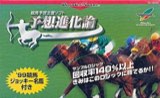
A horse racing prediction tool for the WonderSwan: the player enters data on the runners and builds and refines their own logic for rating them.
Screenshots

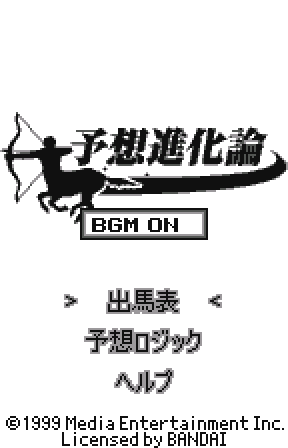
Title screen 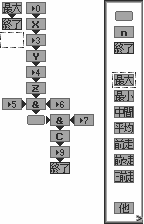
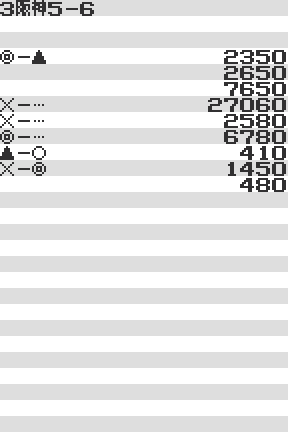
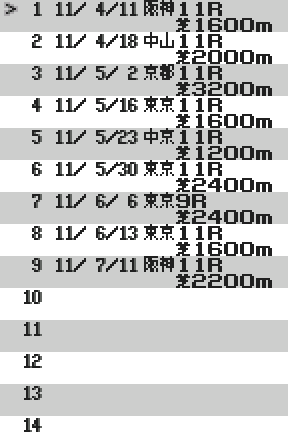
In play 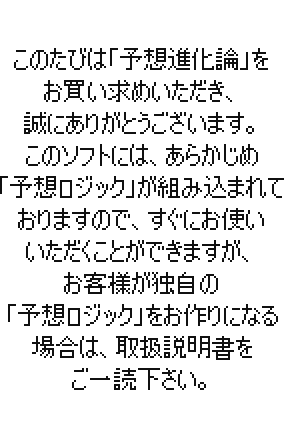
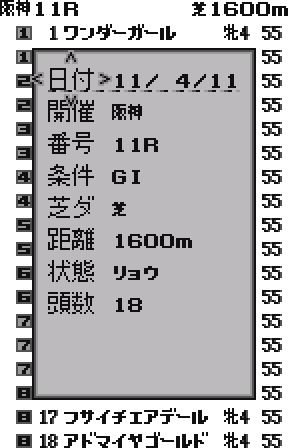
Keiba Yosou Shien Soft: Yosou Shinkaron, whose title means roughly “horse racing prediction support software: the theory of evolving forecasts”, is not a racing game but a tool for people who bet on real races. It was published by Media Entertainment, a Tokyo software company better known for pachislot simulators, and came out on 14 September 1999, six months after the WonderSwan itself.
Instead of training or riding a horse, the user types in the details of the runners in an upcoming race, and the software rates them by a set of rules that the user writes and improves over time. Sample rules come built in for anyone without a method of their own.
Bandai made a point of the handheld format, noting that a forecast could be worked out even while watching the horses in the paddock. The software is used with the WonderSwan held upright, does not use the link cable, and came with a pocket-sized book of racing data meant for use at real meetings.
The story
Yosou Shinkaron has no story and no characters. It is a forecasting tool, and the only premise it has is the one in its title: the user’s theory of how to pick winners is meant to evolve. A set of rules is tested against how real races turn out and reworked in the light of experience, with the aim of the user arriving at the strongest theory there is, one entirely their own.
The title screen sets the tone. A black silhouette of a centaur drawing a bow stands beside the title, written in heavy brush-like characters, against a scatter of small stars, with Media Entertainment’s copyright line and a note that the game is licensed by Bandai along the bottom. The cartridge also has music of its own, played in stereo.
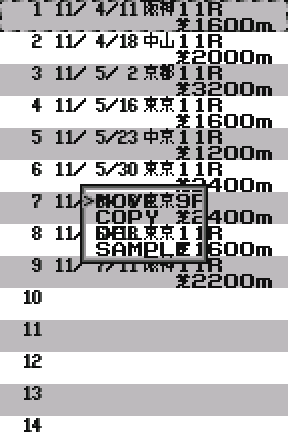
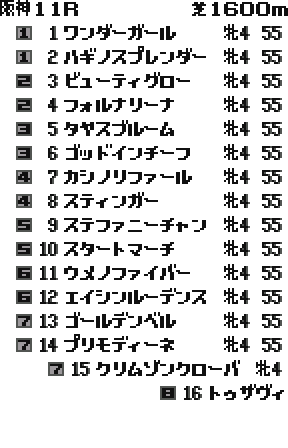
The world the software deals with is real horse racing in Japan. Its sample race card is set at Hanshin, an 11th race over 1,600 metres of turf,. Bandai’s promotion pictured the user at the course itself, working out a forecast in the paddock while the horses walk round, with the bundled pocket data book to hand.
How it plays
The WonderSwan is held upright, and the software is for one person; it does not use the link cable. Using it comes down to two jobs: entering the runners of a race, and building the rules that judge them. Bandai stressed that the data entry takes only simple operations.
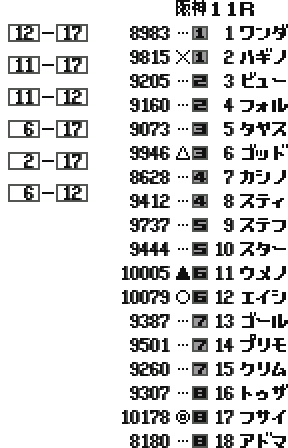
A race is shown as a card. The top line gives the racecourse, the race number, the surface and the distance, and below it the runners are listed, eighteen of them in the sample, each with its bracket number, horse number, name, sex and age, and the weight it carries. A narrow column at the left edge holds the forecast marks, a double circle, a circle, a filled triangle, a triangle and a cross, set beside the horses the forecast picks out.
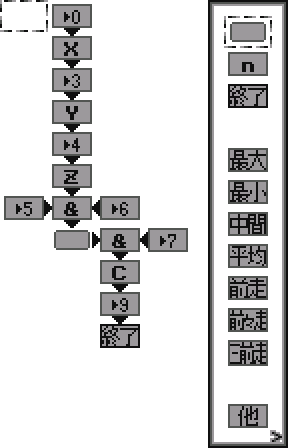
The rules are written as a flowchart. Blocks are laid out on the screen and joined by arrows that run from top to bottom, so a rule reads like a small program. Some blocks hold race data, such as the date, a horse’s age, its finishing margin and a condition, others hold the variables A and B or plain numbers, and the rest are operations: multiply, divide, subtract, compare and test for equality. Branches jump to numbered points, each branch is closed with an “end” block, and the whole chart ends in a finish block.
That flexibility is what makes the rules something to play with. The user can check a rule set against results and keep improving it from experience, so a forecasting method grows over time instead of being fixed by the program. For anyone without the specialist knowledge to write rules, sample logic sold on its excellent track record is built in, so the software can be used as a pocket forecaster from the first race. The cartridge’s S-RAM keeps the entered races and the user’s rules between sessions.
Development and release
Media Entertainment was founded in 1993 by a former Telenet Japan employee and became a joint-stock company in 1995. Its catalogue was made up mostly of pachislot simulators for the PlayStation, alongside a run of food-themed action games. The copyright line names only Media Entertainment, and who programmed the cartridge is unknown. It sold for 4,800 yen before tax, and Bandai promoted the bonus data book as a deluxe extra.
Ports and other versions
Yosou Shinkaron was released on the WonderSwan only and was never ported or re-released. Media Entertainment’s other work was almost all pachislot simulation on the PlayStation, so this pocket betting aid has no obvious sibling in its maker’s catalogue; it stands apart as a program meant to be carried to the racecourse rather than played at home.
Notes
The full package contains the cartridge in its case, a 44-page manual, a reader survey postcard and the bonus booklet. The cartridge holds 256 kilobits of S-RAM, four times the save memory of Kaze no Klonoa: Moonlight Museum from the same year, which leaves room for the user’s race data and rating rules. Bandai spelled the company’s name in Japanese with an extra syllable, as メディアエンターテインメント, where the usual spelling is メディアエンターテイメント.