
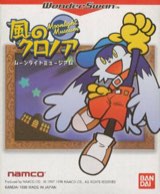
Namco's first handheld Klonoa game, a puzzle-heavy 2D platformer in which Klonoa and Huepow chase the stolen pieces of the moon through a museum of paintings.
Screenshots
Title screen 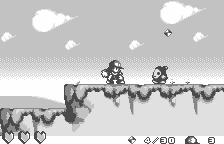
In play 
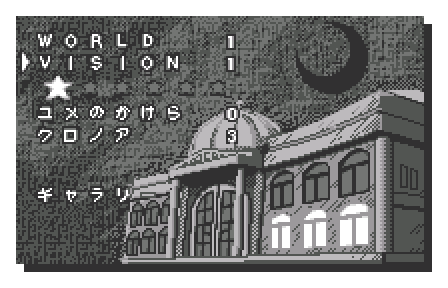
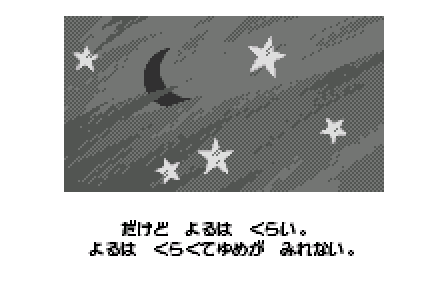
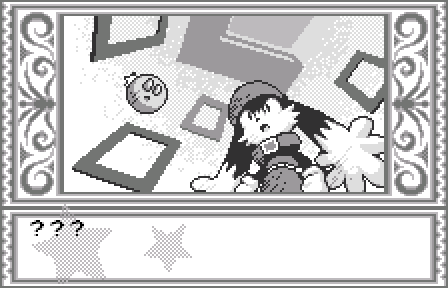
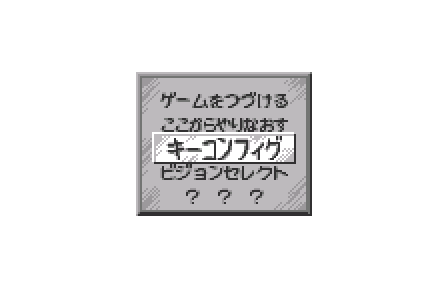
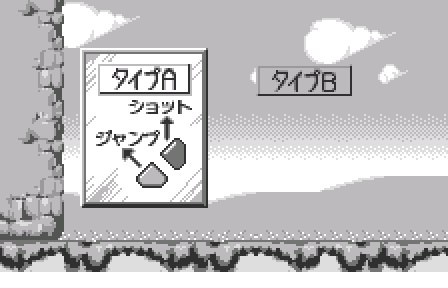
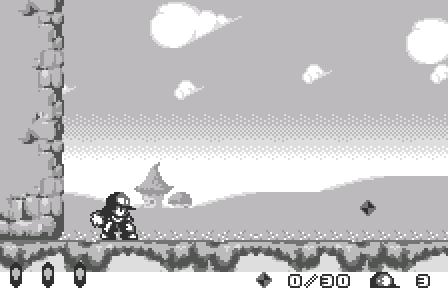
Kaze no Klonoa: Moonlight Museum is a platform game for the WonderSwan, made by Namco and released by Bandai in May 1999. It follows Klonoa: Door to Phantomile on the PlayStation and was announced as a side story to it, and it was developed at the same time as Kaze no Klonoa 2 for the PlayStation 2, whose team concentrated on action while this one was asked to stress puzzles. It was the first Klonoa game on a handheld and the first to take place in an entirely two-dimensional world.
Klonoa and Huepow set out to win back the pieces of a stolen moon from the artists of the Moonlight Museum. The game is a side-on platformer built around the wind bullet and boxes that Klonoa carries, divided into five worlds of six stages called visions, with an extra time-attack world after them. The puzzle-centred design was carried forward into the later Kaze no Klonoa: Yumemiru Teikoku and Kaze no Klonoa G2.
The story
Klonoa and his friend Huepow, a small floating blue ball with a face who lives in Klonoa’s ring and gives him advice, come across a young girl in tears. She tells them that the moon has been broken into fragments and carried off by a strange group of artists who live in the Moonlight Museum nearby, and asks them to go there and bring it back. The game stands on its own and has no direct link to the story of Door to Phantomile.
A mysterious voice welcomes the pair into the museum, and the first artist they meet is Picoo, a long, striped painter in a robe and a small beret who has used people’s memories as paint to make a picture of nostalgia. He is not hostile. He is delighted to show off his work, explains that the moon fragments can be won back from inside his painting, and is sure they will fail. Klonoa and Huepow end up trapped inside the picture, and to put the moon back in the sky they have to clear every vision and recover every fragment.
Each world is a work by one of the artists. Picoo’s painting is a sunny grassland with a small town, much like Klonoa’s home of Breezegale. The bird sculptor Trefle has built a giant statue that swallows the pair, and its insides form a maze. Koof, a dolphin in a necktie, draws a horror comic, and Kahoh, a photographer with a magic camera, shows a palace in the clouds through her lens. The fifth world is the museum itself.
The story is told in short scenes at the start and end of each world, where Klonoa meets the artist, and the visions in between carry no story. The mood is gentle and dreamlike, and the stakes are simple: the moon has to go back where it belongs. The extra world opened after the fifth has no part in the story.
How it plays
The game is played side-on, mostly with the WonderSwan held sideways, but some visions are played with the console upright. Only two buttons are in use at any time, following producer Hideo Yoshizawa’s wish for a game that needs no more than two, and the console’s two button sets mirror each other, so the controls fall naturally under the thumbs either way. Vertical and horizontal stages are mostly kept apart, and once a vision is cleared the player can switch it between vertical and horizontal play from the pause menu.
Klonoa’s wind bullet is fired from his Wind Ring. It pulls in an enemy, which Klonoa then holds over his head. He can throw it forward to knock out other enemies or hit a switch, or jump off it in mid-air for a second, higher jump. Holding the jump button makes him flap his ears, hanging in the air for a moment and carrying him a little further.
Boxes are the centre of most puzzles. Klonoa can carry them and stand on them; heavy boxes pin down floating spiked enemies, can be thrown at targets, block air vents or hold a route open, while the vents themselves lift Klonoa into the air. Later visions add ropes, feather balloons, blocks that can only be pushed, bomb enemies that set off switches against a timer and hurt Klonoa if handled badly, and hidden keys, locked doors and warps that sometimes send him back through earlier rooms. The puzzles are mostly about doing things in the right order and at the right moment. If a room reaches a dead end, the pause menu resets it and its devices to how they were when Klonoa entered.
Klonoa has three hearts and loses one with each hit. Hearts are plentiful and often placed near the dangers, extra lives look like Klonoa’s hat, and some items raise his health. Each vision hides three moon fragments, which open the moon door at its exit, and thirty dream pieces, where a large piece counts as five. Collecting the dream pieces completes one picture for each world, and the pictures, other artwork and the music can be viewed in a gallery. Cleared visions can be replayed to pick up anything missed. There are no boss battles.
There are thirty visions in all, six in each of the five worlds. The pace is slow and careful, the challenge rises steadily, and the last vision of each world is longer and harder than the rest. Signposts with hints are written in Japanese. Clearing every vision opens the extra world, Klonoa Gekkou Daisakusen, which is built more around action than puzzles: its traps can take all of Klonoa’s health at once, extra lives are plentiful, and the clear time of each stage is recorded.
Progress is saved on the cartridge, and switching the console off mid-game lets the player resume from the last room entered. The music is arranged from the PlayStation Klonoa game, and Klonoa has short voice clips.
Development and release
Bandai published the game and Namco planned and developed it. Bandai stressed that the game was not a port of the PlayStation original but a new design for the handheld with many puzzle elements, keeping the characters, the feel of the controls and the side-on view. It went on sale on 20 May 1999 for 3,800 yen before tax. Hideo Yoshizawa was the producer, with four designers, two programmers and a single artist, and the music was shared between two composers, one of them Junko Ozawa. Many of the staff of the first PlayStation game worked on this one.
Modes and features
The game is for one player and has no link-cable play. Beyond the thirty visions, its extras are the gallery, which fills with artwork and music as dream pieces are collected, and the extra time-attack world opened by clearing every vision.
Reception
Weekly Famitsu’s Cross Review gave the game 28 out of 40 in issue 545. Players rate it well, praising how much of the series’ dreamlike mood survives on a small monochrome screen, the soft character art, music that makes good use of the WonderSwan’s few sound channels, and a difficulty that suits beginners while still making late worlds demanding. The puzzles are thought harder than in the later Game Boy Advance games but fair, and the game is often recommended to newcomers to action games. The common complaints are that the story is told only at the start and end of each world, that thirty-six stages is on the short side, and that the original WonderSwan screen is dark and smears.
Ports and other versions
Moonlight Museum was designed for the WonderSwan rather than converted from the PlayStation game, and it was released for that console alone, only in Japan, and never ported, remade or re-released. It did not even receive a WonderSwan Color edition, which disappointed fans of its graphics. Within the series it stands as the handheld, puzzle-first counterpart to the PlayStation games, and the nearest relatives elsewhere are the later Game Boy Advance games, which are new games built on its systems rather than versions of it.
Later history
Its systems went almost unchanged into the Game Boy Advance games Kaze no Klonoa: Yumemiru Teikoku and Kaze no Klonoa G2: Dream Champ Tournament, which leaned further toward action. Some stages, music and a collectible in the PlayStation 2 game Kaze no Klonoa 2, released in March 2001, pay tribute to it.