
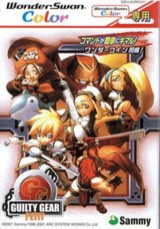
A fighting game for the WonderSwan Color built on the system of Guilty Gear X, with the series' fighters redrawn as small super-deformed figures and a new character, Fanny.
Screenshots
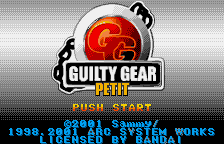
Title screen 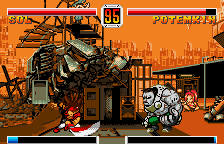
In play 
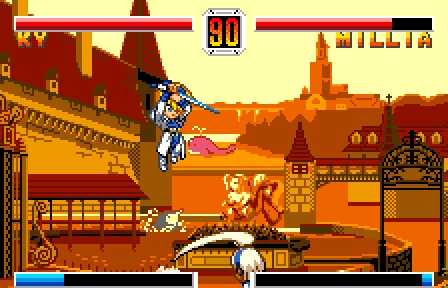
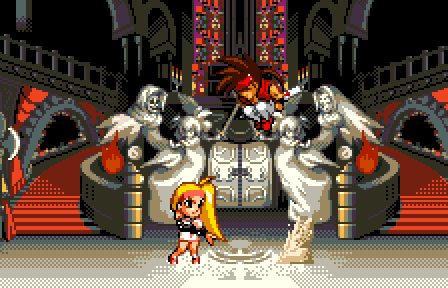
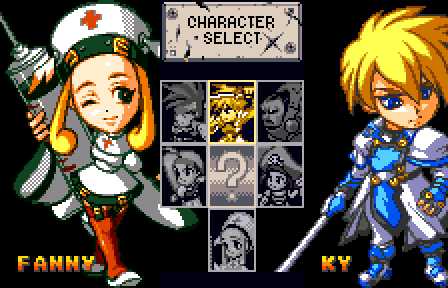
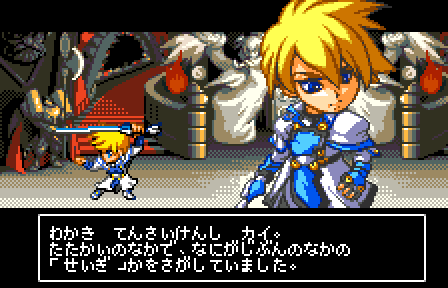
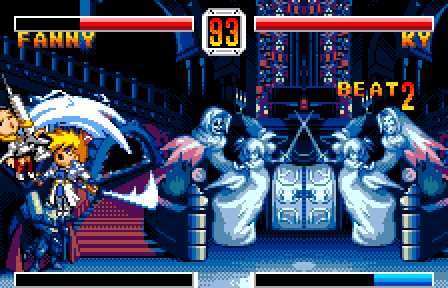
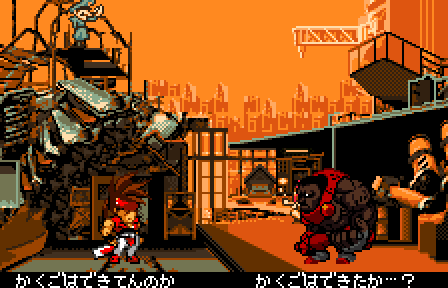
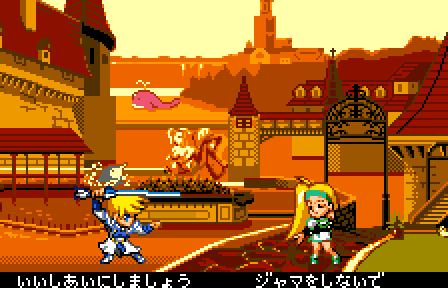
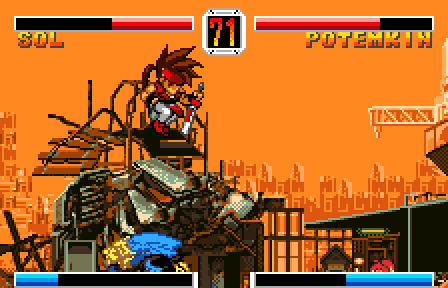
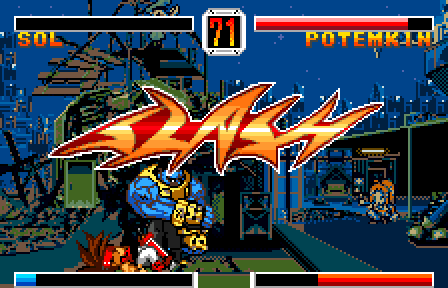
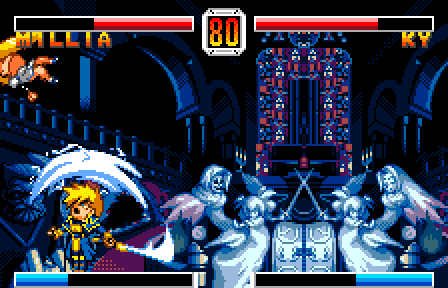
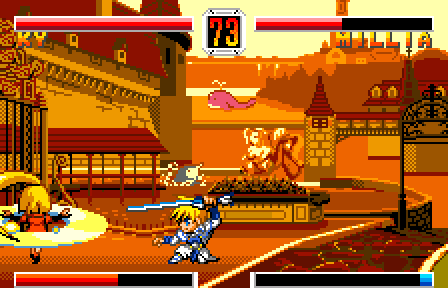
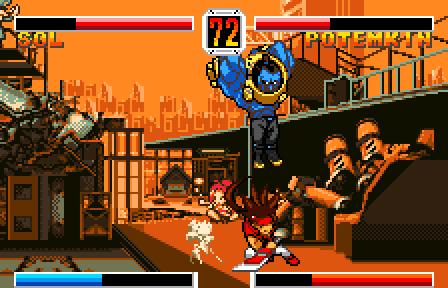
Guilty Gear Petit is a one-on-one fighting game for the WonderSwan Color, released in Japan on 25 January 2001, about seven weeks after the Color went on sale. It was published by Sammy, which then published Arc System Works’ Guilty Gear series, and it is the first of two Petit games on the system. Rather than a port, it is a new game that takes the rules of Guilty Gear X and fits them to the hardware.
The cast is drawn as small, cute super-deformed figures, but the moves are kept close to the larger games, with combos, a tension gauge and the series’ showy one-hit kills and awakened super moves. Alongside familiar fighters such as Sol Badguy, Ky Kiske and May, the game adds Fanny, a syringe-wielding nurse who appears only in the Petit games.
The box included a WonderCoin to make fighting-game commands easier on the WonderSwan’s buttons, and two players can fight each other with the link cable. The cartridge needs a WonderSwan Color or SwanCrystal and does not run on the original black-and-white WonderSwan. A sequel, Guilty Gear Petit 2, followed in September 2001.
The story
Guilty Gear Petit has no single plot. Its story mode gives each fighter a short comic episode set in the world of Guilty Gear X, and each one closes on an ending of its own. The episodes are light in tone to match the small, round figures, and the endings are brief.
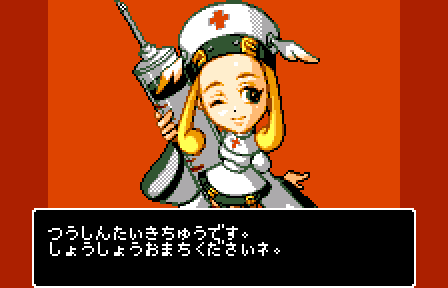
The newcomer is Fanny, a nurse who fights with an outsized syringe. She treasures the syringe as a keepsake of her late mother, cannot stand the smell of hospitals, and her origins are unknown. She worships the surgeon Dr. Baldhead from the first Guilty Gear on the PlayStation, serves as his assistant and fights with the playful moves she picked up from him. In her story she is out looking for the doctor.
The others set out for their own small reasons. Sol is hunting for his missing copy of the record Sheer Heart Attack, while Ky is trying to get hold of Sol’s sword, the Fireseal. May wants to become a better woman so that she can win Johnny’s heart. Millia has escaped from the Assassin’s Guild and crosses paths with May, and Potemkin is sent by President Gabriel to look into a mysterious stranger.
How it plays
The WonderSwan is held sideways. The larger Guilty Gear games use four attack buttons, and here the A and B buttons take their place, with many moves needing both pressed together. Dashing, air dashing and double jumping use the same inputs as in the series. The packed-in WonderCoin fits over the X1 to X4 buttons, which act as the directional pad, and makes circular motions easier to roll. Commands still have to be entered precisely, and there is no simplified-input option, so the game suits players who already know fighting games.
The series’ systems are all present: chain combos, the tension gauge, the awakened super moves and the one-hit kills that end a match at once. The properties of the moves were reworked to suit the short, super-deformed bodies, so the fighters do not play exactly as they do in Guilty Gear X.
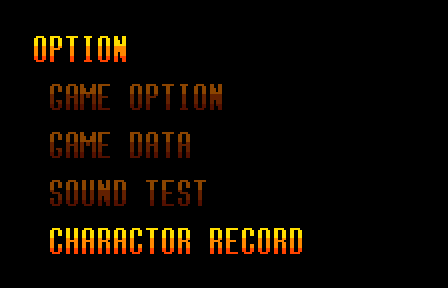
The main menu offers a story mode, a versus mode, a time attack, a training mode and the options. The story mode runs for six stages, in which the chosen fighter meets the other members of the roster once each before reaching the ending. In the time attack each opponent must be beaten within a set time, and damage taken carries over from one bout to the next. Versus fights against a friend use the link cable.
Six fighters are open at the start: Sol, Ky, May, Millia, Potemkin and Fanny. Two more can be unlocked, Jam Kuradoberi and an older version of Millia from the first Guilty Gear, and the unlocks come without much effort. Each fighter also has alternate colour schemes. The stages are Paris, Zepp, Russia, May’s ship and Nirvana, each with a second version.
A run through the story mode is short and the computer opponents are weak, so most of the game’s lasting value lies in two-player fights. The music arranges tracks from the series’ soundtracks in chiptune form and the sprites are detailed for a handheld, but the sound effects are thin: an ordinary hit and a one-hit kill make the same sound, and the overall volume is low.
Development and release
Sammy’s official Guilty Gear website gave the game a page of its own before release, written ギルティギア プチ in the text beside a GUILTY GEAR PETIT logo. Its character page introduced Fanny as a new fighter who treasures a syringe left to her by her mother, hates the smell of hospitals, and works as the devoted assistant of the surgeon Dr. Baldhead from the first Guilty Gear, borrowing his playful style of attack. The other fighters it named were Sol Badguy, Ky Kiske, May, Millia Rage and Potemkin, with a hint that more were hidden. Emiko Iwasaki designed the characters, and she was also the game’s general director and promotional illustrator.
The cartridge holds 16 megabits with 256 kilobits of SRAM for saves; the game is played horizontally, with stereo sound and one or two players over the link cable, and it sold for 4,500 yen before tax. The copyright line names Sammy and Arc System Works.
Reception
Writing about the sequel in October 2001, the Japanese news site Game Watch described the first Petit as a solid hit that had arrived at about the same time as the WonderSwan Color itself.
Ports and other versions
Guilty Gear Petit was made for the WonderSwan Color, its only system, and it was never ported, remade or re-released. The main Guilty Gear games appeared in arcades and on home consoles, and Guilty Gear X itself was converted for the Game Boy Advance as Guilty Gear X Advance Edition, but that is a version of Guilty Gear X, not of this game. The Petit games stand apart from the rest of the series in their small super-deformed fighters and in Fanny, who appears nowhere else.
Later history
The sequel, Guilty Gear Petit 2, came out on 27 September 2001, about eight months later. It kept Fanny, roughly doubled the cast and added a survival mode, and Bandai presented the changes as answers to what players of the first game had asked for most: more characters, better controls, more modes and livelier presentation.