

The second super-deformed Guilty Gear fighting game for the WonderSwan Color, with about twice the roster of the first, a survival mode and passwords from Guilty Gear X Plus.
Screenshots
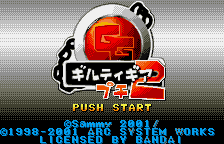
Title screen 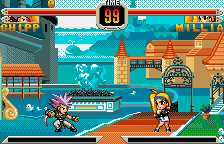
In play 
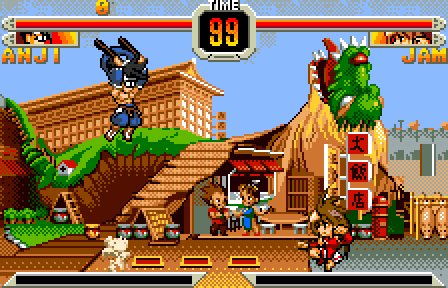
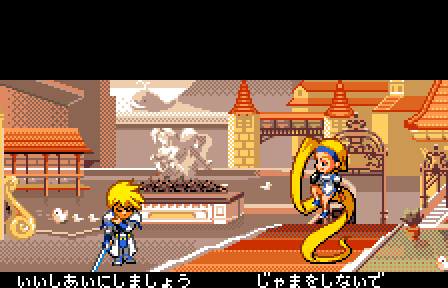
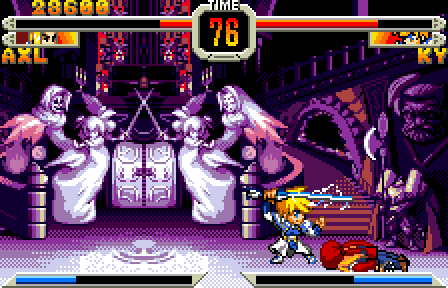
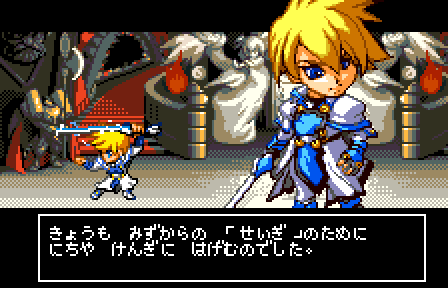
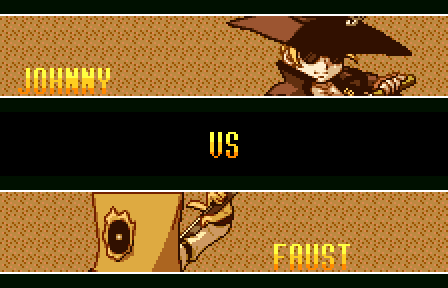
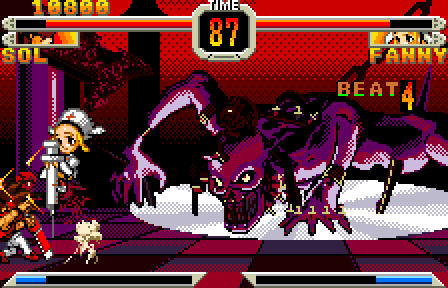
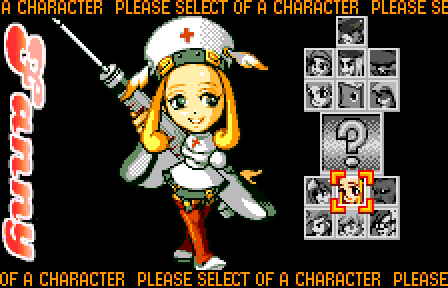
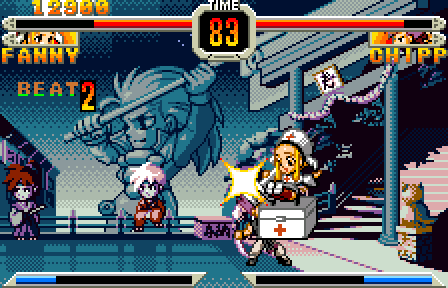
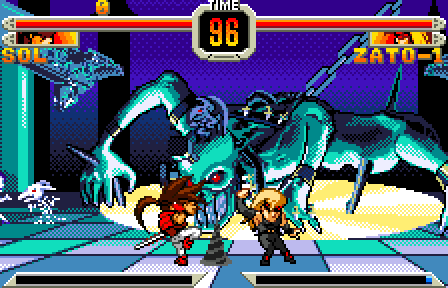
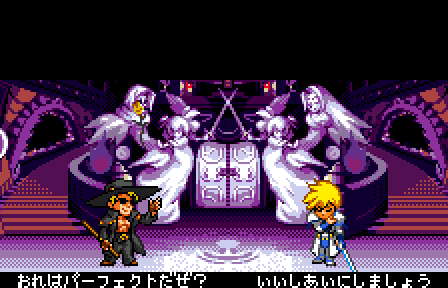
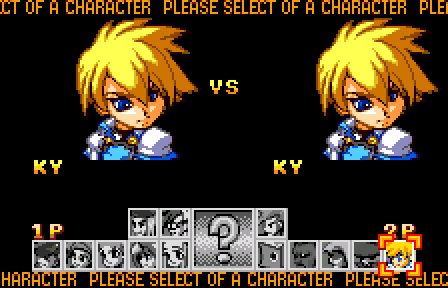
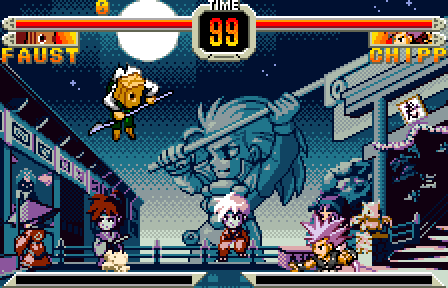
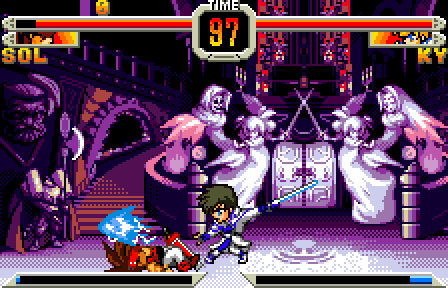
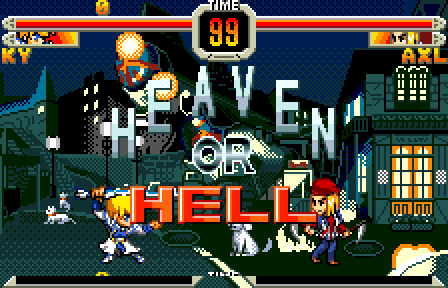
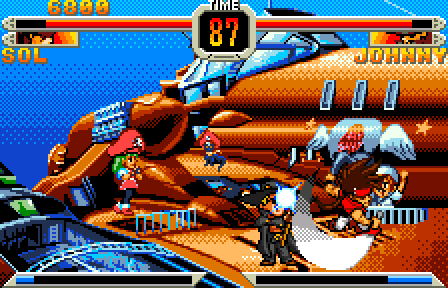
Guilty Gear Petit 2 is the sequel to Guilty Gear Petit, a fighting game for the WonderSwan Color that turns the cast of Arc System Works’ Guilty Gear series into small super-deformed figures. Sammy released it in Japan on 27 September 2001, eight months after the first game. It keeps the earlier game’s system, with combos and the tension gauge, and Fanny, the nurse created for the Petit games, returns.
Bandai’s announcement presented the sequel as a response to what players had asked for: more characters, better controls, more modes and more presentation. Six new fighters bring the roster to thirteen, plus hidden extras, more than double the first game’s count. A new survival mode, an optional simplified input and short story scenes between fights round out the changes.
The game also connects to Guilty Gear X Plus on the PlayStation 2: passwords earned there unlock hidden content in the WonderSwan game. Two players can fight over the link cable. The cartridge needs a WonderSwan Color or SwanCrystal and does not run on the original black-and-white WonderSwan.
The story
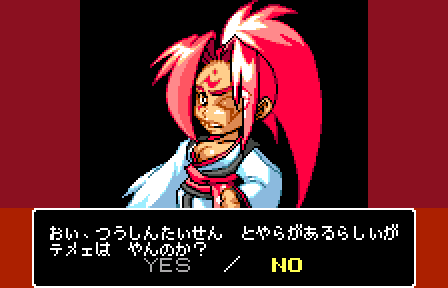
Like the first game, Petit 2 has no single plot. Each fighter has an original, rather offbeat story of their own in the story mode, now told through short demo scenes between the bouts, and the comic tone is far lighter than the darker world of the main Guilty Gear games.
The cast is larger. Sol Badguy, Ky Kiske, May, Millia Rage, Potemkin, Jam Kuradoberi and Fanny, the syringe-wielding nurse made for the Petit games, all return. The six newcomers are all men from Guilty Gear X: Anji Mito, Johnny, Faust, Chipp Zanuff, Axl Low and Zato-1. A few series characters appear without being playable: Baiken can be seen in the background of the Zepp stage, Dizzy drops in at the end of May’s one-hit kill, and Venom is absent.
The survival mode has a small framing of its own. When a run ends, Dizzy, Necro and Undine appear to judge how far the player got, offering encouragement or a hint about what is still hidden in the game.
How it plays
The game is played with the direction pad and the A and B buttons alone, combinations of the two producing a wider set of moves than the button count suggests. The controls respond quickly, dashes and double jumps work as in the series, and chain combos come from timing the presses. The input window for special-move commands is generous enough that the small buttons are not a handicap, though motion inputs can still feel awkward and a WonderCoin fitted over the direction buttons helps. A new simplified-command option shortens the motions, so that a quarter-circle forward with A becomes simply forward with A, at the cost of a few special moves that can no longer be performed.
The tension gauge, awakened super moves and one-hit kills return, with new effects and graphics; Fanny’s one-hit kill throws the opponent into an ambulance, and Faust’s makes use of his afro. Damage is fairly low, so rounds tend to run long. The music is arranged from Guilty Gear X.
There are five modes. The story mode now runs for eight stages instead of six. In the time attack each opponent must be beaten within 99 seconds, damage carries over between bouts and a single loss ends the run. Versus mode pits two players against each other over the link cable, and a training mode is there for practice.
The survival mode sends in random opponents for two rounds each until the player loses, and asks how many can be beaten in a row. Along the way, bosses with colours or abilities not seen in the normal CPU battles break into the run, and the player’s performance is graded at the end. The illustrations awarded in survival hide passwords for Guilty Gear X Plus on the PlayStation 2.
Thirteen fighters are open from the start, and five more can be unlocked: Testament, and Guilty Gear versions of Millia, May, Sol and Ky drawn as they looked in the first game, for eighteen in all. The stages are Paris, Zepp, Russia, May’s ship, Nirvana, China, London and the Japanese Colony, each with a day and a night version. The game has far more content than the first Petit.
Development and release
Emiko Iwasaki again drew the characters, and she was also the game’s general director, designer and promotional illustrator. The cartridge holds 32 megabits, twice the size of the first game’s, with 256 kilobits of SRAM for saves, stereo sound and one or two players over the link cable, and it sold for 4,800 yen before tax. When Game Watch reviewed it in October 2001, the PlayStation 2 game it links to by password was still due out on 22 November.
Secrets and extras
Testament appears as an intruder at the end of the story mode for a player who clears it without continuing, and beating him adds him to the roster. The Guilty Gear versions of the four fighters are unlocked by defeating them when they break into a survival run, or with passwords from Guilty Gear X Plus, which also open a gallery. The password BLACKMAS unlocks every colour scheme and adds a tension setting to the options, ADROPOUT adds the gallery to the options, and KDOKBNZY unlocks the Guilty Gear fighters, Testament and the survival colour schemes.
Reception
Game Watch’s review was enthusiastic. It found the controls quick and responsive, the dashes, double jumps and combos satisfying, and the screen free of flicker even in busy fights, and it felt the new fighters kept the feel of their arcade selves despite the cute redesign. Its one reservation was that the small sprites make it hard at first to tell low attacks from overheads, and it welcomed the comic tone as a contrast to the darker world of the main series.
Ports and other versions
Guilty Gear Petit 2 was made for the WonderSwan Color, its only system, and it was never ported, remade or re-released. Its password link with Guilty Gear X Plus on the PlayStation 2 joins two separate games and does not make either a version of the other. The nearest handheld relatives are Guilty Gear X Advance Edition on the Game Boy Advance, a version of Guilty Gear X, and Guilty Gear Dust Strikers on the Nintendo DS, a four-player action game rather than a one-on-one fighter; the two Petit games remain the only ones with the super-deformed cast and Fanny.