
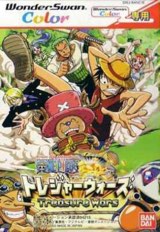
A One Piece board game for the WonderSwan Color in which members of Luffy's crew race each other to find and keep a treasure hidden on five islands.
Screenshots
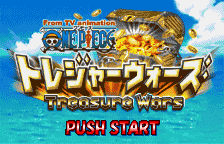
Title screen 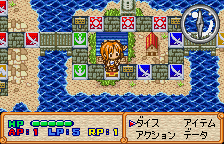
In play 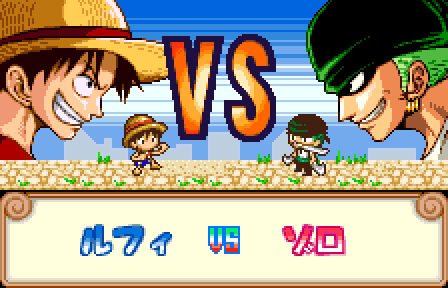
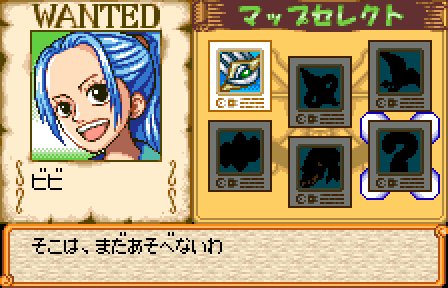
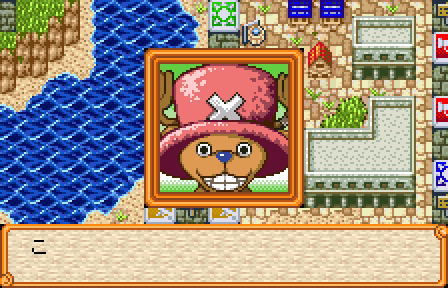
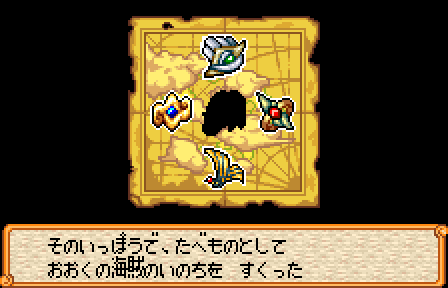
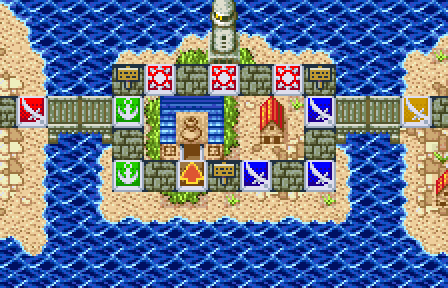
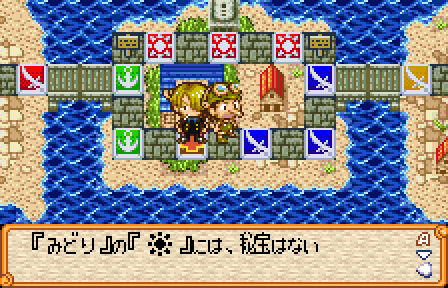
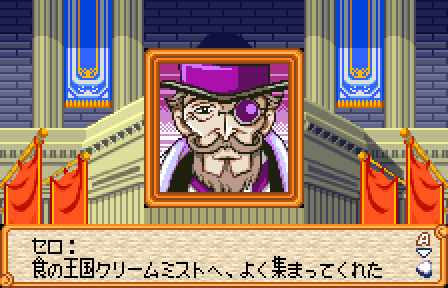
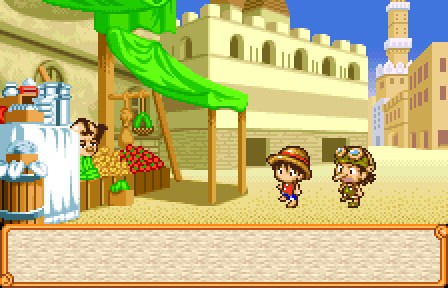
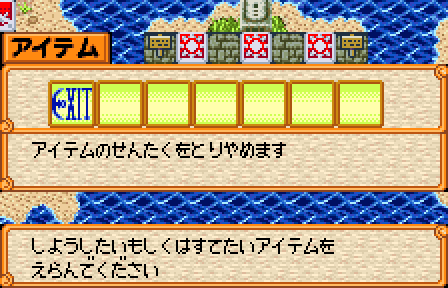
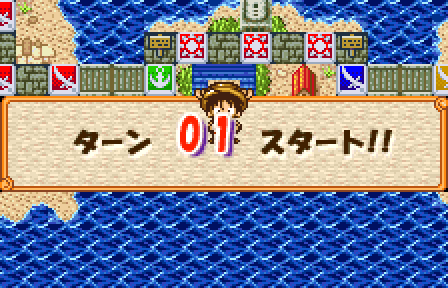
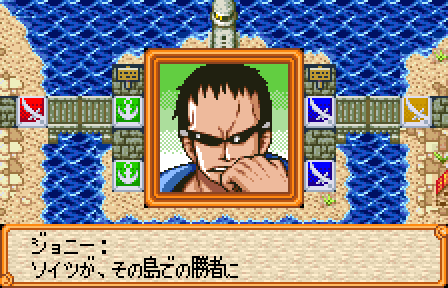
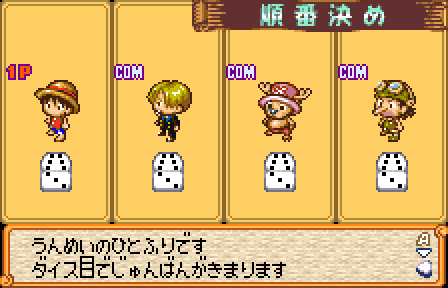
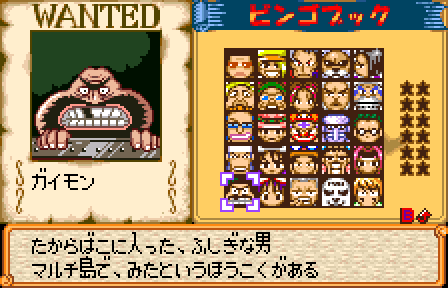
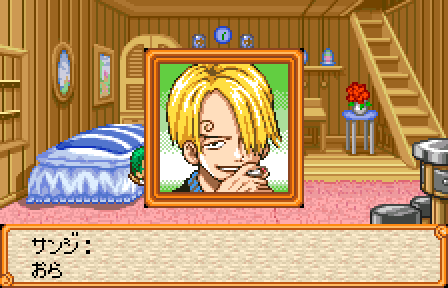
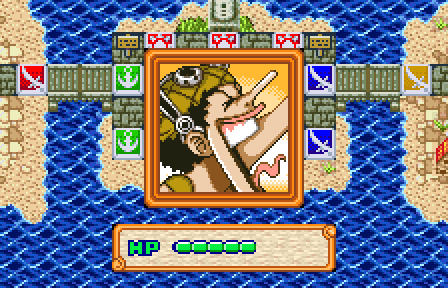
Treasure Wars is a One Piece board game that Bandai released for the WonderSwan Color on 3 January 2002, its third One Piece game for the WonderSwan. Its development is credited to Graphic Research, which is also credited with the sequel, though this has never been confirmed. Bandai described the genre as a “treasure-grabbing battle”.
The game is set on Cream Mist, a group of five mysterious islands that the Straw Hat crew reaches on its way through the Grand Line. The player picks one member of Luffy’s crew and races the others to find a treasure hidden on each island, then tries to keep hold of it while the rest try to take it away.
The cartridge is for the Color only and plays with one or two people, the second player joining over the link cable. First copies came with a large 2002 calendar showing the game’s whole cast.
The story
Long ago, before even Gold Roger’s time, one land in the Grand Line was said to yield Life Gems, jewels that could be eaten like food and that kept many starving sailors alive. Pirates fought to control them and kings and nobles harvested them, until the gems ran out and passed into legend.
On the way to Arabasta, a crow called Karasu swoops down on the ship and steals the crew’s Eternal Pose. They have no choice but to put in at a mysterious archipelago nearby, Cream Mist, to take on supplies. Cream Mist is a kingdom known for its food, and its king, Cello, is holding a contest called the Treasure Wars: whoever finds the Life Gems hidden across the five islands and brings them all to him wins 100,000,000 berries and an Eternal Pose to any island they choose. The crew decide to enter, and the prize draws pirates, members of Baroque Works and many others to the islands as well.
The five islands make up the stages. The crew land first on Malti Island, home of the Marines’ base on Cream Mist; Sorbi Island is a desert, Oligo Island holds mysterious ruins, Xyli Island is covered in snow, and Granu Island is the site of Cello’s mansion. The names all come from sweeteners, such as maltitol and xylitol. Old enemies such as Buggy, Alvida, Arlong, Smoker and Tashigi turn up along the way, along with Mr. 5 and Miss Valentine of Baroque Works, while Vivi and many other characters from the series appear in events. The story is light and comic, and in one scene Sanji’s cooking smells so good that the whole cast gathers round.
How it plays
The player picks one of six crew members: Luffy, Zoro, Nami, Usopp, Sanji or Chopper. The crewmates who are not chosen become the rivals, and they run around the board along with enemies such as Marines, bandits, fish-men and Kung-Fu Dugongs. Characters move square by square by rolling dice, and the squares hide actions and events, of which the most common is a battle against the nearest opponent.
Each stage starts as a search. Players travel around the island gathering information, and each character’s traits and the hints they collect help them work out which square hides the treasure. Once someone has found it, the scramble begins: characters who stop on the same square or mark fight over it. A battle is a short mini-game decided by dice and by bluffing rather than by the highest roll alone, and it allows fights between crewmates that never happen in the series. Items, traps and each character’s own fighting style and special skill, such as Luffy’s Gum-Gum Balloon, change the odds.
The stage ends when enough Log Pose readings have been gathered to leave the island, the Log Pose being the compass that stores an island’s magnetism to point to the next one. Whoever is still holding the treasure at that moment wins the stage.
Every island has its own hazards. On Malti Island a drawbridge in the middle rises whenever a ship passes. Sorbi Island has Buggy’s cannons, quicksand that forces travellers in one direction, an oasis and sandstorms. On Oligo Island two suspension bridges, one red marked AP and one blue marked LP, drop the character on the lower bridge into the sea when two people stand on them at once, and both fall if they share a bridge, while parts of the island rise and sink below sea level. On Xyli Island a Lapahn attacks passers-by, and avalanches sweep everything in their path into the sea.
The characters are drawn in a small, super-deformed style, and the sound is in stereo. In single-player the computer plays the other three characters, and waiting through their turns makes the game feel long.
Reception
Some players rated it poorly, dismissing it as a simple dice game in which the crew members damage each other. Some players rank the sequel, not this first game, as the best licensed game on the system.
Ports and other versions
Treasure Wars was made for the WonderSwan Color and was never released on another system. It is a board game, a kind it shares among the One Piece games of those years only with its own sequel on the same system. The similarly named One Piece Treasure Battle!, which Bandai released for the GameCube in 2002, is a fighting game and a different game, not a version of this one.
Later history
Bandai followed it on 20 December 2002 with From TV Animation One Piece: Treasure Wars 2: Buggy Land e Youkoso, set in a theme park run by Buggy. The sequel keeps the dice-and-treasure formula while more than doubling the number of maps and greatly enlarging the playable cast.