
From TV Animation One Piece: Treasure Wars 2: Buggy Land e Youkoso
From TV animation ONE PIECE トレジャーウォーズ2 バギーランドへようこそ
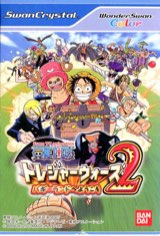
The larger sequel to One Piece Treasure Wars, a WonderSwan Color board game for up to four players set in Buggy's amusement park, with an LED lamp in the cartridge.
Screenshots
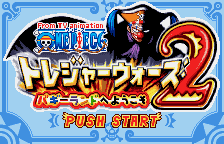
Title screen 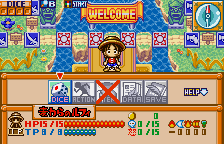
In play 
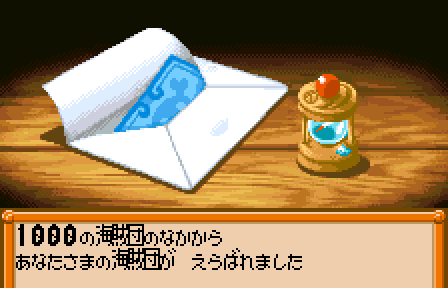
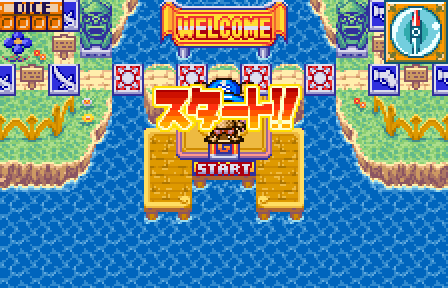
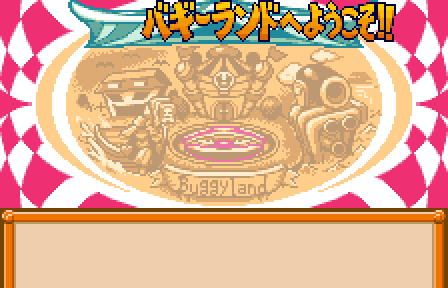
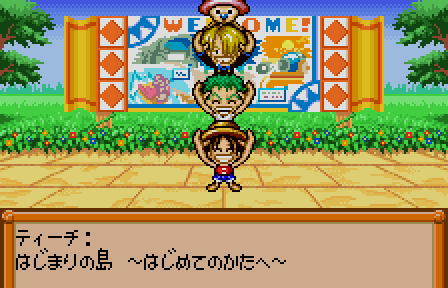
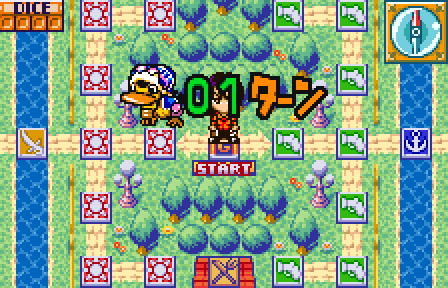
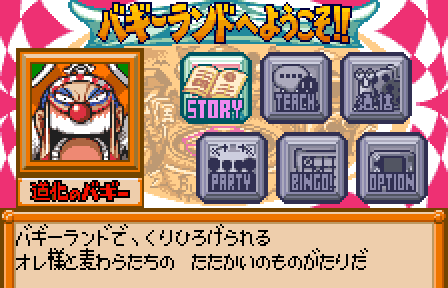
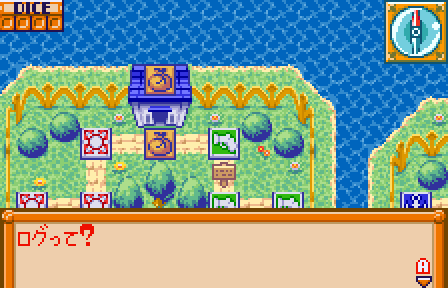
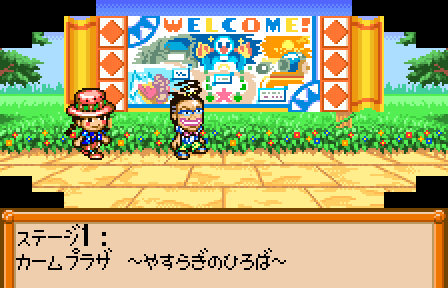
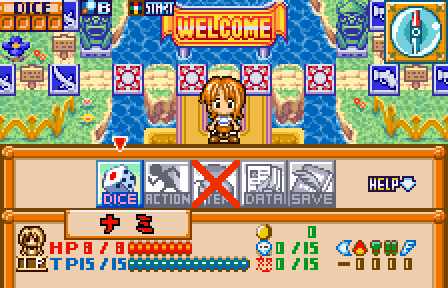
Buggy Land e Youkoso (“Welcome to Buggy Land”) is the sequel to One Piece: Treasure Wars, released by Bandai for the WonderSwan Color on 20 December 2002, a little under a year after the first game. Its development is credited to Graphic Research, as with the first game, though this has not been confirmed. Buggy invites the Straw Hat crew to Buggy Land, an amusement park that covers a whole island, with a fortune promised to whoever finds the key to its treasure.
The rules follow the first game: players roll dice to move around the maps and race to find a hidden treasure. Bandai doubled the number of maps to more than ten and raised the playable cast from six to more than fifteen, Nico Robin among them. Up to four people can play on one WonderSwan, and the cartridge has a built-in LED lamp, which Bandai said was a first in the industry. The game runs on the WonderSwan Color and SwanCrystal.
The story
The Straw Hat crew receive a letter and an Eternal Pose that point the way to Buggy Land, an amusement park that takes up a whole island and is run by Buggy and his crew. The letter promises 1,000,000,000 berries to whoever finds the keys to the treasury in Buggy’s castle. The terms look suspicious, but the crew accept, Nami above all once she sees the size of the prize, and the chance to visit an amusement park does the rest. Buggy built the park as a way to get back at the Straw Hats, so the invitation is a trap from the start.
The park is split into themed attractions, each run by one of Buggy’s allies. Calm Plaza sits at its centre, with a bed of flowers laid out in the shape of Buggy’s face and statues of Mohji and Cabaji. Alvida, who has joined forces with Buggy, runs the Alvida Slider, a slide ride; Cabaji runs Pipe Jungle, a climbing frame; Mohji runs Darkness Island, a horror attraction; and Buggy keeps Buggy Castle, the centrepiece of the park, for himself.
Luffy’s crew, now joined by Robin, are thrown into one chaotic place and fight after another. Hina of the Marines is among the newer characters, and many other figures from the series up to that point turn up without being playable, among them Kuro, Krieg, Arlong, Mihawk, Crocodile and Ace. As in the first game, the story is a light frame for the board game rather than the point of it.
How it plays
Each player picks a character and moves around the map square by square. Normally only one die is rolled, but spending HP or TP lets a player roll two dice or choose the number that comes up. Whenever a single die is rolled, the result is remembered, and the total of the last four such rolls sets off a numbered event.
The treasure is hidden on one square of the map. Passing a signpost by the road gives a piece of information about where it is, shown as one of sixteen marks, and the player uses these clues to narrow the hiding place down and reach it first. A treasure chest does not always hold treasure, and one that turns out to be dangerous can be passed to another character before it does damage. Information and items can be taken from rivals, so a slow player loses them to attacks and traps; unlike the first game, attacks and steals now play out on the map itself. A stage is won by getting to the treasure, or beating the boss, before the other characters do.
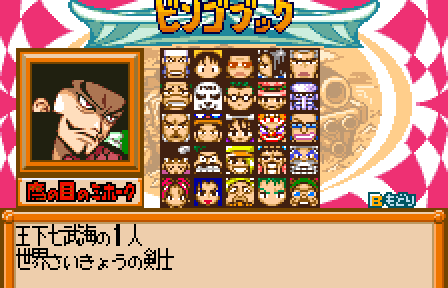
Up to four people can play on one WonderSwan, with Masako Nozawa providing spoken commentary. The LED lamp in the cartridge blinks to show what is happening in the game, so players waiting for their turn can follow along. Besides the main game there is a Party mode, and a bingo board unlocks Smoker and Gaimon as characters for Party mode only. The box recommends the link cable, though what the game uses it for is unclear.
Alone against the computer the game is slow, since every computer-controlled character’s turn has to be sat through, and it is at its best in Party mode with friends. The Japanese text is simple enough to follow without much Japanese.
On the original WonderSwan the cartridge does not run, and shows its own error screen instead, a parody of the scene in chapter 219 of the manga in which Nami apologises to Luffy, Usopp and Chopper.
Development and release
Bandai sold the cartridge at 4,500 yen before tax and promoted it as a much larger version of the first game, with attacks and steals now played out on the map and newer characters such as Hina of the Marines among the cast. The box holds the cartridge, a 36-page manual and a survey postcard, and names the WonderSwan Color or SwanCrystal as required and the link cable as recommended.
Reception
Some players count it the best of the licensed games on the system. It is generally seen as a One Piece take on competitive sugoroku that is easy for children to learn and lively with several people, but that soon grows dull alone, with fewer mini-games than some players wanted and characters that differ more in presentation than in ability.
Ports and other versions
Buggy Land e Youkoso was made for the WonderSwan Color and was never released on another system. Apart from the first Treasure Wars, the only One Piece party or board game of those years is Banpresto’s Mezase! King of Berry, a party game for the Game Boy Advance from 2003, which is a separate work. The LED lamp in the cartridge also ties this game to the WonderSwan hardware it was made for.
Notes
The game is for one to four players. It is sometimes classed under “other” rather than as a board game.