
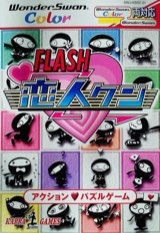
An action puzzle game from Koto and the publisher of the photo weekly FLASH, in which a jilted hero trains at a Love Dojo and wins over suitors by sending them streams of hearts.
Screenshots
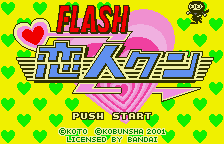
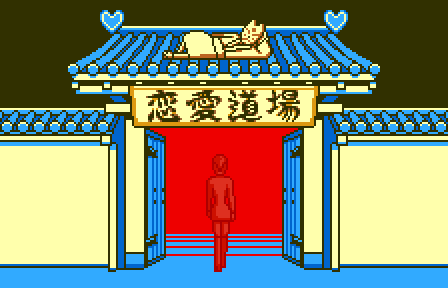
Title screen 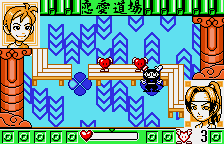
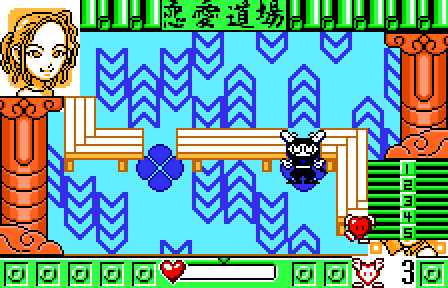
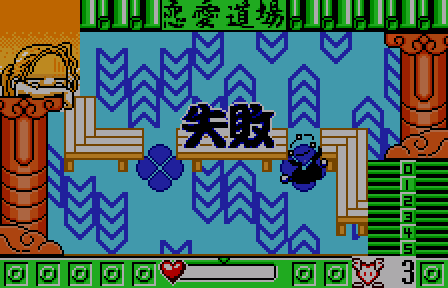
In play 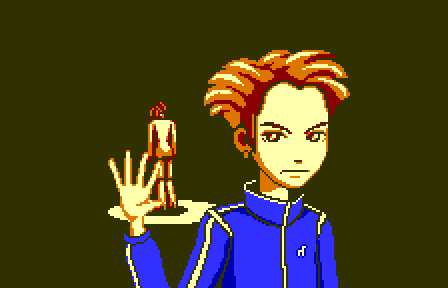
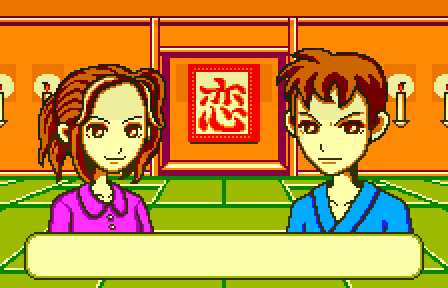
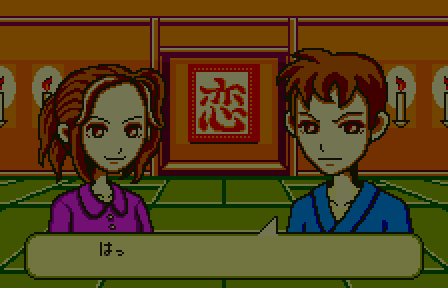
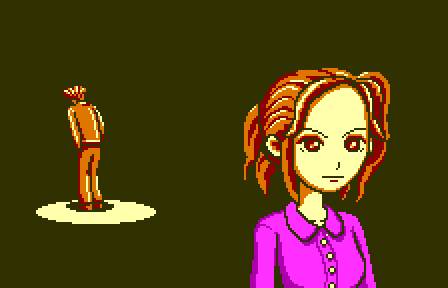
Flash Koibito-kun is a puzzle game released in Japan on 28 December 2000, a few weeks after the WonderSwan Color went on sale. It was published by Kobunsha and developed by Koto, the studio founded by Gunpei Yokoi after he left Nintendo, which had earlier made Gunpey for the WonderSwan.
Dumped without warning, the hero trains at a Love Dojo and then sets out with the cupid Shashamaru to win new sweethearts. The game turns each courtship into a puzzle about guiding a stream of hearts along a path full of holes.
The cartridge was made with the WonderSwan Color in mind but also plays on the original black-and-white WonderSwan. Being released at the end of December 2000, it was one of the first games to appear after the launch of the Color.
The story
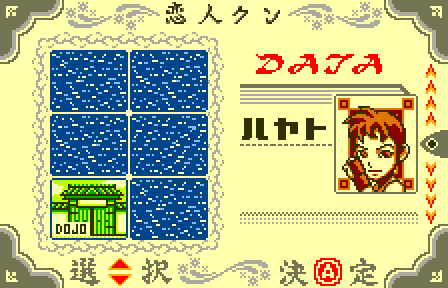
The game opens on a breakup. The hero is told goodbye out of the blue, drifts through the streets and ends up at a mansion called the Love Dojo. Waiting inside is the Love Hermit, a figure in a suspicious mask, who offers to teach the secrets of love, and the training starts there. The hero can be a man or a woman: the game takes the sex from the personal data stored in the console, and asks on the title screen when none has been entered. The suitors are always of the other sex, and apart from the one-point love advice the dialogue barely changes between the two.
After the training, the hero sets off with a partner, the cupid Shashamaru, carrying the kit earned at the dojo: the love gear, a digital camera for photographing each new sweetheart, a mobile memo pad for keeping notes and a map that shows the way. The task is to send passion hearts to each person and make them feel how strong the hero’s love is. Shashamaru, dressed as a ninja, is the one the player actually steers.
The whole thing is framed as the work of FLASH, Kobunsha’s weekly photo magazine, which covers everything from politics and the economy to show business and sport and was then sold every Tuesday for 250 yen. The manual presents the game as having the magazine’s full backing.
The story mode runs through five areas, starting at the Love Dojo, with three suitors in each, fifteen in all. The first is the dojo’s own teacher; people met in the street follow, and further on the cast grows stranger, with aliens among the suitors. The tone is broad comedy. Suitors who sneer at the hero at first turn devoted once their hearts are won, and the love advice is often odd, such as telling the player to spend a day dressed as a woman or to put the game down and go outside to meet people.
How it plays
The console is held horizontally. The four X buttons move Shashamaru between the holes, and the Y buttons are not used. Holding A makes him hold the hearts back; if he is moved to another hole while A is held, he goes back to the first hole by himself when the X button is let go. B calls up the next heart. The hero’s portrait sits on the left of the screen and the suitor’s on the right, with Shashamaru working between them, the love meter along the bottom and the number of sincere hearts still to deliver in the bottom right corner.
Hearts travel along a winding path from the hero to the suitor, and the path is broken by holes. When Shashamaru stands under a hole he holds up the hearts passing over it automatically. A heart that reaches an open hole hangs in the air for a moment and then drops, but if Shashamaru gets under it in time it sprouts wings and flies across. Flashing sincere hearts come along among the ordinary ones, and a stage is cleared once the required number of them has reached the suitor. Each heart that falls makes the suitor lower a shutter a little further over their heart. Six dropped hearts shut it completely, and the game is over.
Holding hearts back is the key to scoring. A held heart links with the ones coming up behind it, and linked hearts score many times what a single heart does. When a sincere heart leads a chain of ten, the chain becomes a big heart, which scores heavily, counts as two sincere hearts and opens the shutter all the way again. Each sincere heart delivered also calls up the Love Hermit, who picks at random between a helping move and a piece of mischief.
The love meter climbs quickly on high scores. Its level when the stage is cleared sets how the suitor feels about the hero on a three-step scale, and their lines change to match; a full meter also earns the one-point love advice. A stage ends as soon as the last sincere heart arrives, so long chains built before then are the way to fill the meter. Any suitor can be replayed as many times as the player likes.
The Love Hermit teaches three techniques along the way. A held heart stays in place for a moment after A is released, which lets Shashamaru link hearts and support them at the same time. Darting quickly between two holes lets a chain cross both, which is essential for long chains. On stages where the holes sit close together, stopping the hearts and supporting them again and again keeps them hovering over the gaps.
Koibito-kun is the story mode, and clearing it once opens three more. In Tatsujin-kun, the mission mode, the Love Hermit sets tasks that differ from area to area, and clearing an area’s three stages in a row moves the player on to the next. Tetsujin-kun is an endless mode played for score; after a game over, choosing the Hermit card on the continue screen allows one continue without losing the score. Taisen-kun is the two-player contest and needs two cartridges, two consoles of either model and a link cable. A match runs over three stages, two chosen by the players and one at random, and the first to win two takes it. A stage goes to whoever clears it first or whose opponent reaches game over, and sending over a chain beyond a certain length brings out the Black Hermit on the other side to make trouble.
The cartridge keeps its records in backup memory. A records mode shows the best scores in Koibito-kun and Tatsujin-kun and the top six of the Tetsujin-kun ranking, and can also erase them; holding Y3 and Y4 while switching the console on wipes the saved data. The game is easy to finish but hard to master.
Development and release
The game takes its name from FLASH, the weekly photo magazine that Kobunsha publishes, and Shashamaru, the ninja-suited mascot of the magazine, is the character the player controls. Bandai presented it as a new puzzle game made by the magazine, and promised that the puzzle side could be trusted because Koto had developed it. The cartridge, priced at 3,800 yen, plays in stereo, saves to 16 kilobits of EEPROM, and carries a joint Koto and Kobunsha copyright line dated 2001.
Secrets and extras
Winning over every suitor with a full gauge unlocks a hidden extra suitor, a goddess. There is a useful trick for players chasing full gauges: one or two dropped hearts do not end the round, so letting a sincere heart fall on purpose delays the end of the round and leaves time to fill the gauge.
Reception
The game is little known but regarded as fun, and in 2021 it was featured in a Japanese column on unusual dating games. Its heart puzzle is considered original, with a balance that makes the game easy to finish but hard to master, while the strange story, the sudden changes of heart and the odd love advice are seen as what really make it stand out.
Ports and other versions
Flash Koibito-kun was made for the WonderSwan and was never ported or re-released. It belongs to no series on other machines; its nearest relative is Koto’s earlier WonderSwan puzzle game Gunpey, from which it stands apart by tying its puzzle to a dating story and to the mascot of a photo weekly.