

Bec's second WonderSwan hamster game: Saffron lives in real time and can now go out to forests, lakes and hills, draw mail and play mini-games; it also runs in black and white.
Screenshots
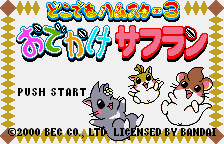
Title screen 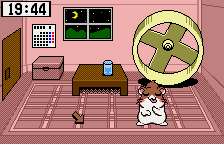
In play 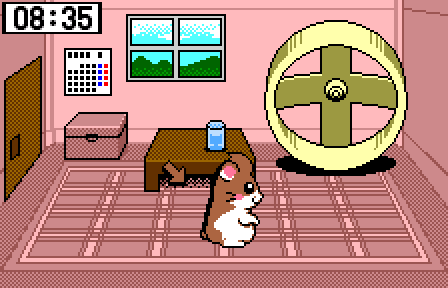
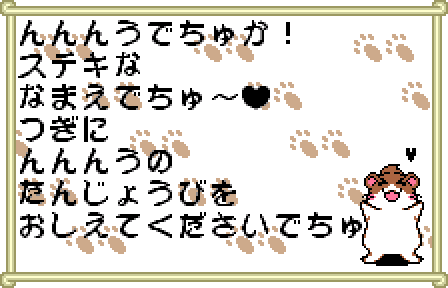
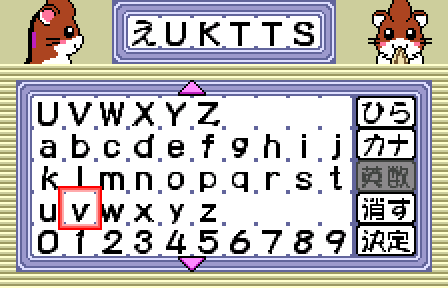
Dokodemo Hamster 3: Odekake Saffron is a pet-keeping game from Bec, released in Japan on 14 December 2000, five days after the WonderSwan Color went on sale. It is the third game in the Dokodemo Hamster series and its second on the WonderSwan, following the first Dokodemo Hamster from January 2000; the second game in between came out on the PlayStation. The subtitle means “Saffron goes out”, after the Djungarian hamster who stars in both WonderSwan games.
As before, the hamster lives in real time and the player is its owner, but this time it can be taken out of the house: walks in the forest, trips to the lake, mountains and grassland, shopping and games of ball. Indoors there are things to do that have nothing to do with the hamster, such as redecorating the room or writing and drawing on sheets of paper.
The game was one of the first cartridges made for the WonderSwan Color, but it is a colour-compatible title rather than a Color-only one, so it also plays on the original black-and-white WonderSwan.
The story
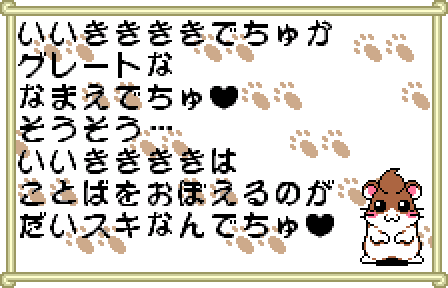
As in the first game there is no plot to follow, but the hamster now has a name and a family. Saffron is a Djungarian hamster, a big eater who loves sunflower seeds and ends his sentences with the baby-talk “dechu”. The series pictures him as a mischief-maker with a strong sense of justice who cannot stand bullying and often lands himself in trouble. His older sister Nibo, a Campbell’s hamster, introduces the game on the official site and calls him its hero.
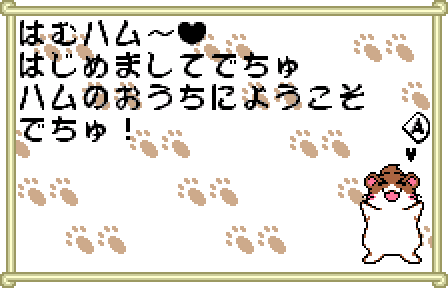
The first game never let the hamster leave its cage. Here Saffron lives in a room of his own, with a table, an exercise wheel, a window and a door, and the door leads out into a wider world of forest, mountains, lakes and grassland. Out there he runs into Nibo, into Kyaro, the Roborovski hamster who leads the Nakayoshi comic, and into new hamster friends, who chat with him and set him quizzes. Bec planned for characters from the PlayStation’s Dokodemo Hamster 2, from the series’ i-mode phone service and from the comic to turn up.
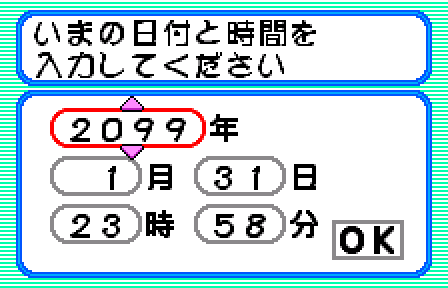
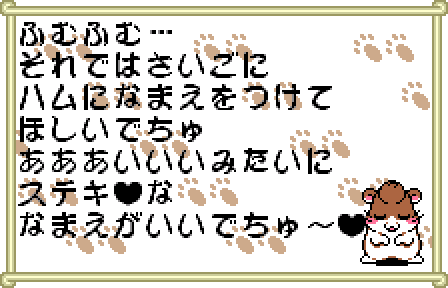
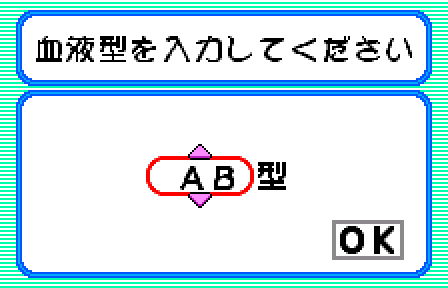
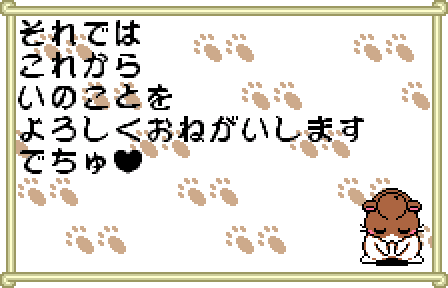
The player is Saffron’s owner and starts by entering their own name and birthday. Day and night follow the real clock, the window shows the night sky after dark, and events happen at any hour, even in the middle of the night. Saffron’s cute way of speaking sets the tone.
How it plays
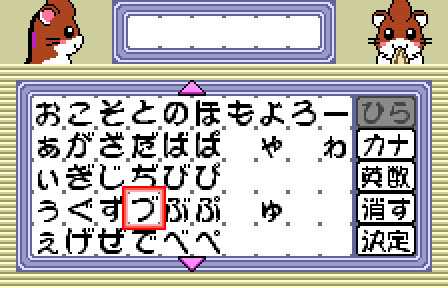
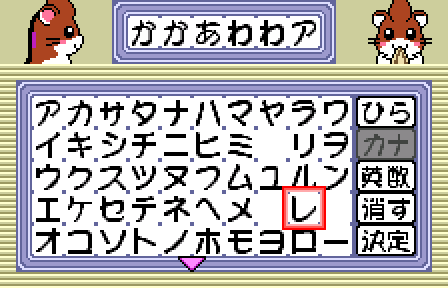
The game is played with the WonderSwan held horizontally, and everything is done with a cursor: moving it over the hamster, the calendar or another object in the room brings up a menu of what can be done with it. The name can be entered in hiragana, katakana or English letters, and the birthday as a month and day. A clock on screen shows the real time.
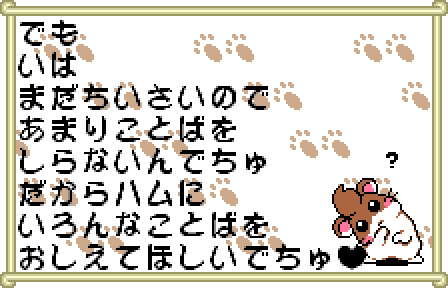
Pointing at Saffron opens a talk menu. The player can teach him a word, ask him to tell a story, offer him something to eat, suggest a game, or ask him to tell a fortune. Saffron also asks questions of his own, for instance wanting to hear more about a topic and offering a list such as idols, comedians, actors, athletes and musicians to pick from.
A box menu holds the rest of the care and the house: food, a broom for cleaning, the calendar, the door for going out, paper for drawing, and three slots shown as question marks at the start. Redecorating lets the player choose the colour of the room. A status screen shows how many days the two have been together, a closeness rating called shinmitsudo, and stars that mark how much of the game has been completed.
Going out opens a map of an area such as the East Forest, with the house in it and arrows pointing in four directions. At forks Saffron asks which way to go, for example the path with a view of the lake on the left or the one with a view of an open square on the right. Scenes include the forest, a mountain at night and a lakeside, and this is where the other hamsters are met.
Mail has changed from the first game: instead of only reading what the hamster writes, the player can draw mail on the WonderSwan’s screen. The drawing tool has a pencil, six colours, an eraser and stamps, both simple shapes such as circles and bars and pictures such as a house, a tree or a mountain. Special and rare stamps are won in events during the game. Drawn mail can be sent to friends, and the game supports the link cable for two players.
There are three mini-games, Ham Catch, Ham Puzzle and Ham Racing, and a hamster shrine that gives the day’s fortune, an omikuji fortune slip or a compatibility reading. Because the cartridge is colour-compatible, all of this also works on a black-and-white WonderSwan.
Development and release
Like the first game, Odekake Saffron was made and published by Bec, the Bandai-owned studio. It arrived in the middle of the Nakayoshi comic’s run, which began in September 2000, and three months after the PlayStation’s Dokodemo Hamster 2.
Ports and other versions
Odekake Saffron was made for the WonderSwan Color, though it also plays in black and white on the original WonderSwan, and it was never ported, remade or re-released. It is not a version of an earlier game but the series’ third entry, following Dokodemo Hamster on the WonderSwan and Dokodemo Hamster 2 on the PlayStation. What sets it apart from the first WonderSwan game is that Saffron can leave the house, for walks, shopping and ball games.
Later history
This was the last Dokodemo Hamster game on the WonderSwan. The series continued on the PlayStation with Dokodemo Hamster 4: Doki Doki Sugoroku Daibouken! in July 2001 and Dokodemo Hamster: Bikkurick Tankentai in February 2002, and Bec was merged into B.B. Studio in 2011.