
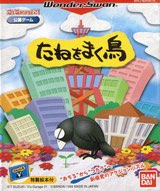
A gentle vertical puzzle game from the TV Asahi programme D's Garage21: steer drops of water down a ladder to make a lonely crow's seeds bloom.
Screenshots

Title screen 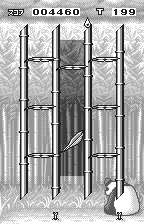
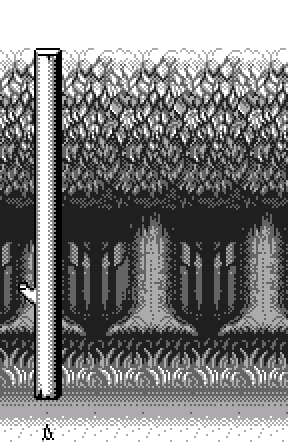
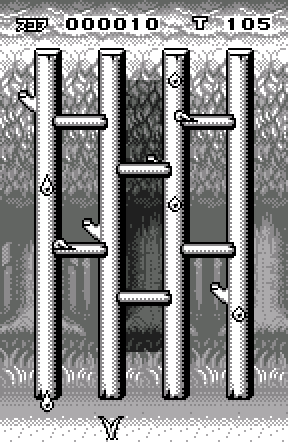
In play 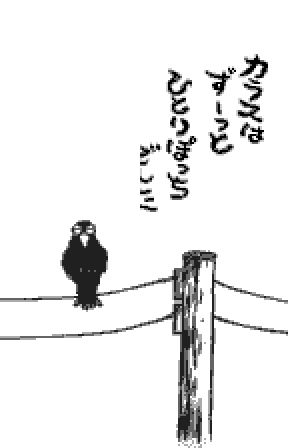
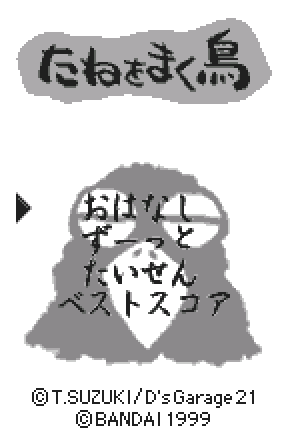

Tane o Maku Tori, “the bird that sows seeds”, is a WonderSwan game that began as an entry to D’s Garage21, a late-night TV Asahi programme that ran from April 1999 to March 2001 and set out to discover the creators of the coming century. Viewers sent in artwork, game concepts and other proposals, and the show tried to turn the best of them into real products. This game, labelled a “koubo game” or open-call game in its title, is one of the results. Bandai published it on 22 December 1999 at a price of 2,980 yen.
The game is a falling-water puzzle with a story mode, an endless mode and a link-cable versus mode, played with the console held upright.
The story
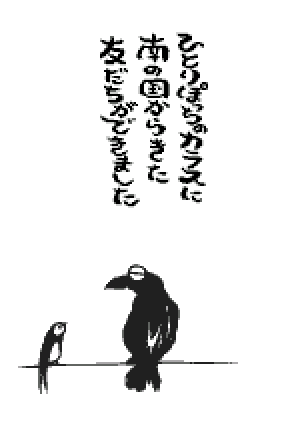
The story is small and gentle. A crow has always been alone until a bird from the southern lands becomes its friend, and the two spend a happy summer together from morning to evening. When summer ends the friend, a migrating bird, has to fly south again, and before leaving it promises to come back once everything is full of flowers.
Left alone again, the crow decides that if the mountains, the fields and the town are all covered in flowers, its friend is sure to return. It takes seeds in its beak and flies up into the sky, carrying them through rain, wind and snow until it is worn and ragged. The game’s opening tells this much in short, simple lines, in the voice of a children’s book.
The picture book that came with the game makes the friend a swallow, and the crow and the swallow are the two characters of the tale. The book was written by Kenichi Takashima and drawn by Seiko Toda, and its pictures also appear in the game.
The story mode tells the rest of the tale in scenes between its eight stages, and the game keeps its ending for those who clear the last one. It is a quiet story about friendship and waiting for someone to come back.
How it plays
The WonderSwan is held upright for this game. Y1 and Y3 choose which of the columns to work on, Y2 and Y4 slide that column’s rungs up or down, X3 confirms and makes the water drops run faster for as long as it is held, X4 cancels, and Start begins and pauses the game.
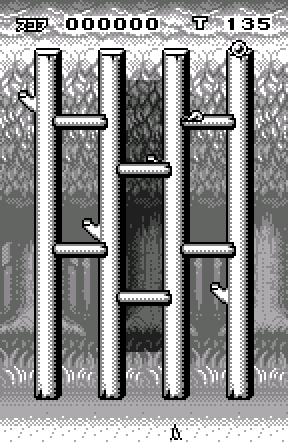
The field is a ladder lottery of three columns, which stays at three throughout. Drops of water trickle in from the top and follow the rungs down towards the crow’s seeds at the bottom, and the player slides the rungs to steer them. A seed that keeps getting water sprouts, forms a bud and then blooms, and a stage is cleared when every flower on it has bloomed. Later stages have more seeds to look after and more pests in the way.
Drops that meet merge into a bigger drop, which is worth more points and, once it is big enough, can wash away a pest. The largest size is a trap: a drop that grows that far no longer follows the ladder and falls straight down where it is, scoring nothing, although it can still knock out a pest. Making bigger drops therefore pays only up to a point.
The pests crawl along the same paths as the water but can move up as well as down. A pest that reaches a flower eats it, and losing a flower ends the game. A pest that runs into a drop soaks it up, which can be used to hold a pest back, and each stage’s results show the share of drops that reached their target. Moving the top rungs down sends drops along quickly, but it carries the pests along just as fast.
The story mode has eight stages. After a game over the player continues from the stage they were on, so the story can be finished without much trouble by anyone who does not chase high scores, while a high score needs real skill. Clearing all eight stages without continuing opens a special stage with a darker, eerie look, which is not especially hard. The endless mode runs until the game is over, and two consoles joined by the link cable can play a versus mode.
Development and release
Bandai’s announcement called the game a new kind of action puzzle and summed up its idea as a shift from things that fall to things that trickle along a path. The copyright line names T. Suzuki together with D’s Garage21 and Bandai, but no development studio is credited, and the developer is unknown. The box came with a picture book that tells the story of the story mode, a sturdy board book whose illustrations also appear in the game.
Modes and features
The game has three modes: the story mode of eight stages with story scenes between them, the endless mode, and a versus mode for two players with two consoles joined by the link cable. The box also held the picture book of the story.
Reception
Players at the time found the game easy to pick up and kept coming back to it, but felt that it played more like an action game than a puzzle, since steering pests away was usually enough and the reward for building big drops was small. Magazines presented the ladder idea as new, though earlier games had been built on the same idea. Later opinion has been warmer, praising the vertical screen, the ink-wash style art that suits the monochrome display and the simple, clear rules, while noting that chasing high scores is far harder than finishing the story.
Ports and other versions
Tane o Maku Tori was made for the WonderSwan from an idea sent in to the programme, and it was never ported or re-released on another system. It belongs to no game series. Two other works are connected with the show, Another Heaven: memory of those days and the budget title SIMPLE 1500 Vol. 53 THE Helicopter, but both are separate games.