
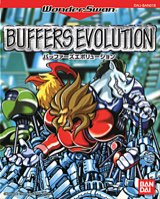
A near-future action race by Koto, the company Gunpei Yokoi founded: animal cyborgs change form to race against the clock over 18 branching side-scrolling courses.
Screenshots
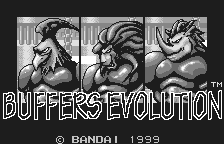
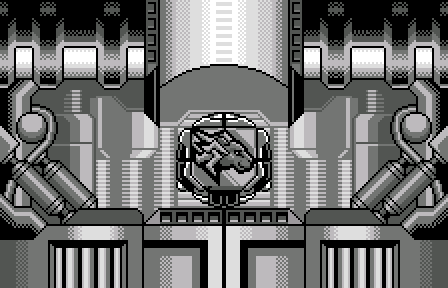
Title screen 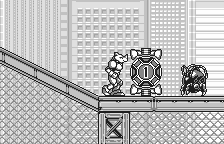
In play 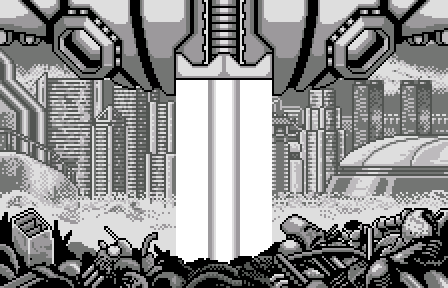
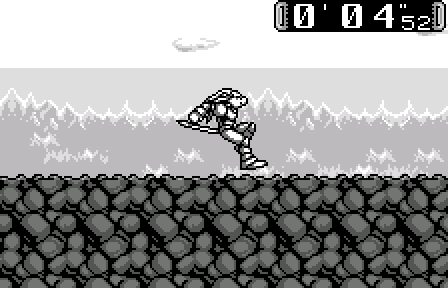
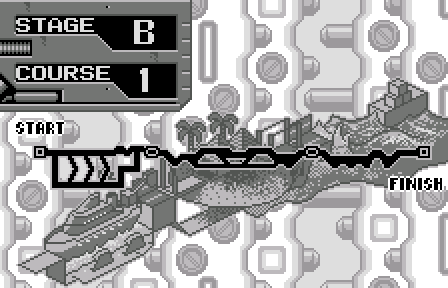
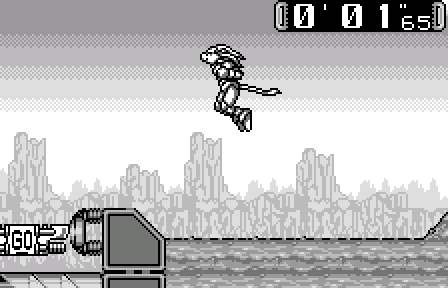
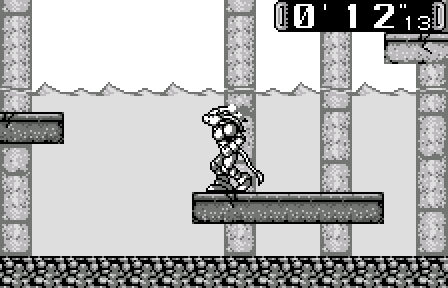
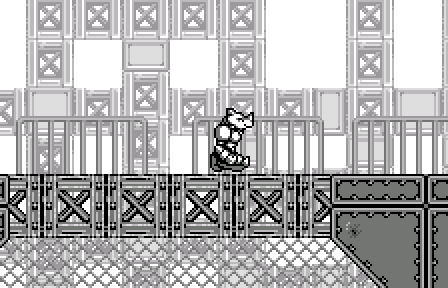
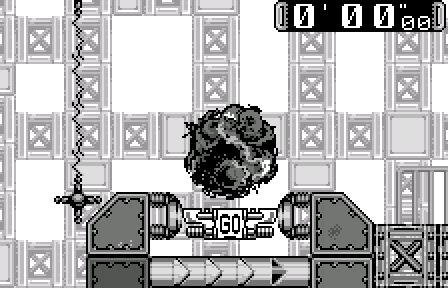
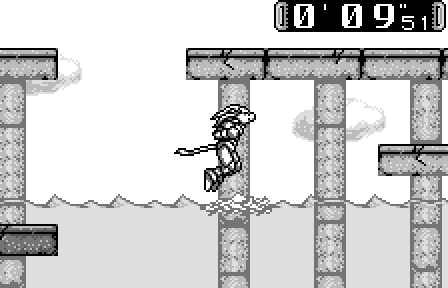
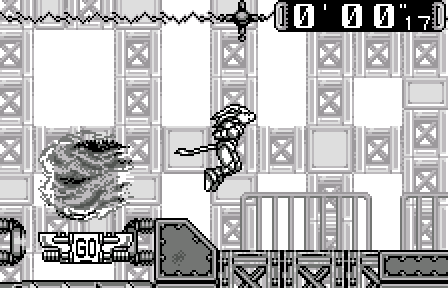
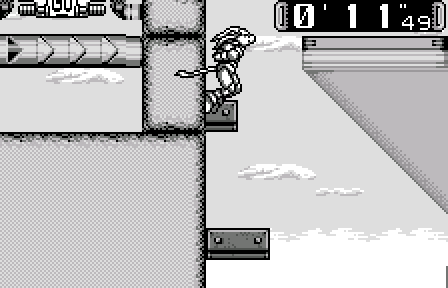
Buffers Evolution is an action racing game for the WonderSwan, released by Bandai on 9 December 1999. It was planned and developed by Koto, the company founded by Gunpei Yokoi, whose main games for the original black-and-white console were this one and the puzzle game Gunpey. The studio is also known in English as Koto Laboratory.
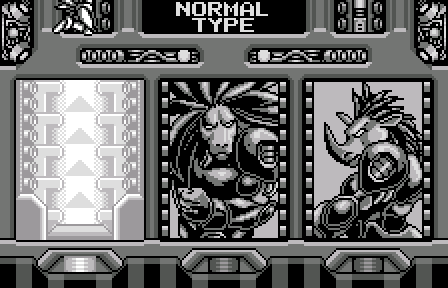
The game is set in the near future. The player picks one of three animal cyborgs, a bird, a lion and a rhinoceros, and runs it through side-scrolling courses for the best time. At the press of a button the racer turns into a hard metal form, the buffer of the title, so the game is partly a platformer as well as a race.
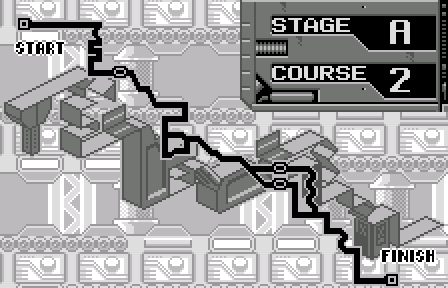
Lap times depend on more than reflexes. The choice of cyborg, the items used and the branch taken at each fork in the course all change the result, so planning a route is part of the game.
The story
The world of Buffers Evolution is an Earth left in ruins, where the courses run through jungle, desert, old factories and wastelands of scrapped machinery, each one fenced in by electric barriers. In this future a gambling syndicate has found a way to profit from the wreckage. It fuses the traits of animals with machine parts to build three beast-like cyborgs, based on a bird, a lion and a rhinoceros, takes bets on them, and sends them through hostile mazes of scrap metal while a crowd looks on.
The three racers are the only characters. They are bulky, muscular figures that run on two legs, salvaged from the junk heap to compete, and the lion and the rhinoceros have fixed, glaring eyes that sit oddly with their armoured bodies. Each is built for a different kind of race: the bird is light and jumps highest but cannot take much punishment, the rhinoceros is tough but slow, and the lion sits between them.
That framing is all the story there is. The game tells it through its setting rather than through scenes, and once a cyborg is chosen the rest is course after course, with no plot that develops along the way and no special ending waiting at the finish. The tone comes from the contrast between the bleak premise, animals rebuilt as gambling stock, and the brisk, cheerful music and toy-like feel of the racing itself.
How it plays
The console is held horizontally, and the view is from the side. The cyborg runs, jumps and slides, and the jump comes in a small and a large height; even the small one is high, and the cyborg needs a run-up to jump any distance. A button turns it into the buffer, a hard metal shape that smashes enemies on contact and bounces off in a chosen direction, which is the way up to high ledges. Enemies are seldom a real threat and mostly serve as bumpers to bounce from, and only two kinds fire shots.
Each course is a race to the finish with no time limit, only a clock. The ten parts scattered over a course also repair damage, and collecting all ten adds a new form to the cyborg’s kit. Courses usually split into upper, middle and lower routes, a few of the later ones run in a single line, and one run takes from about one to five minutes. The cyborg is seldom knocked out of a race, but damage makes it misbehave: a battered cyborg shorts out at random, which cancels its current form, and the more damage it has taken the more often that happens.
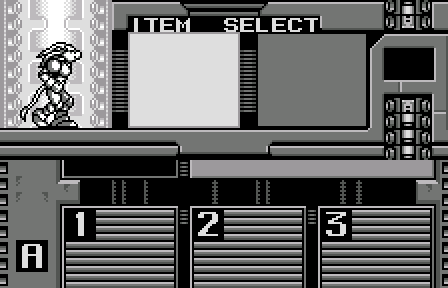
The forms are the heart of the game. Among them are a unicycle wheel, a plane, a board for riding slopes, a fish tail and a torpedo for water, drill arms that can cling to walls, a bulldozer, a rocket that shoots upwards, a large shield, a five-way shot, a weight and forms that break blocks. Only two or three can be fitted to a cyborg at once (the exact number of slots is not certain), and the form needed to reach a given part often only becomes clear on the spot, so a course tends to be run more than once. The unicycle comes after the first course and is one of the most useful forms, while the shield and the shot do little to cut a time.
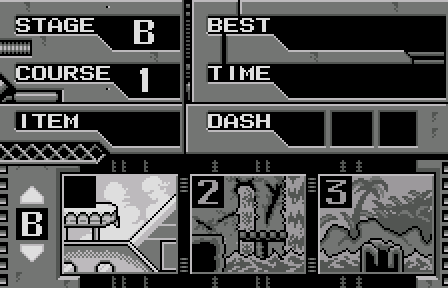
Choosing the cyborg and its forms to suit the course is the planning side of the game. Some courses favour pure speed, others are close to puzzles, and there are underwater stretches, a waterfall climb on narrow footholds and sandstorms that throw the cyborg about. There are 18 courses, numbered A-1 to F-3: nine main courses, then nine more that reuse the same layouts with the start and finish swapped, so the second half is quick to learn. The cartridge saves the best time for every course, and the result of each run is also shown as a rating.
Beating a course’s target time plays a demonstration run, a staff ghost that shows the fastest route and the form combinations that make it work, and it also gives away where the hidden items lie. The runs come in grades, from a beginner class up to gold and super, and clearing a course to the top grade earns the Great Player award for it. Each course also hides three pieces of a power suit. Hunting down the last missing part on a wide course can take a long time, which is the game’s most common complaint, but that early searching doubles as learning the map for the time attack that follows.
The game is not hard to finish. The real challenge is the time attack, where the timing is strict and the super grade demands near-perfect routes. At the top grades the plane ends up doing most of the work and the jump becomes a helper move. The gold run on the underwater course is built around the torpedo, course C-2 rewards the awkward but very fast board over the plane, and F-2 is where bouncing twice off enemies in a row comes into its own. A separate mode, S.S, sets the cyborg loose in tight spaces packed with blocks to clear out enemies quickly, without a target to aim for.
Development and release
Koto handled both planning and development, with Bandai as publisher. Bandai presented the game as a fast-scrolling action race of a kind earlier handhelds could not manage, with difficult courses that scroll both vertically and horizontally. Some courses reward pure speed and others lean towards puzzles, and Bandai stressed that the racer can be set up to suit each one. The cartridge saves to a small EEPROM, and the game supports the link cable, though what the link is used for is not known.
Modes and features
The main game is the series of timed courses, with S.S as a separate mode. Beyond the target times there is the demonstration run for each course, which teaches the techniques for cutting time and so works as a built-in guide. Three composers are credited for the sound.
Secrets and extras
The hidden items are pieces of a power suit, and collecting all of them gives the cyborg a faster suit that roughly doubles its normal running speed. A faster version of the plane form is unlocked after the last course. The demonstration runs come in grades, from a beginner class up to gold and super runs with their own music; the staff roll follows the super replay and can be paused by holding Start, and clearing every course to the top grade earns a Great Player award rather than a special ending.
Reception
Opinions are mixed. It is seen as an overlooked good game that suits players who care more about cutting times than about simply finishing, its music is praised, and players who grew up with it remember it fondly. Fans single out the soundtrack and sound effects and liken the music to Konami’s action games, though others find the jumping awkward and the game overrated. Some who tried it later have found an obstacle-course race too thin and lost interest quickly.
Ports and other versions
Buffers Evolution was made for the black-and-white WonderSwan alone, and it was never ported, remade or re-released. It stands apart from the rest of Koto’s output in that way. Gunpey, the studio’s other game for the original WonderSwan, was followed by later Gunpey titles for the WonderSwan Color, the Nintendo DS and the PSP, while this racing game had no follow-up on any system.