
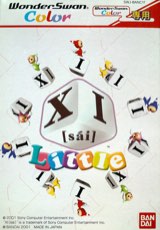
A WonderSwan Color version of Sony's dice puzzle game XI, known abroad as Devil Dice, with the PlayStation modes, a link-cable battle and a new rhythm mode.
Screenshots

Title screen 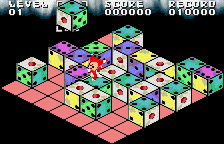
In play
XI Little is a handheld version of XI, the action puzzle game that Sony Computer Entertainment released for the PlayStation in 1998 and that was sold in North America and Europe as Devil Dice. Bandai published it for the WonderSwan Color on 20 December 2001, with Sony Computer Entertainment credited for planning, cooperation and supervision.
The player guides the small devil Aqui across a field of dice, clearing them in groups before the field fills up. The cartridge has the three modes known from the PlayStation, Trial, Battle and Puzzle, with 1,000 further puzzle stages after the first 100, and adds a fourth mode made for this version, Aqui-chan’s Dice de Dance, which brings music into the rules. Battle and Dice de Dance can be played against a friend with two consoles joined by the link cable. The game needs a WonderSwan Color or SwanCrystal.
The story
XI Little has no story. It is an action puzzle game, and its only character is Aqui, a small, cute devil who moves around on top of giant dice the way a circus performer balances on a ball. In the PlayStation original the character had no name in the manual and was simply called the little devil; this cartridge calls the character Aqui-chan on its official pages and in the title of its new mode.
The dice fill a field seen from an angle above, with pink floor tiles under them and the level, score and record shown along the top of the screen. The dice faces come in several colours, and each number is marked with dots as on an ordinary die.
The Dice de Dance mode gives Aqui more to do. Two Aquis, one red and one yellow, stand on small fields side by side and dance to music, and Aqui raises one hand, throws both arms up in a cheer or spins round in place depending on where the dice are cleared, eight poses in all.
How it plays
The game is played with the console held sideways. The rules are the same as in the PlayStation game. Aqui can stand on top of a die and roll it like a ball, which turns a new face upwards each time it moves one square, or walk on the floor and push dice along. To climb from the floor back onto the dice, Aqui steps up on a die that is sinking or one that is just rising out of the floor. New dice keep coming up out of the floor at intervals, and the game ends when the field is full.
Dice are cleared by joining them vertically and horizontally. When at least as many dice as the number on their top faces touch one another, such as four dice all showing four, the group starts to sink and disappears. A sinking die is still part of the field for a while, and pushing or rolling a die with the same number against it adds that die to the group, a rule called a chain. A die showing one cannot be cleared in the usual way. Instead, joining a one to a sinking one makes every other one on the field vanish apart from the one under Aqui’s feet, a rule the game calls Happy One.
Trial is the basic mode, played for a high score by clearing dice efficiently. Endless lasts until the field is full, Time Limited runs for three minutes, and Exhibition is a two-player game in which both players clear dice together, which can only be chosen when two consoles are joined by the link cable.
Battle is a contest over the numbers one to six. A number a player clears becomes that player’s, and the rival can take it back by clearing that number again; the numbers won are recorded in a gauge at the top of the screen, and whoever fills the gauge first wins. On the menu screen the X2 and X4 buttons raise or lower the size of the gauges, which serves as a handicap. VS MAN is a match against a person and needs the link cable, VS COM is a match against the computer, and VS COM2 is a harder computer opponent against which only the player’s own gauge can be changed. A setting adds a time limit of three or five minutes or none.
Puzzle sets a field of dice and a number of moves. Clearing every die within that number clears the stage, and failing sends the player back to the start of it. As a hint the die to clear first is shown in the bottom right corner of the screen. On the stage select screen solved stages are shown in yellow together with the number of moves used, and unsolved ones in white. Clearing all 100 normal stages brings out 1,000 further puzzle stages made for the WonderSwan version.
In Dice de Dance, dice rise from below towards a frame, and the player has to roll a die on the field to show the same number before the rising die fits into its frame. Rolling at exactly the right moment, so the die drops neatly into the frame, doubles the score. The squares of each field are marked plus one, plus two or plus three, and the number of points depends on the square where the number is shown. Each success shifts a shared gauge towards the player’s own colour, but if the rival scores on a richer square the player still loses ground: a player who gains one point while the rival gains three is pushed back by two. Every success adds one to a counter, and the first side to reach six is given a new field with more plus-three squares. When the music ends the side with more of the gauge wins, and if the gauge is pushed all the way to one side the game ends at once. The mode can be played against the computer or against a second WonderSwan Color.
When each mode ends the game asks whether to save the data, and asks again before writing over an earlier save, which is then lost. Playing over the link cable needs two WonderSwan Color consoles and two copies of the game.
Development and release
Bandai published the game, while the copyright belongs to Sony Computer Entertainment, which is credited with planning, cooperation and supervision; Bandai handled both publishing and distribution. The developer is unknown. It is sometimes credited to Shift, the studio that made the PlayStation XI games, though this has never been confirmed, and Shift’s own list of works, both in 2006 and today, names only its PlayStation and PlayStation 2 games. The colour-only cartridge holds 16 megabits with 256 kilobits of save memory and sold for 3,800 yen before tax.
Ports and other versions
The game XI Little comes from first appeared on the PlayStation in Japan on 18 June 1998 and reached North America and Europe as Devil Dice later that year and early the next. The WonderSwan cartridge is a cut-down handheld version released by Bandai in Japan only. It keeps the Trial, Battle and Puzzle modes, but not Wars, the PlayStation party mode for up to five people with a multitap; on the WonderSwan, play against another person is limited to two consoles on the link cable. In return the cartridge adds the 1,000 extra puzzle stages and the Dice de Dance mode, the one mode added over the PlayStation game.
The PlayStation original was reissued in Japan as a budget PS one Books edition in October 2001 and was later included on the PlayStation Classic in 2018. Versions of XI also appeared for Japanese mobile phones, among them a 3D edition called XI DX, and XI COLOSSEUM came out for the PSP in 2006, with content close to the first game and graphics nearer to the later XI GO. The series’ sequels, XI JUMBO on the PlayStation in 1999 and XI GO on the PlayStation 2 in 2002, sold abroad as Bombastic, are separate games. XI Little itself was never re-released.
Notes
Bandai ran online score tournaments for the game through a dedicated ranking site that could be reached from a computer or an i-mode phone. A player took a public password from the site and entered it under the LINK option to unlock a special tournament stage, and the password shown at the end of that stage was then registered on the site to join the national ranking. The mode changed from one tournament to the next: the first was decided on Time Limited scores and its winner received a PlayStation 2, and a later puzzle tournament was won not by the fastest time but by whoever finished in seventh place.