
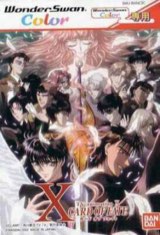
A card battle adventure based on CLAMP's X, in which the player takes one of fourteen Dragons of Heaven or Earth to defend or destroy Tokyo's barriers.
Screenshots
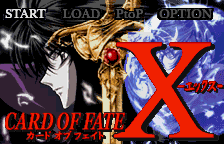
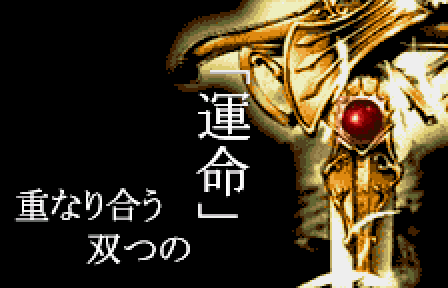
Title screen 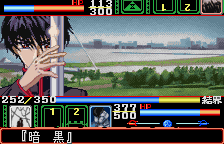
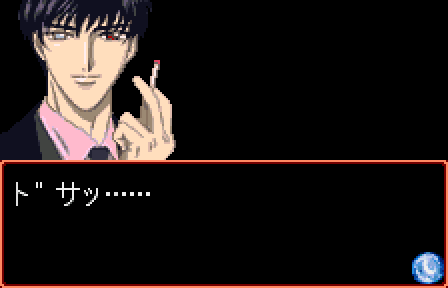
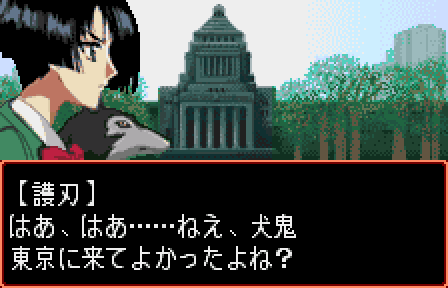
In play 
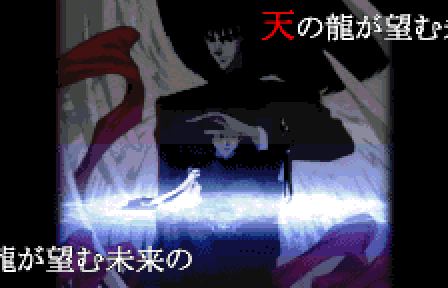
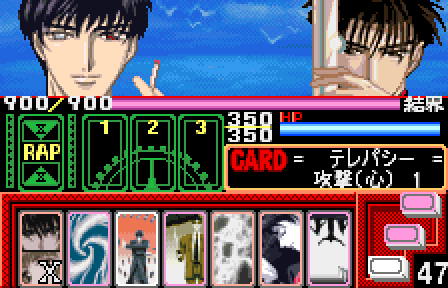
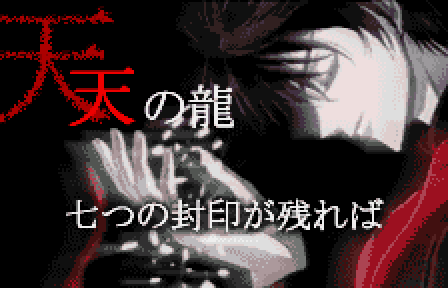
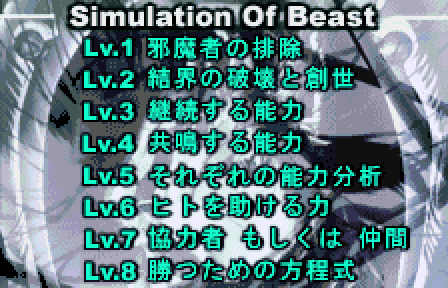
X: Card of Fate is a card battle adventure game based on X, the manga by the artist group CLAMP, and carries the copyright of the X television anime as well. Bandai published it for the WonderSwan Color on 27 June 2002, and Bandai described it as the first time the manga had been made into a game. The development is credited to Access.
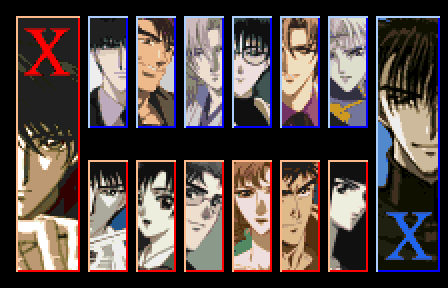
At the start the player chooses one of fourteen characters from the seven Dragons of Heaven, who protect the world, and the seven Dragons of Earth, who want to destroy it so that the earth can be reborn, and follows that character’s story across the wards of Tokyo in conversations and card battles. More than 250 cards, all drawn from the world of X, can be won, combined and traded, and two players can battle or trade with two consoles joined by the link cable. The game needs a WonderSwan Color or SwanCrystal. First copies came with a mobile phone strap carrying an illustration newly drawn by CLAMP.
The story
The game opens with a short prologue. Tokyo, it says, is the wedge that holds the earth up, and the city is full of barriers raised by people. The power behind those barriers is the Dragons of Heaven, also called the Seven Seals, and the power that breaks barriers and brings the world to ruin is the Dragons of Earth, led on by those called the Seven Angels. Only the Seven Seals, who guard the barriers, can stop it. The prologue then turns to the player: this future can still be changed. The name Kamui has two meanings, one who carries out God’s power and will to save the world, and one who hunts down those granted God’s power and destroys the world, and Kamui can become either.
Kamui Shiro is the one who holds the key to the earth’s future, and the story begins as he sets foot in Tokyo for the first time in six years to obtain the divine sword. Fuma Monou is his childhood friend, a kind young man devoted to his younger sister, whose nature turns around completely once he awakens on the side of the Dragons of Earth.
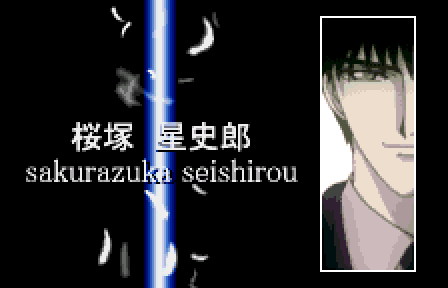
The other twelve come from the same cast and each has a short introduction. Arashi Kishu lost her family at seven and was raised as a hidden shrine maiden at Ise. Subaru Sumeragi is the head of the Sumeragi clan of onmyoji and fights with paper charms, while Seishiro Sakurazuka belongs to a rival onmyoji family and fights with shikigami and spells. Yuzuriha Nekoi is the granddaughter of the Mitsumine shrine and is never without her spirit dog Inuki. Sorata Arisugawa was brought up by a high priest of Mount Koya and wields esoteric Buddhist charms. Satsuki Yatoji gained the power to command computers after touching one at six, and Nataku is a being made with an artificial womb and gene manipulation and has no feelings. Seiichiro Aoki is gentle and honest and controls the wind, Karen Kasumi is a Christian who is always praying and controls fire, and among the Dragons of Earth are Yuto Kigai, who wears a joking expression and controls water, Kakyo Kuzuki, their dreamgazer, kept apart from the outside world since childhood, and Kusanagi Shiyu, the steadiest of them, who does not much like fighting.
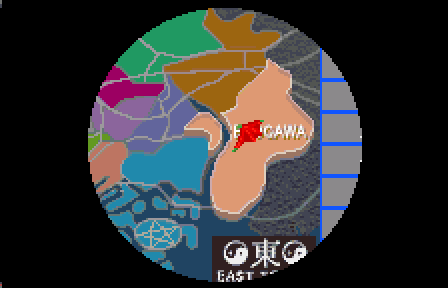
The story runs the same way whichever character is chosen, but it is seen through that character’s eyes, and the goal depends on the side: a Dragon of Heaven sets out to protect every barrier spread across Tokyo, a Dragon of Earth to break them all. It unfolds on a map of 23 areas divided between East and West Tokyo. Allies met there pass on information and enemies have to be fought, with scenes before and after each battle, and each character’s story ends in an ending of its own. The plot moves in short conversations between battles, and the battles take up most of the game.
How it plays
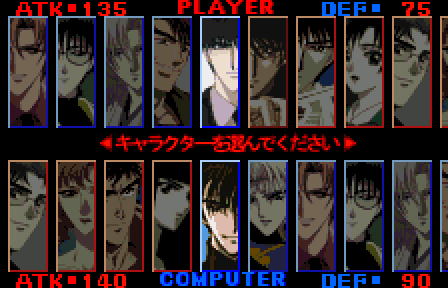
The game is played with the console held sideways. Start begins the game and, on the map, opens the save screen; A confirms and moves messages on and B cancels. On the map X1 and X3 choose an area, Y3 opens the options and Y4 the exchange screen, and in battle X1 and X3 choose a draw pile, X2 and X4 choose cards and X3 shows a card’s details. The character select screen shows each character’s basic attack (ATK) and defence (DEF).
The loop is moving between areas, talking, fighting card battles and then combining cards, until the events in every area are done. Areas marked with the symbol of the Dragons of Heaven or of Earth hold that group’s events, and areas without a symbol can still hold card battles against shikigami. Once an area’s event has happened, the area cannot be entered again. The game saves from the map with Start or after a card battle, and a lost battle is game over and a return to the last save.
Battles are one on one. Each character starts with a deck of 54 cards built differently for each, and in battle the deck is split into three draw piles. A turn has four phases: draw, card, battle and end. The first hand of seven is dealt automatically, and from the second turn the player tops the hand back up to seven, choosing which pile to draw from; the backs of the cards in each pile show their attribute colour. In the card phase both sides pick three cards, which are played one per round over three rounds, and setting a card costs one EP. Every card has an EP value, shown as a Roman numeral, and the higher EP acts first, with attributes breaking ties. In the second round a change icon offers to swap the second and third cards, useful when a healing card set for the third round is needed sooner.
On top of the three cards a player can set one RAP card. A RAP card keeps its effect going every turn by spending its own EP, and is removed the turn after its EP falls to one. It takes effect from the battle phase on, so a card that needs a RAP effect cannot be played in the same turn the RAP card goes down. While a RAP card is kept in play no other card can take its place; it has to be taken off first. A battle ends when either side’s HP reaches zero, when a draw pile is empty and no card can be set, or when the barrier’s HP gauge reaches zero, which is a defeat for the Dragons of Heaven and a win for the Dragons of Earth.
Cards come in six attributes shown by the colour of their frames: water, fire, wind, heaven, earth and mind. Water beats fire, fire beats wind and wind beats water; heaven beats earth but is weak to the three elements, earth beats all three but is weak to heaven, and mind has no strengths or weaknesses. Each character has an attribute too, heaven for Kamui and earth for Fuma, and the colour of the barrier gauge shows the attribute of the place where the battle is fought. Physical attacks add the card’s power (CP) to the attacker’s ATK and hit HP, technique attacks do one and a half times that and hit both HP and the barrier, and mind attacks do the card’s CP alone. Other cards counter, use a character’s own ability, raise or lower stats, boost other cards, restore or attack the barrier, draw particular cards, change the field’s attribute, seal RAP cards or certain cards, lift seals, ignore defence, or reduce or cancel damage. Three cards set together can form a combination: three with the same EP give Full Strike, adding one EP, three of the same attribute give Flash Strike, raising attack to 120 per cent, and both at once give Royal Strike. A card’s details give its number, attribute, CP, EP, rarity from E to S and the condition for using it.
Winning a battle leads to the exchange screen, where the cards just won are marked NEW. Here two cards can be combined and traded for a new one, and which card comes out depends on the abilities of the two put in. A player can hold up to 70 cards, and combining is not possible when only 30 are held. The full set has 256 cards. The battle system has a tutorial and is simple to learn, and a steady stream of attack cards is often enough to win.
Finished stories leave a clear mark on the character select screen, and the strengthened deck and the clear record stay even when a new game is started. A password shown after the ending, entered in the options from the map screen, gives hidden cards. The options also hold a list of every card obtained by any character, a sound test, a colour bar for setting the screen’s contrast, and, when opened from the title screen, Training, which allows practice battles against any opponent. Two players can also battle and trade cards over the link cable.
Development and release
Bandai presented the game in May 2002 in a list of coming WonderSwan titles published alongside the announcement of the SwanCrystal, giving 27 June as the planned date and 4,980 yen before tax as the price. Access, which also developed Bandai’s Hunter × Hunter games for the WonderSwan, handled the development. The 32-megabit cartridge saves to 16 kilobits of EEPROM rather than battery-backed memory. The mobile phone strap with CLAMP’s new illustration was a bonus for first copies only. The game is also known by the longer name TV animation X CARD OF FATE, while Bandai called it simply X CARD OF FATE; which form is printed on the box is unknown.
Ports and other versions
X: Card of Fate was made for the WonderSwan Color and was never ported, remade or re-released on another system. There are only two X games, both published by Bandai in 2002 and both carrying the television anime’s name. The other, TV animation X: Unmei no Sentaku, came out for the PlayStation on 22 August 2002, two months after this one, and is a separate game: a versus fighting game based on the anime rather than a card battle adventure.