
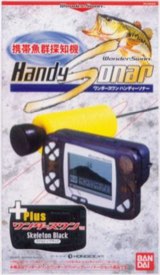
A sonar unit for anglers that connects to the WonderSwan and turns it into a fish finder, with a built-in fish guide and tide chart.
Screenshots
Title screen 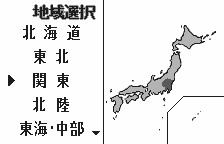
In play 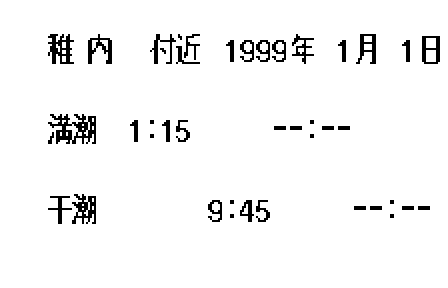
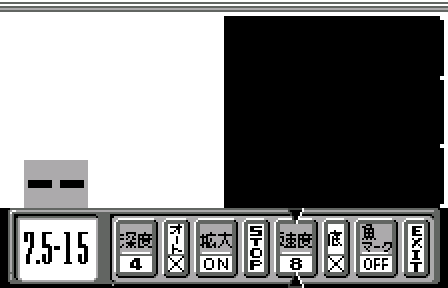
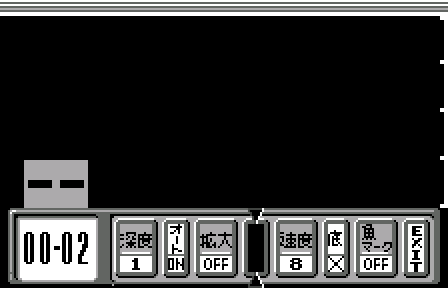
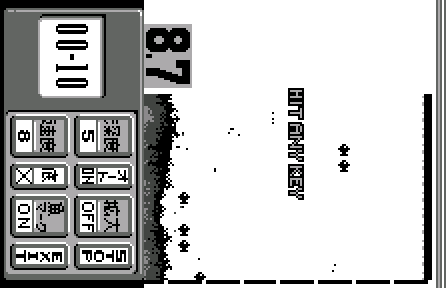
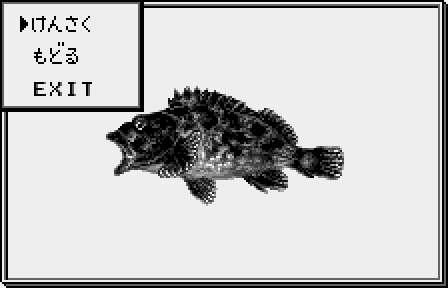

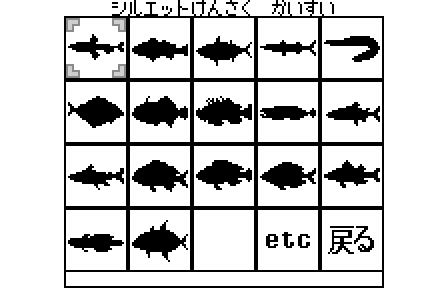
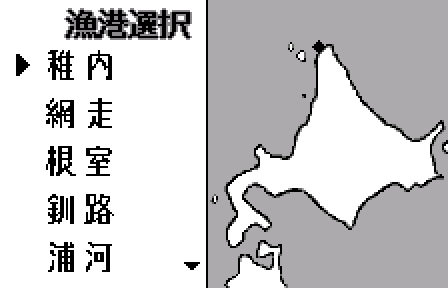

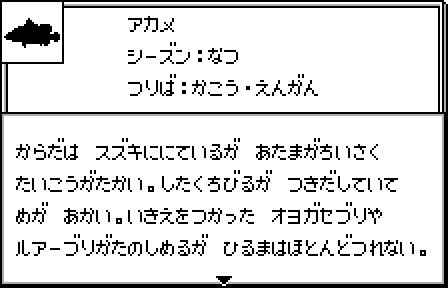
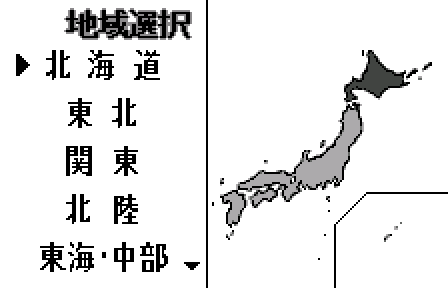
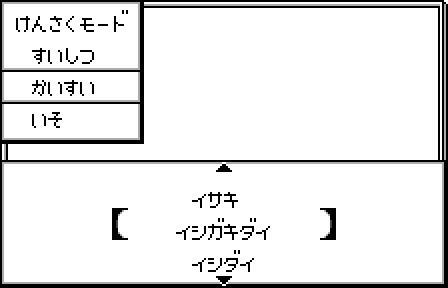
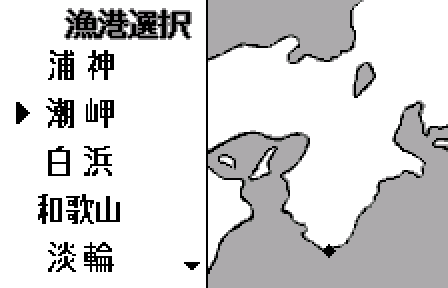
WonderSwan Handy Sonar is not a game but a fish finder. Bandai released it on 13 May 1999, about two months after the console itself, and presented it as proof that the WonderSwan could be more than a games machine. The product is a sonar unit that is connected to the WonderSwan, which then shows on its screen what the sensor picks up under the water.
The unit pairs an 8-megabit cartridge with a sensor made by Honda Electronics under its HONDEX brand, a name that anglers already knew from proper fish finders. At 9,800 yen before tax it cost more than twice the price of most WonderSwan games of the time.
The story
The Handy Sonar has no story, because it is not a game. There are no characters, no stages and nothing to win. It is a tool, and the only setting is the water the angler happens to be fishing.
The framing Bandai gave it was practical. The company sold the unit as a way to turn the WonderSwan into a fish finder and as a companion to take out fishing, and it used the product to show that the new console could do more than play games. The fishing magazine TACKLE BOX gave the WonderSwan space in its July 1999 issue, which shows the audience Bandai had in mind.
The unit found its following among anglers who wanted a cheap and simple way to see the depth and the bottom, bass anglers fishing from float tubes among them. Anglers of the time thought it good value and easy to use, and some bought a WonderSwan only to use it.
How it plays
The sensor is a HONDEX transducer set in a yellow float, on a cord of about 15 metres. The angler throws the float out onto the water and reels it back in while the WonderSwan shows what lies beneath. The screen can be read with the console held upright or on its side.
The sensor works at a frequency of 200 kHz and sends out its ultrasound in a cone of 20 degrees. On screen it shows shoals of fish, the depth of the water and the shape of the bottom, down to 20 metres of water and across an area of up to 7 metres. As the float comes in towards the shore the reading changes with the bottom, so a slope from about 2 metres of water up to under 1 metre near the bank shows as the depth falls.
Besides the sonar, the cartridge’s ROM holds two reference tools: an illustrated guide to fish and a simple tide chart that shows the rise and fall of the tide. The sound is mono, there is nothing for a second person to do, and there is no link-cable function.
Expectations should be modest today. On a surviving unit the readings give a rough sense of depth rather than a detailed picture, the sensor sometimes shows nothing, and fish may not appear at all. The screens of old WonderSwan consoles have often faded, and a faint display is hard to read outdoors. Whether the unit works on the WonderSwan Color is not certain, and an original black-and-white console is the safe choice. The unit went out of production in 2003, and the run is estimated at 5,000 to 10,000 units, so it is rare today.
Development and release
Bandai is usually credited with developing the unit, though this has never been confirmed.
Bandai sold the Handy Sonar on its own at 9,800 yen before tax. A set that packed it with a WonderSwan console in skeleton black sold for 14,600 yen. The software sits on an 8-megabit cartridge.
Ports and other versions
The Handy Sonar was made for the WonderSwan and has no port or re-release, but it had a forerunner on another console: Pocket Sonar, a fish finder that Bandai released for the Game Boy on 4 July 1998. The two are different products for different machines rather than one program carried across. The Game Boy unit had the same reach, a 20-degree beam down to 20 metres and across up to 7 metres, cost 14,800 yen, and was taken off sale and succeeded by the WonderSwan model. Pocket Sonar worked with the Game Boy, Game Boy Pocket and Game Boy Light, hung its sensor on a 15-metre cord and came with minigames, where the WonderSwan unit offers a fish guide and a tide chart instead.
Notes
Bandai itself called the product Wonder Sonar for short. Today the WonderSwan model is somewhat harder to find and dearer than its Game Boy predecessor.