
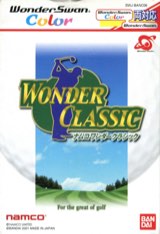
A golf game revisiting Namco Classic, with four 18-hole courses, golfers with special strengths including Namco characters, a 32-player tour and WonderGate tournaments.
Screenshots
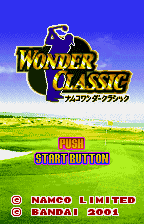
Title screen 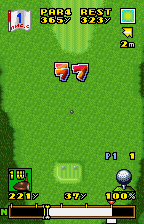
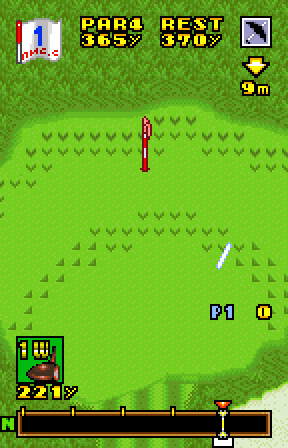
In play 

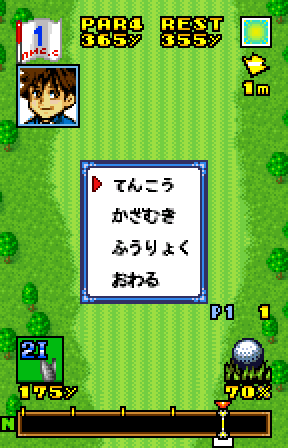

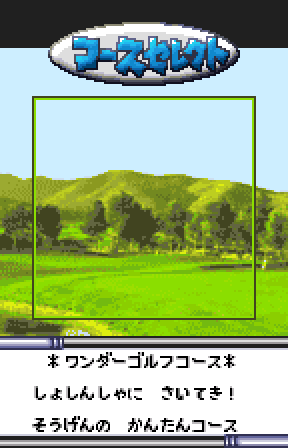
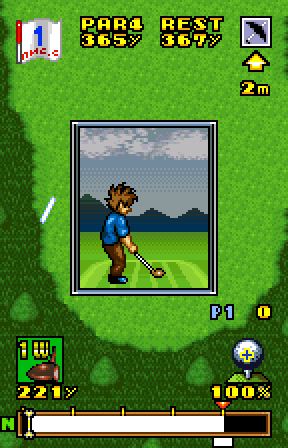
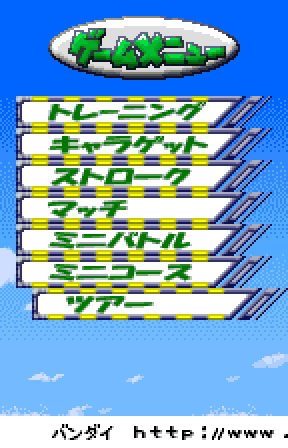
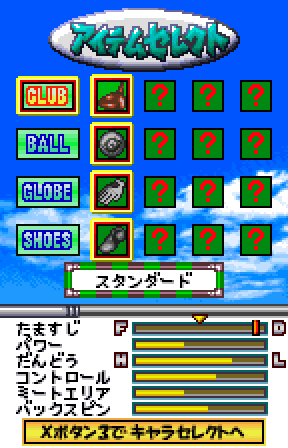
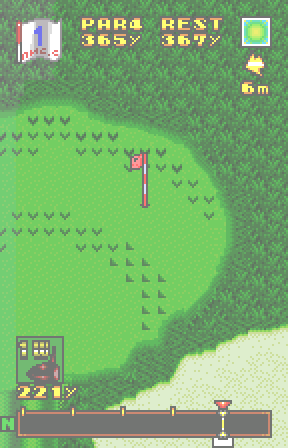
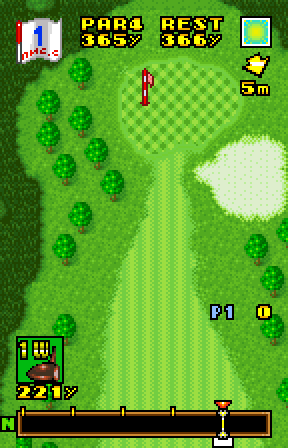
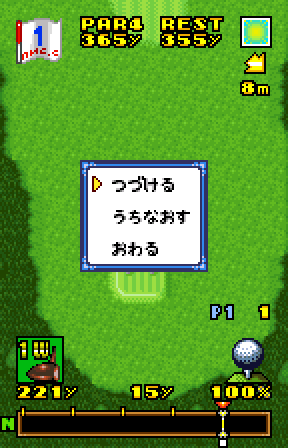

Wonder Classic is a golf game that Bandai published on 18 January 2001, carrying the copyright of Namco. Bandai presented it as a return of Namco Classic, the golf game that Namco first released for the Famicom in 1988 and that was known for how easy it was to pick up and for sloping greens and fairways that rewarded careful shots.
The 32-megabit cartridge holds four courses with 72 holes in all, a cast of golfers that includes characters from other Namco games, and a choice of modes for one player. Its most ambitious feature was the network tour, which used the WonderGate adapter to run national tournaments and to deliver new clubs, equipment, golfers and courses.
The story
Wonder Classic has no story. There is no plot and no hero’s career to follow: the game is a set of golf courses and a group of golfers, and the reason to play is to win rounds and tournaments. What framing it has comes from its name. Bandai sold it as the legendary Namco Classic, a golf game that had won people over with its polish and ease of play, arriving on the WonderSwan Color.
The four courses take the place of a world. The first is an ordinary grassland course, the second runs through mountains and asks for more technique, the third is a hard course in the tropics, and the last is a tricky course themed on Namco itself. Each has 18 holes, and they are drawn with more colours and smoother shading than golf games on the Game Boy, such as Mario Golf.
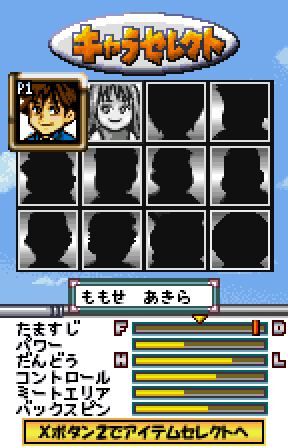
The golfers are the cast. Each has a face and a profile of strengths, and some come from other Namco games: Reiko Nagase is among them, and her gift is that wind has no effect on her shots. The game also hides a secret golfer called Chuck Morris, a joke on the name of the actor Chuck Norris, who hits the ball even harder than the others. At the start only two golfers can be chosen, and the rest of the character screen is a grid of black silhouettes waiting to be filled.
How it plays
The WonderSwan is held upright, and a round follows the usual pattern of a golf game: the player picks a golfer, chooses items, and plays each hole stroke by stroke, judging the wind and the slope of the ground. The Y buttons set where the club meets the ball, which changes the flight and roll of the shot. Each round also comes with six power shots, stronger strokes that can carry a hazard but cannot be used on every hole, so deciding where to spend them is part of the game.
Each golfer is rated on six points on the selection screen: the shape of the ball’s flight, power, height, control, the size of the sweet spot, and backspin. On top of these, most golfers have a special strength. Reiko Nagase ignores the wind, and others are better at particular kinds of shot. From the character screen a button leads on to item selection, where equipment is fitted before the round. Two golfers are available at the start, and 22 more were to be won in play or downloaded.
The modes cover what a golf game usually offers. Training is a mode for practice. Character Get is built around winning new golfers by beating them. Stroke play is a round against par, match play is a hole-by-hole contest against one opponent, and the mini course is a short course for quicker games. Tour mode is a 32-player tournament, and winning it opens new courses. The Net Tour is the WonderGate mode.
Through the WonderGate the player could enter the national tournaments that Bandai held regularly, with prizes from a sponsor for the best results, and send scores to a nationwide ranking. The service also sold new clubs, equipment that raises a golfer’s ratings such as gloves, and new golfers and courses. Several golfers, caddies and items were only ever available this way, so a cartridge played today cannot be completed in full.
The game is much milder than the hard Famicom original, closer in difficulty to Namco’s Super Famicom golf game Namcot Open, and playing through it takes about seven to eight hours. A round can be suspended at any point, which suits a handheld, and the cartridge keeps progress in 256 kilobits of save memory. It does not keep a record of great shots, so chip-ins, eagles and holes in one are not saved. The game is for one player, has no link-cable mode, and plays on the original black-and-white WonderSwan as well as on the Color.
Development and release
Bandai published the game, which carries a copyright line for Namco beside Bandai’s own and is credited to both companies; which company programmed it is unknown. The game came out on 18 January 2001 on a 32-megabit cartridge with 256 kilobits of save memory, at 4,500 yen before tax.
Reception
Players found the upright screen a good fit for golf and the game much easier than the Famicom original. A common regret is how much of the content was tied to the WonderGate: several golfers, caddies and items could only be obtained through the service, so the game can no longer be completed in full.
Ports and other versions
Bandai sold Wonder Classic as Namco Classic arriving on the WonderSwan Color, but it is not a conversion of the 1988 Famicom game. Its four themed courses, Namco guest golfers, character-collecting mode and WonderGate tournaments have no counterpart in any earlier version, and the Famicom original has only a round mode and a tournament mode. The Famicom game itself went to the Game Boy in 1991 with a different course, and an arranged version was included in the PlayStation compilation Namco Gallery Vol. 1 in 1996, while the sequel Namco Classic II of 1992 was later reissued on the PlayStation and the Nintendo Switch; those belong to the older games, not to this one. Wonder Classic itself was never ported or re-released.
Notes
Bandai called the game Wonder Classic, but it is also known as Namco Wonder Classic, with Namco’s name in front. Which form is printed on the box is unknown.