
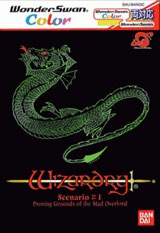
Bandai's port of the first Wizardry dungeon crawler, playable in colour or black and white, with auto-mapping added and WonderGate extras such as new dungeon data.
Screenshots
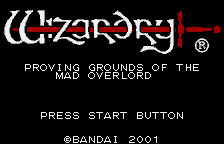
Title screen 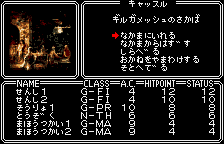
In play 
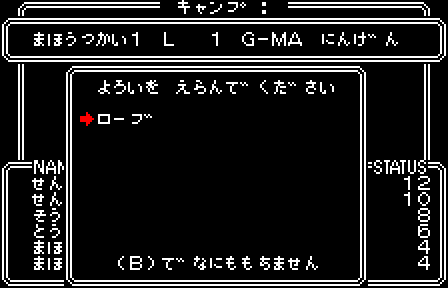
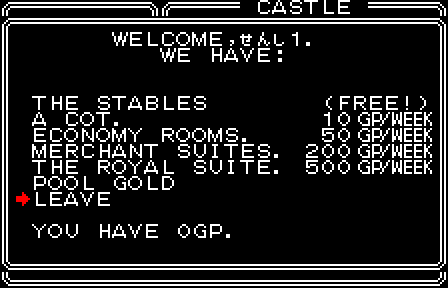
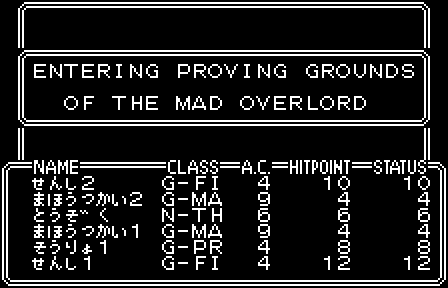
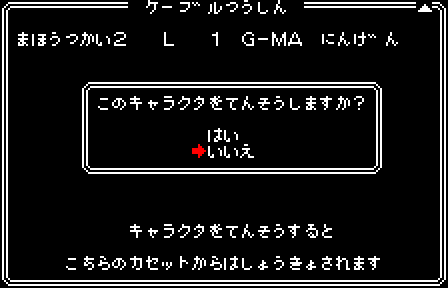
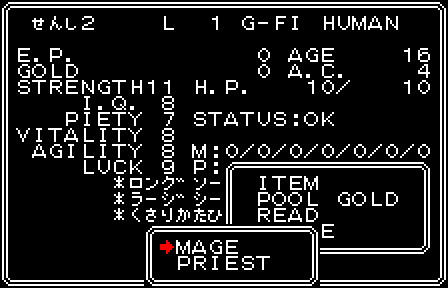
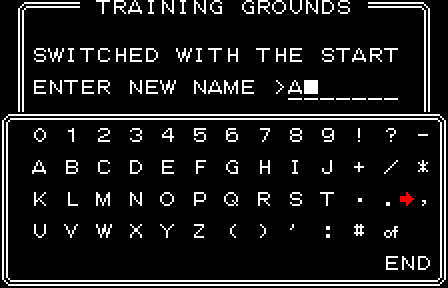
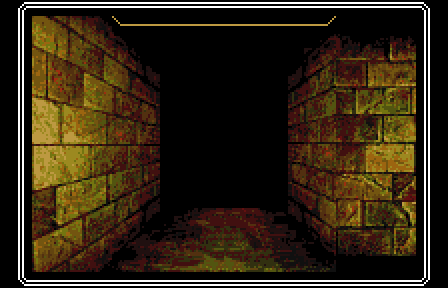
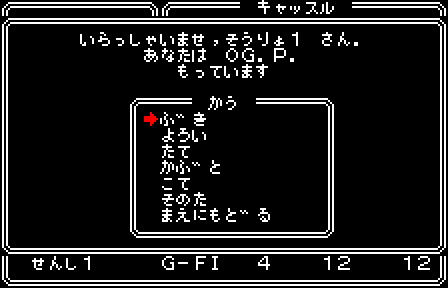
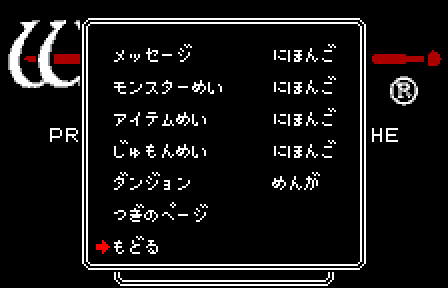
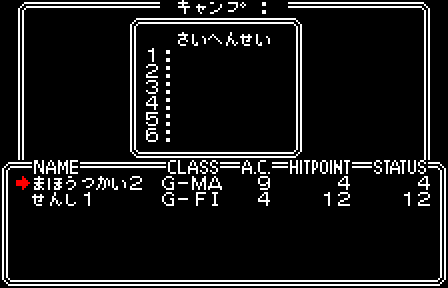
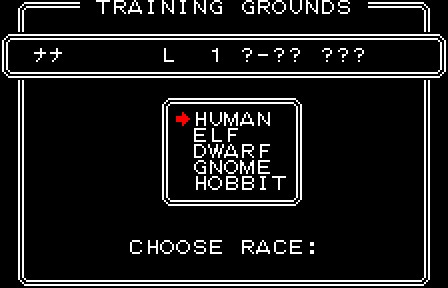
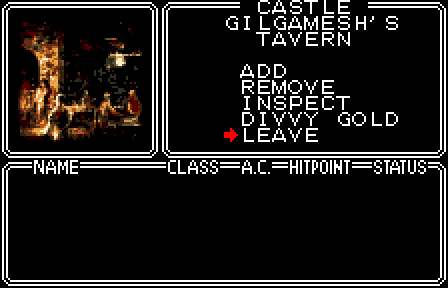
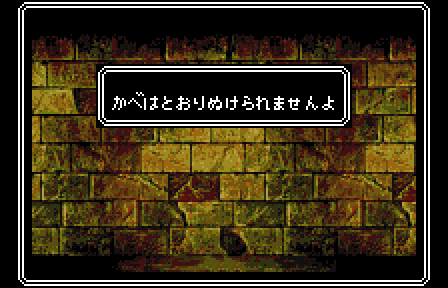
Proving Grounds of the Mad Overlord is the first scenario of Wizardry, the computer role-playing series that Andrew Greenberg and Robert Woodhead created for Sir-Tech, whose Apple II version came out in 1981. Bandai brought it to the WonderSwan on 1 March 2001, with the conversion itself carried out by Sting. It remained the only Wizardry scenario released for the system.
It is a first-person dungeon crawler in which the player builds a party of adventurers in the town and sends it down a ten-floor maze. The cartridge runs on both the WonderSwan Color and the original black-and-white WonderSwan, and Bandai added automatic mapping, collection lists and WonderGate and link-cable features to the original game.
The story
The game is set in the domain of King Trebor, a town with a castle above and a great maze below. Trebor once held a magic amulet of great power, and the wizard Werdna stole it from him and withdrew into the depths of a dungeon he had built himself. The king ordered that the amulet be brought back, and the call went out to any adventurer willing to go down after it.
Many went, chasing wealth and fame as much as the king’s favour, and many never came back, caught by the maze’s traps or killed by the monsters that fill it. Over time the dungeon came to be known as a place where adventurers prove themselves, which gives the scenario its name. The player’s party is one more group answering the king’s call, put together at the tavern in town.
There are no fixed heroes. Every member of the party is a character the player creates, with a race, an alignment and a class, and the story is carried by that premise. The tone is grim and sparse: the maze is dangerous from the first floor, it grows harder with each level, and the goal throughout is to reach Werdna at the bottom and return the amulet to the castle.
How it plays
The console is held horizontally, and the game is for one player with stereo sound. The screen keeps the window layout familiar from earlier versions of the series. The colour and black-and-white consoles each get their own set of graphics, and pictures appear for items and some events as well as for the monsters. An option switches the dungeon view to plain wireframe lines, as in the early computer versions.
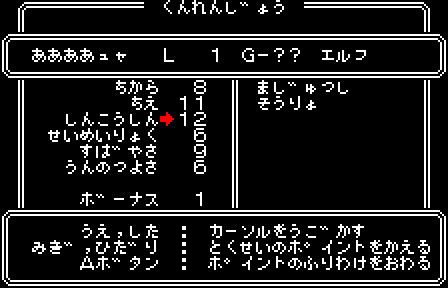
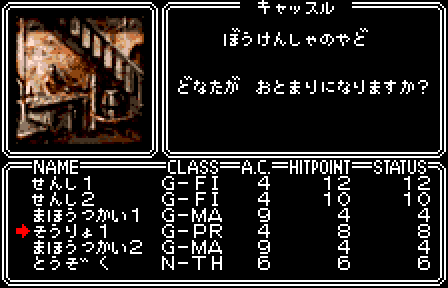
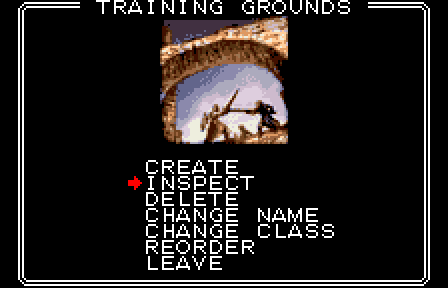
Play starts with character creation. Each character takes one of five races (human, elf, dwarf, gnome and hobbit) and one of three alignments (good, neutral and evil), receives six statistics, strength, IQ, piety, vitality, agility and luck, and adds a pool of bonus points to them. Each class needs minimum statistics, and alignment narrows the choice: a thief, for instance, cannot be good. The four basic classes are fighter, priest, mage and thief. Up to six characters form a party at the tavern, and good and evil characters normally cannot travel together.
As characters gain levels they learn spells and can change class. Priests and mages each have spells in seven levels, and the four elite classes, bishop, samurai, lord and ninja, are reached by changing class once a character has grown strong enough. The core loop is to go down from town, explore, fight, take the treasure and come back to rest and recover, then go a little deeper.
Battles are fought against one to four groups of monsters at a time. The maze holds darkness zones, teleport traps and other hazards. A spell shows the party’s coordinates, while a teleport spell can kill the whole party if it sends them into solid rock. Elevators run from the first floor to the fourth and from the fourth to the ninth, so floors five to eight need not be explored in full. Automatic mapping, new in this version, records every square walked and can be turned off for those who prefer to draw maps on paper.
Death is a constant risk. A dead character can be taken to the temple of Cant to be raised, but the attempt can fail and leave the character as ash, and a failure at that stage loses the character for good. A party that is wiped out stays in the maze, and a new party has to go down and carry the bodies back. Enemy ninja that can kill with a single blow by beheading are a well-known danger.
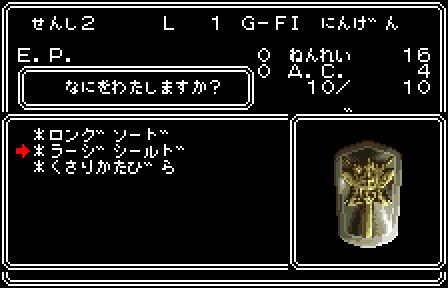
The game holds more than 120 items and more than 120 monsters, and the item museum and monster museum record what has been collected and met, which also helps in planning against each monster. The version stays close to the original, so guidebooks written for the original game remain usable. Through the WonderGate the game could also buy items that are hard to come by in normal play, and a ranking mode let players compare the strength of their parties.
Development and release
Sting, whose own titles included the Saturn and PlayStation role-playing game Baroque, carried out the conversion for Bandai. Sting kept a promotional page for the game on its website. The game’s more than 120 monster pictures were drawn by 氷樹むう (Hyohju Mu), who had designed the characters of Baroque, and Sting showed a gallery of these illustrations on that page. The title was already scheduled for March when the WonderSwan Color went on sale in December 2000, and it came out on 1 March 2001 on a 16-megabit cartridge with 256 kilobits of battery-backed save memory, priced at 4,500 yen before tax.
Modes and features
Sting stressed that each floor keeps the original 20 by 20 grid, which it called a first for a handheld version. The item and monster lists act as a catalogue for completing a collection. The wireframe view also shows messages in the manner of the early computer versions, and the messages can be switched to English.
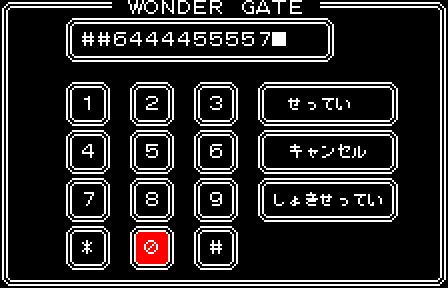
The WonderGate download added ten extra floors, 20 new items and 26 new monsters, and the new items and monsters appear only on those downloaded floors. Two cartridges joined by the link cable can trade the downloaded dungeon as well as characters and items. After the ending a Survival entry appears in the Special menu: the party fights every monster recorded in the game’s museum, one battle after another, until it is wiped out, and the number of enemies defeated could be sent through the WonderGate to an online ranking. The WonderGate service has since closed, and the leader of the final table had defeated more than 30,000 monsters.
Secrets and extras
A soft reset is available: hold Y4 and press START to restart the game. The Survival mode is the main unlockable and appears only once the amulet has been returned to the castle and the ending has played.
Ports and other versions
Proving Grounds of the Mad Overlord began on the Apple II in 1981 and had been converted many times before it reached the WonderSwan. Versions appeared for the Commodore 64, IBM PC compatibles and the Macintosh, and in Japan for the PC-8801, PC-9801, FM-7, Sharp X1, MZ-2500 and MSX2 computers. ASCII brought it to the Famicom in 1987 with newly drawn monsters and new music, and further versions followed on the PC Engine CD-ROM in 1993, paired with the second scenario, in collections for the PlayStation, the Sega Saturn and Windows in 1998, and on the Super Famicom in 1999.
The WonderSwan Color cartridge came out about a week after a Game Boy Color version from ASCII, released on 23 February 2001. In the Game Boy Color version the maze was shrunk to a 16 by 16 grid while the connections between rooms and corridors stayed close to the original, and floors five to eight were rebuilt there as an extra dungeon for characters who have earned a title. The WonderSwan version keeps the full 20 by 20 floors, as Sting stressed, and gets its extra floors from the WonderGate download instead.
The scenario has kept appearing since. A version for NTT DoCoMo mobile phones, Wizardry ORIGINAL #1, followed in 2004, cut down to six floors. In 2024 Digital Eclipse released a full 3D remake for Windows, the Nintendo Switch, the PlayStation 4 and PlayStation 5, and the Xbox One and Xbox Series X|S. It was made by carrying the Apple II code over to a modern engine, a single button switches to the old Apple II screen, and it takes its monster designs and music from the Famicom version.
Notes
The downloaded items are strong enough to upset the balance of the original game, among them a talisman named after the console, a katana stronger than the Muramasa blade and a robe that brings armour class down to -10, and the new monsters are hard enough to need them. The downloaded floors are kept in the cartridge’s battery-backed save memory, so collectors back up cartridges that still hold the data before the battery fails.