
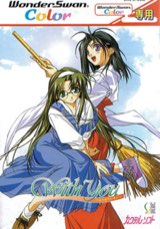
A WonderSwan Color version of Cocktail Soft's 1998 romance adventure, narrowed to the story's two heroines, the hero's childhood friends Manami and Naori.
Screenshots
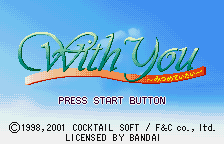
Title screen 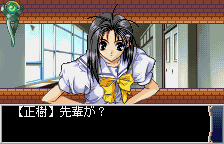
In play 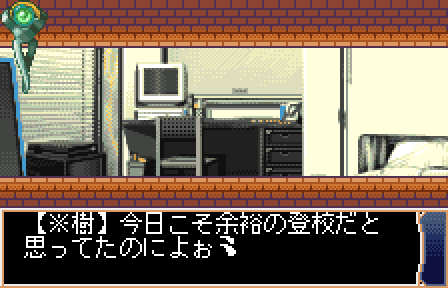
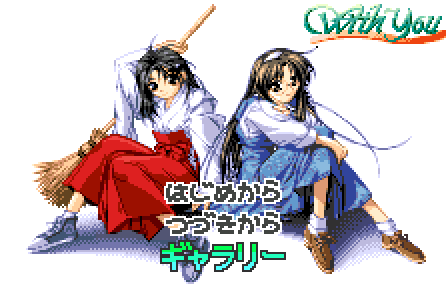

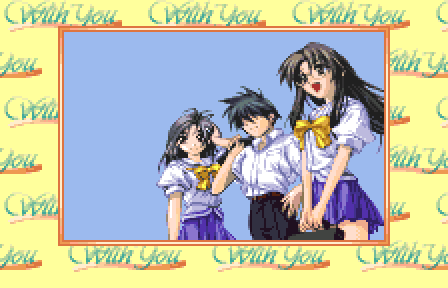
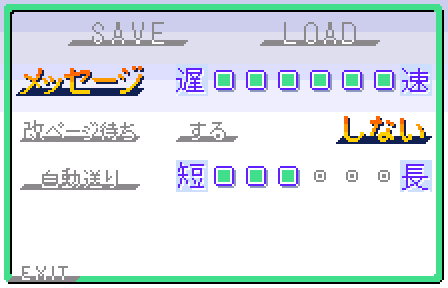
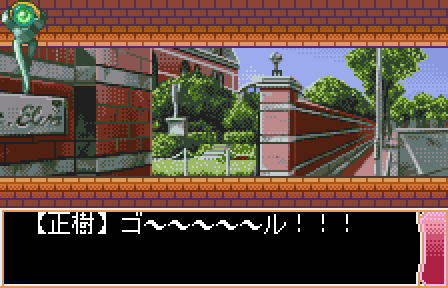
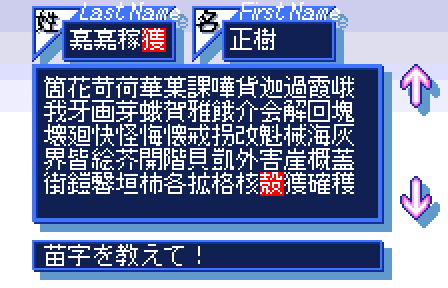
With You: Mitsumete Itai is a romance adventure for the WonderSwan Color, published by Shall Luck on 25 January 2001. The game first came out for Windows in 1998 from Cocktail Soft, where it was an adult title, and NEC Interchannel then brought all-ages versions to the Sega Saturn in 1999 and, under a different name, to the PlayStation in 2000. It was also the debut work of the character artist Takashi Hashimoto.
The game follows a boy whose feelings swing between two childhood friends, Manami Naruse and Naori Hikawa. There is a large supporting cast, but only these two heroines can be won, and the WonderSwan Color version concentrates on them, exploring each one’s story in more depth. Besides the standard edition, a limited first edition was sold at a higher price with a trading card and a figure of Naori. The cartridge needs a WonderSwan Color and is for one player.
The story
The story is set in a town modelled on the area around Sakuragicho in Yokohama. The hero, Masaki Ito, is a second-year pupil at St. Elsia Academy, and his family runs a café where he sometimes lends a hand. As a child he had two close friends, Manami and Naori, until Manami’s family moved to Myanmar while they were still at primary school. He chased the train that was taking her away to tell her how he felt, and did not catch it. Out of that defeat he took up sprinting with the track club, thinking that if he had been faster he would have reached her, but with nobody left to run for he has lost his drive, and Naori spends her days nagging him back into training.
Six years after the parting, Manami comes back to Japan looking much as she did then, and turns up in front of Masaki again. As the three of them talk about old times, he realises that what he felt for her as a child was his first love. At the same moment he becomes aware of how much Naori, who has always been at his side looking out for him, has come to mean to him. Manami is gentle but tends to keep her troubles to herself, and she is scatterbrained and hopeless with directions; her parents are still abroad, so she lives with her younger brother. Naori is brisk and down to earth: her family keeps a Shinto shrine, she is often seen in a shrine maiden’s robes, and early in the story she loses a bet with Masaki and has to work as a waitress in his family’s café. Masaki gets steadily closer to Manami, and Naori’s peace of mind goes with it.
Manami has brought back a pendant, given to her at a market in Myanmar shortly before she returned, and it becomes the thread of her story. It ties to an old legend of a man and a woman who promised to stay together, were parted by fate and were sealed into two jewels. The rest of the cast fills the school and the café: Masaki’s younger sister Noemi, a quiet girl who adores her brother and helps in the café, the gossip-hungry classmate Miako Shigaraki, the handball player Saeko Tanaka, a new English teacher just back from America, an exchange student from Myanmar named Chamna Phon, and Takuya Shibazaki, the star of the football team, who sets his sights on Manami and clashes with Masaki. Noemi became the most popular character of the game, but she is not one of the girls who can be won.
Each of the two routes has its own theme. Manami’s is about parting with the past, hope for the future and the bonds still to come, while Naori’s is about hope held up by someone else, the love that grew out of her years of quiet support and the bond built along the way.
How it plays
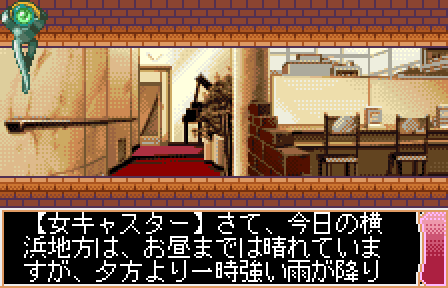
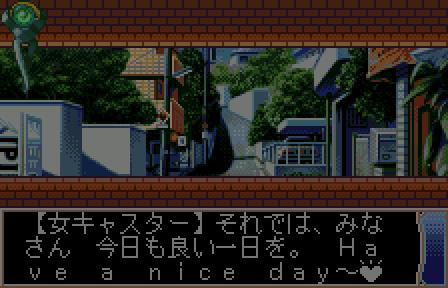
The game is a choice-based romance adventure, played with the console held horizontally. The story is told in text over still pictures of the characters and the town, and at set points the player picks what Masaki does or says from a short list of options. Those choices are the player’s only say in how events unfold.
The story divides into two main threads, one for each heroine. Each choice leans Masaki towards one girl or the other, and that leaning decides whose story he follows.
The WonderSwan Color version has no voices and no songs, so every line is read as text, and its pictures are coarser than those of the home console versions. Progress is kept on the 16-kilobit EEPROM inside the cartridge. Seeing both heroines’ stories means playing through at least twice, taking Masaki down the other route the second time.
Development and release
The WonderSwan Color version arrived from Shall Luck on 25 January 2001, between the two volumes of an original video animation based on the game, released in December 2000 and May 2001. The copyright line names Cocktail Soft together with F&C for both 1998 and 2001, and Cocktail Soft (F&C) made the game, with Shall Luck as publisher. Two editions were sold: the limited first edition at 6,980 yen before tax under the model number SWJ-SHLC01, and the standard edition at 4,800 yen under SWJ-SHLC02. The figure is a painted PVC model of Naori in the waitress uniform she wears in the story, roughly the size of a larger capsule toy and well made by the standards of 2001.
Modes and features
The 32-megabit cartridge saves to a 16-kilobit EEPROM, the sound is in stereo and the game does not use the link cable.
Reception
Weekly Famitsu’s Cross Review gave the WonderSwan Color version 24 out of 40 in its issue of 2 February 2001, two points below the Saturn version. Players have been cool towards this edition. It is hard to see who the handheld port was meant for, beyond people who want to play outdoors, and the Naori figure is seen as the real reason to own the limited edition. Of the story itself, the supporting cast is liked, but the hero’s behaviour is found hard to follow and the writing unconvincing.
Ports and other versions
The WonderSwan Color cartridge is the last of the game’s four versions. Cocktail Soft’s adult original for Windows came out on 11 September 1998 on one CD-ROM. NEC Interchannel then made all-ages versions on two discs each, for the Sega Saturn on 29 July 1999 and for the PlayStation on 6 April 2000. The PlayStation edition was built on the Saturn one but was retitled Kizuna to Iu Na no Pendant with Toybox Stories, using the game’s working title, and it was the fullest of the console versions: its opening movie was largely remade, and it added the Toybox side stories, short scenarios led by four of the supporting characters with more than thirty new illustrations.
The handheld version follows the consoles in being suitable for all ages, but it carries less than they do. It adds nothing new, its pictures are coarser than on the home consoles, and it lacks the voices and songs heard on the Saturn and PlayStation; the ending song is a feature of the home console versions only. The home console versions have ten save slots, where the PC original adds three quick saves and an automatic save.