
A turn-based war game on a hex map that follows the battleship Yamato's voyage from the anime, with branching routes, several endings and WonderGate downloads.
Screenshots
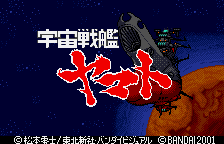
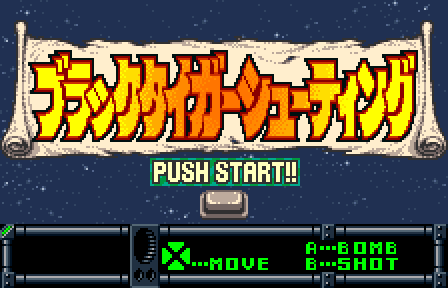
Title screen 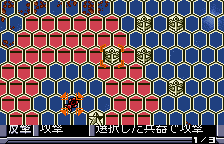
In play 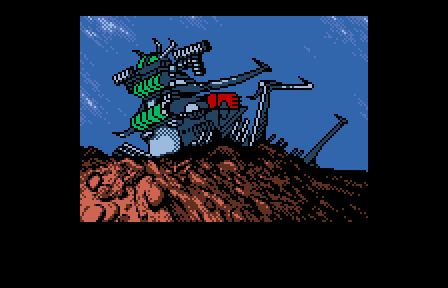
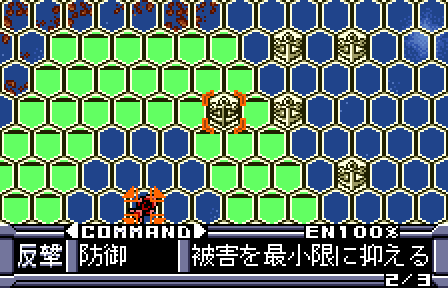
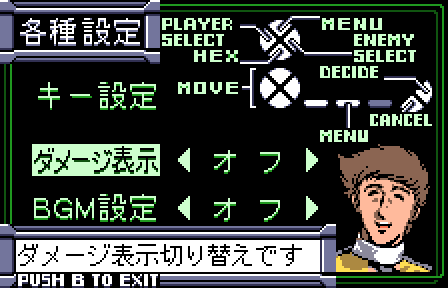
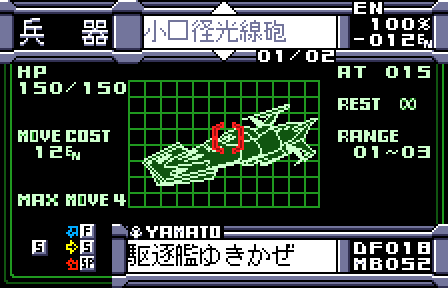
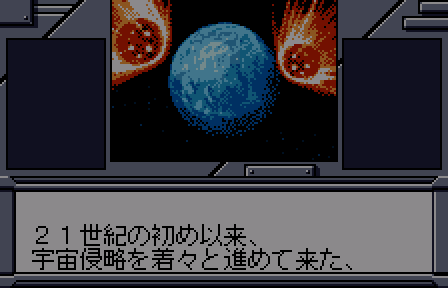
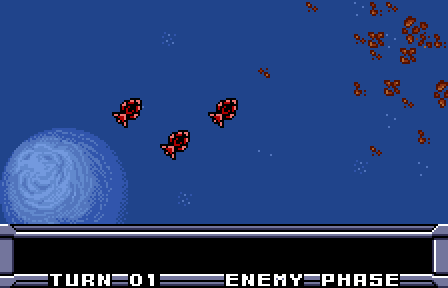
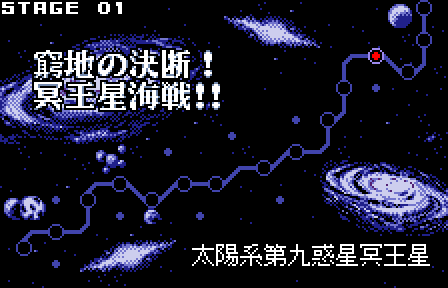
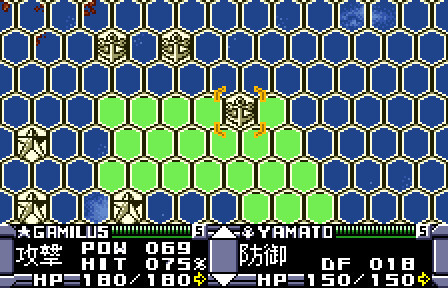
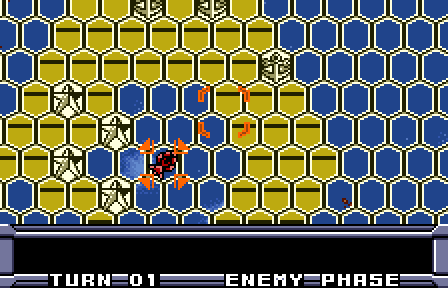
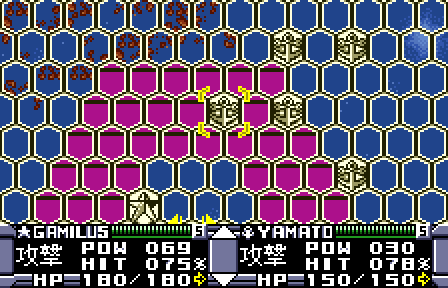
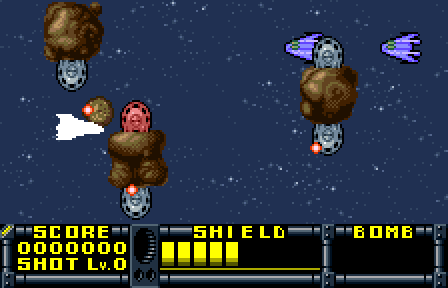
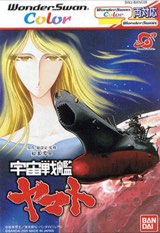
Uchuu Senkan Yamato is a strategy game based on the science-fiction anime Space Battleship Yamato. Bandai released it on 8 February 2001. The cartridge shows colour on the WonderSwan Color and also runs on the original black-and-white WonderSwan. It is for one player.
The game is built as a series of missions on the Yamato’s voyage to Iscandar. Each stage mixes story scenes with turn-based battles on a hex map, and between stages the player saves and upgrades the ship. The story draws on the television series, the films and the manga, and its route branches toward several endings. Through the WonderGate adapter players could download extra units and materials for the ship. First buyers received a newly drawn poster of Dessler, the Gamilas leader.
The story
The year is 2199. The Gamilas have been bombing Earth with planet bombs fired from outer space, and mankind is close to extinction. The one hope lies at Iscandar, a planet of the Sanzar system in the Large Magellanic Cloud, 148,000 light years away, where a device that removes radiation, the Cosmo Cleaner D, is waiting to be collected. It has to be brought back within one year. Mankind rebuilds the old battleship Yamato as a space battleship, and after 250 years asleep she sets out on a round trip of 296,000 light years, travelling faster than light. Every stage reminds the player of the stakes: when it ends, the screen shows how many days are left before Earth is lost, and the box puts the figure at 369 days.
The voyage is told in 17 stages, each played like an episode of the show. A stage opens with a title showing where the ship is on its route, then a story scene with dialogue, and then battles fought in space and on planets. Famous scenes from the anime are recreated as short visual scenes, with the human drama between the crew kept in, though some lines differ a little from the television version. One of the recreated fights is the battle in the Seven-Colour Nebula, where Gamilas heavy bombers launch drill missiles at the Yamato.
The game does not simply replay the anime. Its scenario combines the television series, the films and the manga, and it adds eight new scenarios with enemies that do not appear in the show: Bagades, a Gamilas officer of the game’s own who sees Domel as his rival, space creatures, and the Siren of Space, a story taken from a little-known manga spin-off about Jura. The route to Iscandar branches according to how missions are cleared and to the choices made in conversation scenes, so the voyage can go differently from the anime, and how well the player does decides which of several endings it reaches.
How it plays
The WonderSwan is held horizontally and the game is for one player. A stage follows a fixed order. After the title and the story scene, which the Start button skips, comes crew placement: the player puts members of the crew at posts inside the ship and picks the crew who will sortie. Where each person sits changes which commands are available and how well the Yamato performs. In some stages the scenario fixes the placement and the player cannot change it.
The main part of a stage is the strategy map, a turn-based hex map on which the Yamato fills two hexes. The player moves the ship and the other units with commands such as navigate and attack until the stage’s objective is met. A battle starts whenever a unit attacks or is attacked, and its result plays out as a short animated scene. Fleet battles use a firing system built on the direction and spread of three batteries, the main guns, the second main guns and the secondary guns, so where the ship is pointing matters when it fires. An action-energy gauge gives the player the means to turn a losing fight around.
Meeting the victory condition clears the stage. The result screen shows the days left before Earth’s destruction, and in some stages the route branches here. Then comes the intermission, where the player saves, restocks missiles and carrier aircraft and upgrades the Yamato. Through the WonderGate the player could download units and materials to build a stronger Yamato, along with entries of the ship’s log to read.
The cartridge also holds a separate side-scrolling shooting game, Black Tiger Shooting, chosen from the menu after starting a new game. The player flies a Black Tiger fighter through three levels, the first an asteroid field full of Gamilas gun turrets, fighters, space mines, missiles and bosses. One button fires lasers and the other drops bombs that clear the screen, and power-ups come as Iscandar message capsules. Unlike the main game it needs no Japanese to play.
Development and release
The game was developed by Tom Create, one of its works for the WonderSwan and WonderSwan Color. The same studio had made SD Gundam G Generation games for Bandai on the PlayStation and also made Bandai’s Ultraman fighting game for the WonderSwan Color a few months later. Bandai presented the cartridge as following a Yamato game that had sold well on the PlayStation the year before, and it carries the copyright of Leiji Matsumoto and Tohokushinsha and Bandai Visual alongside Bandai’s. In February 2001 Bandai was adding character titles such as Yamato to the WonderSwan Color line-up to widen the age range of its buyers, whose core was then players in their late teens. The cartridge cost 4,500 yen before tax under the model number SWJ-BANC09.
Modes and features
Progress is saved during the intermission between stages, in 256 kilobits of SRAM on the cartridge. The game is for one player, with no link-cable play, and supports the stereo headphone adapter. A guidebook for the game was published by Dengeki Game Magazine.
Ports and other versions
This Yamato game was made for the WonderSwan Color, and it was never ported to another system or re-released. It is one of many games based on the anime, from a 1985 Taito arcade game to PlayStation games in 1999 and 2000 and PlayStation 2 games in 2004 and 2005, and Bandai presented it as following one of the PlayStation games. It is a separate game rather than a version of any of them, a hex-map war game with its own branching route and an original Gamilas officer. It should not be confused with two older games of exactly the same title, a 1992 war game for the Game Boy published by Beck and another from the same year for the PC Engine Super CD-ROM2 published by Human, which are different games.