
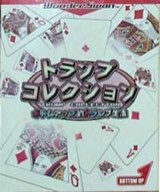
Bottom Up's card collection for the WonderSwan: Daifugo, Page One, poker and blackjack against computer characters, with wins earning furniture for a house.
Screenshots
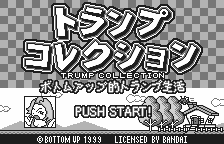
Title screen 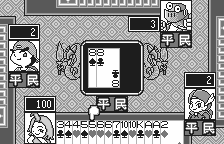
In play 
Trump Collection: Bottom-Up Teki Trump Seikatsu is a collection of playing-card games for the original WonderSwan, made and published by the Japanese developer Bottom Up and released on 1 July 1999, four months after the console went on sale. “Trump” is the Japanese word for playing cards, and the game continues Bottom Up’s Trump Collection series, which had started on the Super Famicom in 1995 and moved on to the Game Boy and the Nintendo 64.
Four card games are included: Daifugo (also called Grand Millionaire), Page One, blackjack and poker, all played against computer characters. Around them is a light life-simulation frame, as the subtitle about a “card life” suggests: wins earn experience points, experience points bring household goods, and furnishing the rooms is what moves the game on.
The story
There is no plot as such. The subtitle’s “card life” is the whole premise: the player takes the part of one character, shown in a room of their own, and the way to fill that room with furniture is to play cards. Wins in card tournaments raise the character’s experience points, and at set totals a prize arrives. Filling a room with all of its household goods clears that stage and opens the next.
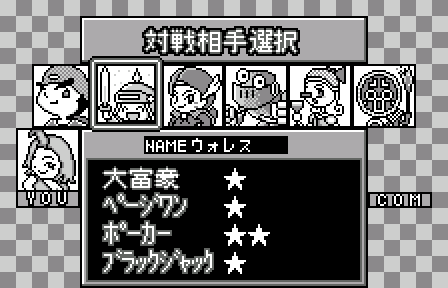
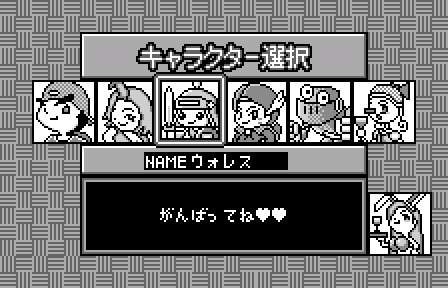
At the start the player picks one of six characters, each with an age, a short life story and a game they are best at. Yutaka-kun is a hard-working 16-year-old from Gunma who bought his own house with what he saved from a newspaper round, and he is good at Page One. Camerin is a 21-year-old tomboy with a good figure whose game is Daifugo. Wallace, 13, is a trainee warrior who practises swordsmanship whenever he has a spare moment and has a bit of a temper; he plays poker. Inde-chan is an 8-year-old girl from a vast land who does not take kindly to being treated as a child, and her game is blackjack.
The other two are the oddest of the set. C2-PO is a robot of unknown age built from scrap, called Iron Man by its robot friends, and it plays Page One. Rosette, 24, is cheerful and popular, has always liked a drink and has been drinking heavily since her boyfriend left her; her game is poker. The same faces turn up across the table, and as the player’s experience grows new characters join them, more than twenty in all, each with its own way of thinking about the cards.
The prizes are handed over by the tournament chairman, and the screen cuts to the chairman’s room whenever a new item is won. One of the prizes is a staircase, which opens the upper floors of the house to furnish in turn, and the manual hints that something waits further up without saying what.
How it plays
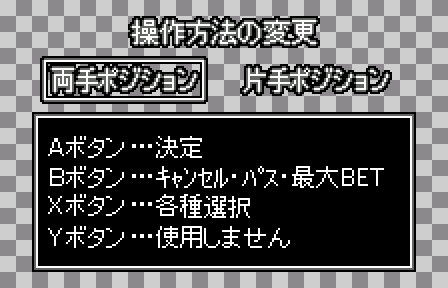
The WonderSwan is held horizontally, and the Options screen offers two control layouts. In the two-handed layout the X buttons move the cursor, A confirms or turns a page and B cancels or goes back, with the Y buttons unused. The one-handed layout puts everything on the left side: the X buttons still move the cursor, while Y4 confirms and Y2 cancels. The title screen has a skippable opening demo, a new-game option and, once a save exists, a continue option.
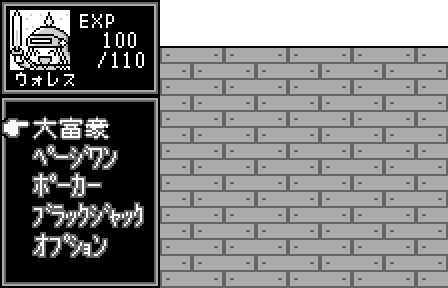
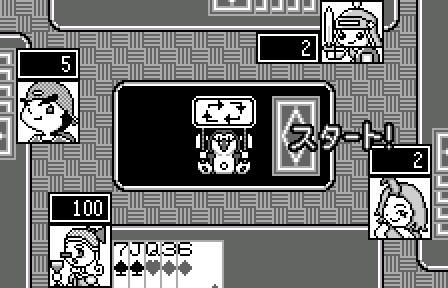
The home screen is the character’s room. It shows the current experience points, which start at 100 in a new game, the total needed for the next prize, the character’s face and name, the floor the player is on and how many of the items have been collected. Its menu has three choices: enter a card tournament, move to another floor, or save. There is one save, kept in the WonderSwan’s own internal memory; saving overwrites it, and other games that save to the console can erase it.
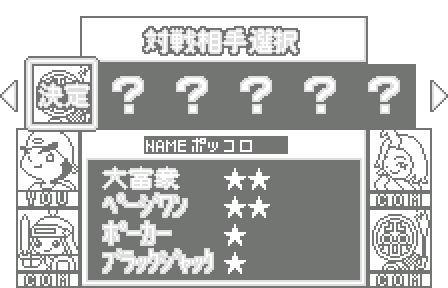
Choosing cards leads to a second menu with the four games and the options. Before each game the player chooses opponents: three for Daifugo and Page One, one for poker and blackjack. Six characters are available at first, and more appear as the player’s experience reaches certain levels. A star rating shows how strong each character is at each game, and stronger opponents are worth more experience. A character who is strong at one game can be weak at another, so the best way to climb is to pick opponents that suit the player’s level.
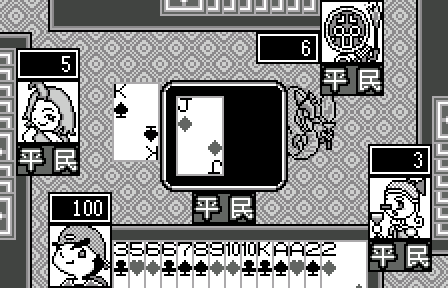
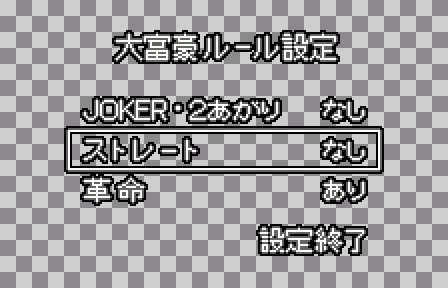
Daifugo is a shedding game in which each player must beat the card on the table with a higher one, or pass. Cards rank from 3 up to king, then ace, then 2, with the joker on top. Pairs and sets of the same number can be played together, as can runs of three or more consecutive cards in one suit. Players finish as Daifugo, Fugo, Heimin or last place, and in the next round the loser hands the winner their two strongest cards and the second-to-last player gives one to second place, getting cards of the winners’ choice back. Playing four of a number causes a revolution that reverses the order of strength until another revolution restores it. The options can switch runs, revolutions and the rule on going out with a joker or a 2 on or off. Experience is the sum of the values of the characters who finish below the player, and Page One pays out the same way.
Page One is played by matching the card on the table by number or suit. A queen reverses the order of play, a jack skips the next player, an 8 lets the player name the suit, and a 2 makes the next player draw two, which can be stacked up to eight cards. A player down to the last card must declare Page One with the X1 button or draw four cards as a penalty.
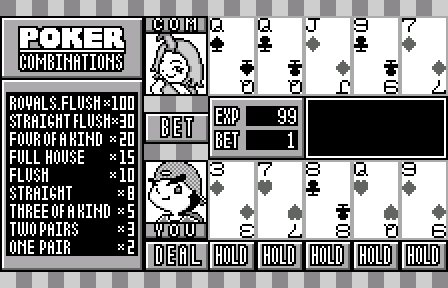
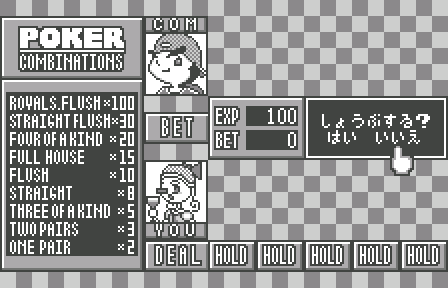
Poker and blackjack are played one against one, and the player bets experience points, with A adding one unit and B betting the maximum, which depends on the opponent and rises roughly with their level. In poker the player gets five cards, holds any of them, makes one exchange and compares hands. A win pays the bet times the hand’s multiplier, from 2 for one pair, 3 for two pair, 5 for three of a kind, 8 for a straight, 10 for a flush, 15 for a full house, 20 for four of a kind and 30 for a straight flush up to 100 for a royal straight flush, and a loss costs the bet times the opponent’s multiplier. When neither side has a hand it is a draw and the bet comes back. Cards rank from 2 up to ace, and the suits are ranked too, with spades highest, then hearts, diamonds and clubs.
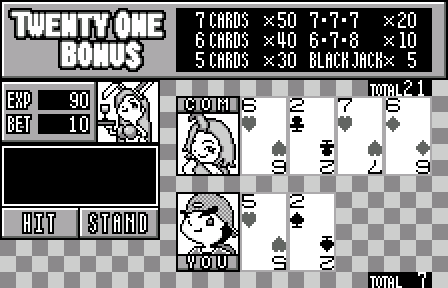
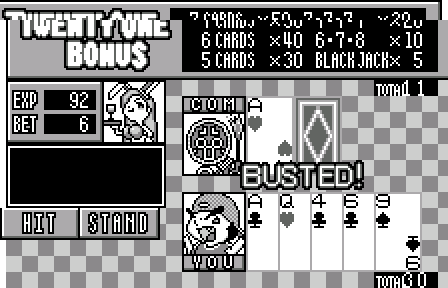
Blackjack has the usual deal, hit and stand, and the hand nearer 21 wins, while going over loses the bet and a tie returns it. A plain win pays double the bet. Reaching 21 in special ways pays more: 5 times for a blackjack, 10 for 6-7-8, 20 for three 7s, and 30, 40 or 50 for 21 made with five, six or seven cards. Because a bad run can wipe out what Daifugo and Page One earned, the manual advises against throwing experience away on big bets.
There are 53 items to collect. Each time the experience total reaches its target, the chairman hands over the next one, and when the staircase is won the floor-move command opens the second floor, then the third and beyond. A full run takes about four to five hours. Daifugo’s many local rules cannot be set beyond those three switches, and the small screen makes some of the text hard to read.
Development and release
Bottom Up published the cartridge itself rather than through Bandai, under the model number SWJ-BTM001 and at a price of 3,980 yen before tax, on a 4-megabit cartridge played with the console held horizontally. The copyright line names Bottom Up alone, dated 1999, and no other company took part. In the same year Bottom Up also released a card game collection for the Game Boy Color, Pocket Color Trump, in December.
Modes and features
The game is for one player only. There is no link-cable play, so all the opponents are computer characters, and the sound is stereo. There is a single mode, the furnishing campaign, with the four games played inside it.
Ports and other versions
This collection was made for the WonderSwan, and it was never ported to another system or re-released. It sits in Bottom Up’s run of card game collections: Super Trump Collection and its sequel on the Super Famicom in 1995 and 1996, Trump Collection GB on the Game Boy in 1997 and 64 Trump Collection on the Nintendo 64 in 1998. The WonderSwan cartridge is a separate entry in that line rather than a conversion of one of them, with its own selection of four games and its tournament-and-furnishing frame, and Pocket Color Trump on the Game Boy Color is likewise a different game from the same maker.
Later history
This was Bottom Up’s first game for the WonderSwan. A sequel, Trump Collection 2, followed in 2000 with four different card games, but it reached the shops only after Bottom Up had closed at the end of March that year, with another company stepping in as publisher. The two WonderSwan games were the last of Bottom Up’s works to carry the Trump Collection name.