
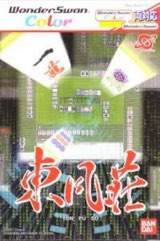
Bandai's WonderSwan version of Tonpuusou, the Japanese online mahjong service, played against computer opponents, with ratings linked through the Mobile WonderGate adapter.
Screenshots
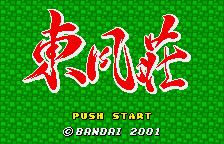
Title screen 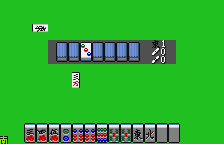
In play 
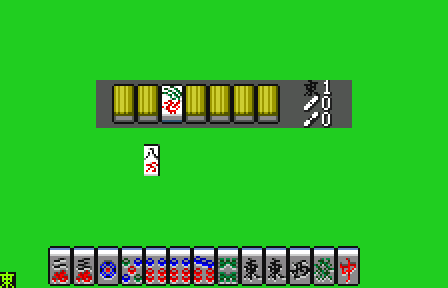
Tonpuusou is a mahjong game for the WonderSwan, published by Bandai on 28 June 2001. It carries the name of Tonpuusou, one of the best known online mahjong services in Japan, which opened in 1997 after a test period from late 1996. The service was named after the short east-round-only game, and its main free server was set aside for that format, with others for full games and three-player mahjong.
The cartridge brings the service to a handheld. With the Mobile WonderGate, the optional adapter that connected the WonderSwan to the network, players could send the results of their games on the cartridge to the service and enter its national rankings. That connection depended on the mopera service, and these online features stopped working when mopera closed, while the service itself carried on until its closure was announced for March 2018.
Tonpuusou belongs to the small group of cartridges that use colour on the WonderSwan Color but still run on the original black-and-white WonderSwan. It was classed in Japan as a table game, and it sold for 4,500 yen before tax.
The story
Tonpuusou has no story. It is a game of mahjong, and its setting is the online mahjong parlour whose name it carries: a place where people met at tables over the internet, which the cartridge brings to a handheld for one player. Bandai sold it as serious mahjong rather than a novelty, with the rules and the feel of the service kept as they were, and the play screen was arranged to look like the service’s own table.
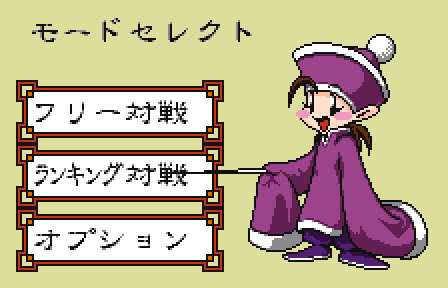
The nearest thing to a character is Tonpuu-chan, the girl who was the service’s mascot. She wrote a weekly column about the cartridge in the service’s mail magazine around its release, reported on its tournaments for the promotional site, and appears on the cartridge as a moving figure, so the service’s face goes with it to the handheld.
What frames the game is its tie to the service. The cartridge was presented as a training hall for online play, where a beginner could learn the rules and a regular could keep practising away from a computer, and the rating it keeps is the same number by which the service ranked its players. The administrator of the service, Katu Azuma, supervised it closely, and the computer players were promised to play fair, without cheating, so that a game on the cartridge felt like a real game on the service.
How it plays
The WonderSwan is held sideways, and the game runs on the original black-and-white console as well as the WonderSwan Color, where colour makes the tiles easier to tell apart. It is for one player, who sits at the table with computer opponents. A game selection screen at the start chooses the format, and from there it is an ordinary game of Japanese mahjong played against the machine.
The formats are those of the service. The full east-and-south game plays both rounds; the east-only game, from which the service takes its name, is a short game of the east round alone; and three-player mahjong takes one player away from the table and adds red bonus tiles to the rules. All the rules were the same as those in use on the service when the cartridge came out, so it served as practice for the real thing.
The centre of the game is the rating, the number that measures a player’s strength. A higher rating means a stronger player, and it moves with results, with the ratings of the opponents and with the number of games played. A screen in the game gives a guide to what different ratings mean. In the single-player game the computer opponents draw on the same system: they grow stronger as the player’s rating climbs, so the game keeps pace with the player. The opponents differ from one another in how they play, and Bandai noted that the programmer in charge of them was a strong player who had reached eleventh place during the qualifying rounds of the service’s first tournament.
The WonderGate adds the online side. Connecting through the adapter links the player’s rating on the cartridge with the same player’s rating on the Windows version, so that a game played on a train counted towards the rating used on the computer. The connection also entered the player in a nationwide ranking of yakuman, the highest-scoring hands. For the second tournament in August 2001, which Bandai ran to mark the release, two places in the final were set aside for WonderSwan owners who had connected through the WonderGate during the qualifying period. None of this works any longer, as the connection depended on the mopera service.
The game has no ending and no stages; it is played one game after another for the rating. There is one hidden reward. After 100 games in the single-player mode, the player can read a section of remarks by Katu Azuma, the author’s own idle talk recorded for the cartridge, in which he also writes about what he had been doing. The game saves to the cartridge’s small EEPROM, so the rating carries over from one session to the next.
Development and release
Bandai described Tonpuusou as a network game with more than 600,000 registered users and around 400,000 visits a day, and the copyright lines name BNT Corp., short for Business Network Telecom, beside Bandai. Bandai said the computer players had passed strict checks by the author of the original, who cared a great deal about its playing logic. The studio that programmed the cartridge is unknown. Arowana, the company that hosted the game’s promotional website, announced that it had cooperated in making the WonderSwan version. The same company helped plan and run tournaments for the online service, and it later cooperated on a PC mahjong game, GAMESPACE Tonpuusou 24.
The promotional site announced a prize campaign of black mahjong tiles to mark the release, and a report on the first Net J Cup mahjong tournament presented by the service’s mascot character.
Modes and features
The cartridge offers the same three formats as the internet service: the full east-and-south game, the quick east-only game and three-player mahjong. Play is against computer opponents, the rating is linked with the Windows version through the WonderGate, and the cartridge runs on both the original WonderSwan and the Color.
Ports and other versions
Tonpuusou was a computer game before it was a cartridge. The service is played through client software that each player installs: a Windows client, a Mac OS 9 client distributed in the past and a Java test version, as well as an app for the i-mode, EZweb and Yahoo! Keitai mobile phone services that was being advertised in 2009. Bandai presented the WonderSwan game as a port of the internet game to the WonderSwan Color that kept the feel of the original, and it was the first game console version of the service. A second followed a year later: Internet Mahjong Tonpuusou de Asobou, developed and published by Success for the PlayStation 2 on 13 June 2002, connected to the service so that its players could sit at the same tables as computer users, and offered computer opponents offline.
The handheld version differs from the service mainly in who sits at the table. On the cartridge the opponents are computer players, whose play Bandai described as passed by the original’s author and as standing comparison with the original, while the service matches people over the internet; the publisher pitched the cartridge as a place to practise before playing online. The rules and modes are the same, and Bandai pointed out that colour on the WonderSwan Color makes the tiles easier to tell apart. Through the WonderGate the cartridge linked the player’s rating with the Windows version and fed a national ranking of yakuman. The PC game GAMESPACE Tonpuusou 24 and Tetsuya@Tonpuusou, which combined the service with the Tetsuya manga, are separate products rather than versions of this cartridge.
Notes
Famitsu gave the game no Cross Review score and classed it as a table game, while Bandai called it simply mahjong.