
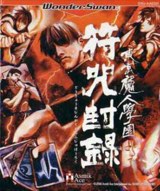
A card battle game in the Tokyo Majin Gakuen occult series, in which the dying hero of Kenpūchō becomes the guardian god of two young exorcists and fights with five kinds of card.
Screenshots
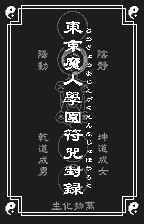
Title screen 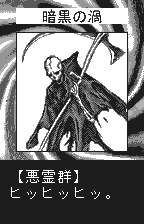
In play 

Tokyo Majin Gakuen: Fuju Hōroku is a card battle game for the WonderSwan from Shout! Design Works, the studio behind the Tokyo Majin Gakuen series, and the publisher Asmik Ace. It is the second game in the series, not counting a fan disc, and it builds on the first, Tokyo Majin Gakuen: Kenpūchō for the PlayStation. The scenario is newly written, and it brings in more than 150 characters from Kenpūchō, its fan disc Oboro Kitan and a drama CD.
The game alternates between story chapters, told in conversation scenes, and card battles fought with a deck drawn from roughly five hundred kinds of card. Its ideas draw on Japanese occult traditions such as yin and yang, the five elements and summoned spirit servants.
The story
The game opens at Sakuragaoka Hospital, where doctors are failing to save a dying young man. His soul drifts into a vortex of darkness between life and death, and there a woman’s voice asks him his name, which the player enters; the default is Tatsuma Hiyū, the hero of Kenpūchō. A mass of lost spirits, souls that clung to life until they lost themselves, tries to drag him down, and fighting them off is the first battle. The voice tells him that a special bond carved into his soul is calling him onward, and that he will keep his own self in the world he goes to next.
He wakes on Kurayami-zaka, a slope in Tokyo, beside an old god named Enra, who has pulled him out of the darkness. On the slope a phantom killer has been murdering passers-by, and a malign energy has driven the crows mad enough to attack two young people. Enra is the guardian deity of these two, and he hands the role over to the hero, who answers their call and comes down to fight beside them. Enra then leaves on business of his own, asking him to protect the pair.
The two are Shun Yamura, a summoner who calls on his guardian god, and Isuzu Mizukane, a shrine maiden. Shun is stiff and formal and insists on treating the hero with the respect owed to a god, while Isuzu thinks he looks like any boy of their age in a school uniform and talks to him as a friend. Together the three set out to quiet the source of the evil on the slope, and from there the story moves across Tokyo in search of the sins that threaten it.
The story runs over thirteen chapters, each with its own title, from Darkness for the first to Summoning for the second. Between chapters the hero passes an interval at a temple called Kōmyōin, where the characters talk and new cards are handed over. The tone is dark and occult, with lost souls, maddened animals and a killer at large in the city, lightened by the bickering between Shun and Isuzu.
How it plays
The WonderSwan is held upright. In the conversation scenes the player answers the other characters through the series’ emotion input, which offers eight kinds of feeling, such as love, friendship, anger and sorrow. The replies mainly decide which cards the hero is given rather than branching the story, although the final balance of emotions alters part of the ending. At the start the player enters the hero’s name, birthday and blood type, and the elements of the starting deck change with the hero’s place of origin.
In a battle each side is a card user with a pool of life, and the battle is won by bringing the other side’s life to nothing; the first enemies have sixty life. There are five kinds of card. Character cards, drawn from the cast of the series and from its monsters, are the fighters, each with attack, hit points, speed and an action point cost, an element among wood, fire, earth, metal and water, and a yin or yang nature. Possession spirit cards attach to one character, for example giving it the aiming skill or sending it back to the hand when it falls. Barrier spirit cards change the rules for the whole field, such as dealing ten damage to every character at the end of each turn. Spell cards have one-off effects, such as drawing three cards, wiping every barrier from the field or raising the action points for a turn, and land cards, named after places in Tokyo, set up the field.
Every card costs action points, and the strongest need the most. Character cards are laid face down and turn face up at the start of the next turn, so a newly laid card cannot attack that turn, except for cards with a quick-attack skill, which players consider the strongest. Land cards raise the field level of one element by one, or by more at a cost in life, and some also strengthen the characters linked to that place. As the field level rises, each character card gains up to three further skills of its own, and damage taken is reduced; the generating and overcoming cycles of the five elements push the level up or down, and knock-back from the PlayStation games is also part of the rules. Decks hold sixty cards, and one redraw is allowed at the start of a battle.
Cards are generated as they are won, so two cards with the same name can differ at random in their values, element and some of their special skills, and cards can be combined to make stronger ones. A collection holds at most 999 cards. Once it is full the game no longer lets the player choose which cards to keep, and saved games on the WonderSwan were often corrupted, a fault put down to the hardware, so it pays to keep the collection below the limit.
Story progress depends entirely on winning battles, and enemies grow much stronger towards the end, so the way forward is to rebuild the deck and retry rather than simply level up. The rules take time to learn, but a careless player seldom loses outright; the battle simply drags on for many turns.
Two players can battle each other by joining their consoles with the link cable, which is also a way of earning cards. The cartridge holds a 64-megabit ROM. A Game Boy Advance version followed in 2004.
Development and release
Shout! Design Works, the studio that created the series with Kenpūchō, developed it, and the copyright line names Asmik Ace and the studio together. The game was promoted on its 64-megabit cartridge, unusually large for a card game, and on a card generation system advertised as producing more than 120,000 distinct cards. The character art was no longer by Michi Kobayashi, who had drawn Kenpūchō; another illustrator took over. A complete strategy manual supervised by Shout! Design Works followed in November 2000, along with an official guidebook.
The story is set apart from the main series. The hero of Kenpūchō, near death after a battle, is called to serve as the guardian deity of a young summoner and, with him and a shrine maiden of sealing, seals away the sins that threaten Tokyo. Characters from the earlier games return mainly as cards. The summoner and the shrine maiden appear again as summoned spirits in a later entry in the series, Gehōchō.
Modes and features
Beside the thirteen chapters there is a dungeon a hundred floors deep, an echo of the endless old school building of Kenpūchō. From the second playthrough the hero can be made a girl, with her own events, a changed card for the hero and a higher chance of drawing male character cards.
Reception
Japanese fans welcomed a new entry in the series and found that it made good use of the console’s upright layout and eight buttons, and some bought a WonderSwan just to play it. Its timing was regretted, though: the WonderSwan Color arrived two months later, and fans joked that for once Shout! Design Works had released something too early. Fans were divided over the new illustrator’s eerie, seductive style, which made familiar characters hard to recognise, and over the female hero, who cannot have romance with the main cast. Voices are hard to make out through the speaker, so headphones were recommended. Some newcomers to the series found the rules too complicated to learn.
Ports and other versions
Fuju Hōroku began on the WonderSwan, and its one other version is a Game Boy Advance edition released on 1 April 2004 for the series’ fifth anniversary. Marvelous Interactive published it, Shout! Design Works developed it again, and it came on a 128-megabit cartridge at 6,090 yen including tax. Marvelous announced it in December 2003 as a complete edition of the handheld game with more than five hundred cards and a haiku mode; it is a port of the WonderSwan original. There has been no further release.
The port gave fans the colour they had wished for, with the screen proportions redrawn for the Game Boy Advance, a higher resolution, better sound quality and art by the same illustrator that now looked more like the familiar characters. It added a large number of cards for characters from later series entries, Gehōchō, Gehōchō Keppūroku and the manga Yōto Chinkonka, premium cards drawn by the series’ illustrators, booster packs opened like real card packs, and a shop where unwanted cards can be traded in. Most new cards are won only by entering the right poem in the haiku gathering, with the answers released bit by bit in books and guides, the second playthrough becomes a new chapter called Byakko-hen, and cards for Kowloon Yōma Gakuenki, released half a year later by another publisher, are the final secret. The choice of who moves first changed from a roulette to drawing numbered face-down cards.
Some changes were less welcome. Element cards can no longer be played unless the field level is at least one, some effects that could be skipped on the WonderSwan cannot be, and, depending on the production lot, the card list freezes once enough kinds of card have been collected. Because the Game Boy Advance has only two face buttons, this is the one entry in the series without the usual emotion input chosen with the direction pad and four buttons. The port is generally seen as a worthy anniversary release, but the card rules became more complicated and the pace slower, which bothers players who know the WonderSwan game more than newcomers.