
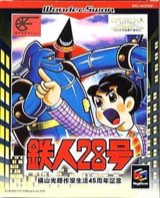
An adventure game based on Mitsuteru Yokoyama's original Tetsujin 28-go manga and its first black-and-white anime, with command-input robot battles.
Screenshots

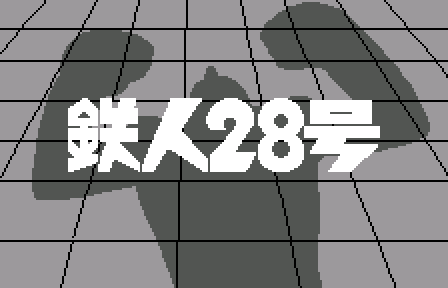
Title screen 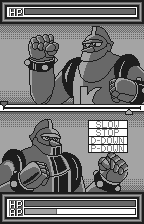
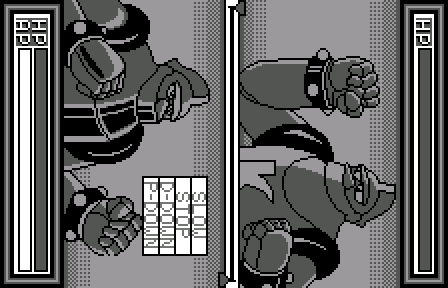
In play 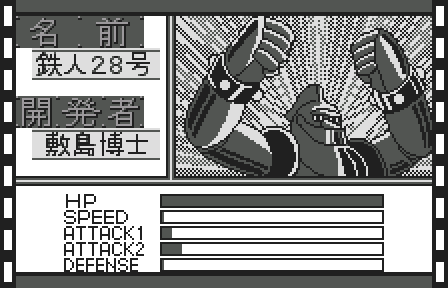

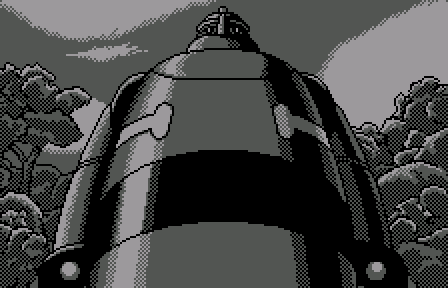
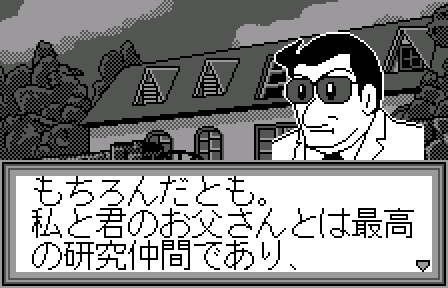
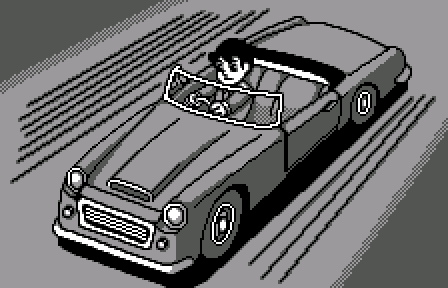
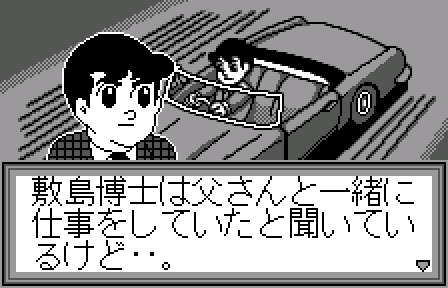
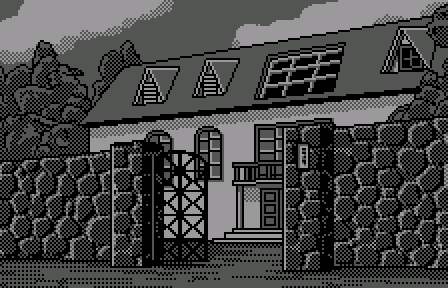
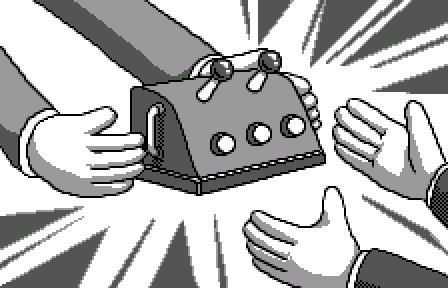
Tetsujin 28-go is a WonderSwan game based on Mitsuteru Yokoyama’s robot manga, which began serialisation in 1956, and on its first television anime, the black-and-white series of 1963. MegaHouse released it in Japan on 22 December 1999 to mark the 45th year of Yokoyama’s career as a manga artist. It follows the original manga and that first anime, although some details of the setting differ, so the old monochrome version of the story returns on the WonderSwan’s own monochrome screen.
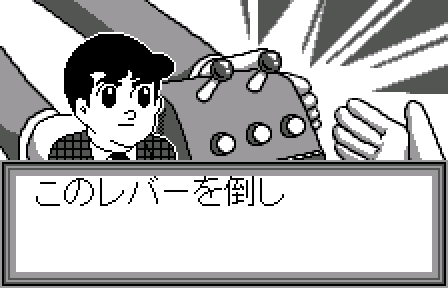
The player follows the boy detective Shōtarō Kaneda, who controls the giant robot Tetsujin 28 and uses it to solve a series of strange and difficult cases. The story is told as an adventure game, and the fights switch to battles fought by entering commands, which call for fast, accurate input and sound judgement.
The game is for one player and uses the console both upright and sideways. It has mono sound and saves to SRAM on the cartridge. It does not use the link cable.
The story
The hero is Shōtarō Kaneda, a boy detective whose intelligence and nerve have earned him the respect of the police and a part in solving many cases. He is also a first-class shot, and his name is known around the world. The game follows the original manga and the first black-and-white anime, and many enemy robots from that original return, among them Black Ox.
The game rewrites the opening of the story. Shōtarō’s late father Dr. Kaneda designed Tetsujin to prepare for a coming wave of crimes committed with giant robots, and his friend and fellow researcher Dr. Shikishima finished it from the plans. On the anniversary of his father’s death Shōtarō is called to Shikishima, who hands the robot to him as his father wished; the boy is shaken but resolves to use it against evil. The robot’s wartime origin in the manga is left out, and Shōtarō already knows both Shikishima and Police Chief Ōtsuka when the game begins.
Tetsujin moves only by remote control, and Shikishima teaches Shōtarō to steer it in practice bouts against a training robot he has built, the Kaloria Tetsujin, which looks much like Tetsujin but has a K on its chest. The cases then begin. The story is divided into episodes, and each one opens with a call from Chief Ōtsuka.
In the first case mysterious robots have attacked the control room of the express train Pegasus, and Tetsujin must fight its way through them. The culprit gets away, and the story runs on into the next episode, in which a criminal announces an attack on the office towers of Shinjuku and demands that Tetsujin be handed over. While Tetsujin guards the city, the police and Shikishima investigate who is behind it. The second episode’s title promises a scheme to build a robot empire. The short story rearranges several episodes of the manga, and it was promoted with the promise that its end would reveal an important secret about Tetsujin.
How it plays
The story scenes play as a conventional adventure game. For the fights the console is turned upright and the two sets of direction buttons become the two levers of Tetsujin’s remote control, one for each hand. Tetsujin stands at the bottom of the screen and the enemy robot at the top, and the blows are shown as still pictures rather than animation.
A fight is a trade of moves, and the first side to empty the other’s HP wins. A gauge in the middle of the screen fills as time passes, and a move can only be made once it is full, so speed decides who acts first. Every move is made by pressing a direction on both pads at the same time. Both pads pressed up gives a punch, both pressed outward a kick, and both pressed down a block. The special moves are short sequences that start with both pads pressed inward: inward then up gives a body charge, inward then outward a jump kick, and inward, down and then up the drill attack.
The special moves are paid for from a second gauge, the AP gauge, which the punch and kick fill, and the drill attack uses all of it. The punch uses little of the action gauge, so the next move comes round sooner; the kick uses more but fills the AP gauge faster. A block reduces the damage of the enemy’s attack and lets Tetsujin strike back quickly. The usual plan is to build up AP faster than the enemy and attack with special moves.
Each episode is a run of fights against many enemy robots, and Tetsujin’s HP carries over from fight to fight with no healing until the episode is over. The boss at the end of an episode is far stronger than the robots before it. The first one barely feels Tetsujin’s blows and can knock it out in a single hit, so Tetsujin has to be trained before it can win.
Tetsujin has five statistics. HP starts at its maximum and never rises. Speed sets how fast the action gauge fills and rises by beating sparring partners. Attack 1 is punching power and Attack 2 kicking power, and each rises by using that move; Defence rises by blocking. Training means practice bouts set up by Shikishima, at first against the Kaloria Tetsujin, and every named robot beaten in the story is later added as a sparring partner.
Growth is slow. Ten or so practice fights bring only small gains, and a boss’s statistics can be far above Tetsujin’s, so beating it can take dozens of bouts. The story itself is fairly short, so most of the playing time goes into training, and with a simple fighting system the repeated bouts soon feel like a chore. Speed is the statistic that matters most, and since the statistics always rise with practice, a player who is weak at action games can still finish the game given enough time. There are no known secrets, no link play and no strategy guide; progress is saved to the cartridge.
Development and release
The copyright line names Hikari Production beside MegaHouse, and the provisional price was 4,200 yen before tax. The game was promoted with the promise that its end would reveal an important secret about Tetsujin. The studio that programmed it is unknown; only MegaHouse is credited. Famitsu files the game under Angel, a Bandai-group company that MegaHouse had absorbed in 1997, with the genre given as action. The game has no known secrets, and no strategy guide was published for it.
Reception
Steering Tetsujin with simple, easily learned commands was found enjoyable, and the hits feel weighty even though the battles are drawn as still pictures. The main complaint was the slow growth of Tetsujin’s statistics: the story is short, and bosses are far stronger than the robot at first, so most of the playing time goes into dozens of practice fights that soon feel like a chore. The same design means that a player who is not good at action games can always win by training long enough, and the game was seen as a fair introduction to the original manga.
Ports and other versions
Tetsujin 28-go was made for the WonderSwan and was never ported or re-released; besides this cartridge, the manga has inspired only one home console game, for the PlayStation 2. That later game, published by Bandai on 1 July 2004, shares the title but is a separate work: it is built on the fourth television anime of that year rather than on the original manga and the first anime, it comes from a different developer, and its contents have nothing in common with the WonderSwan game, so a guide to one is of no use for the other.