
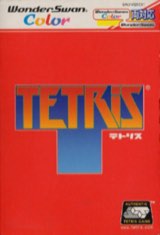
Vanguard's version of Tetris for the WonderSwan Color, with three upcoming pieces shown, hold and ghost piece, three solo modes and link-cable versus play.
Screenshots
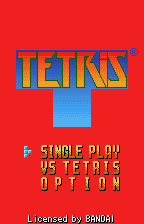
Title screen 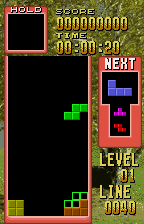
In play 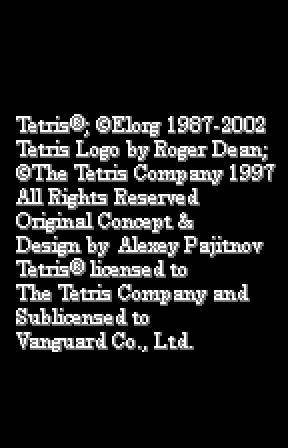

Tetris for the WonderSwan Color is a version of Alexey Pajitnov’s falling-block puzzle game, published in Japan by Vanguard on 18 April 2002 under a sublicence from The Tetris Company. It was sold at a modest price of 2,800 yen. The game was planned with the many improved versions of Tetris released before it in mind, and it is regarded as the first game in Japan to follow the rules The Tetris Company had set for modern versions, coming out eight days before Tetris Worlds on the Game Boy Advance.
It adds three features the original did not have, a preview of the next three pieces, a hold slot and a ghost piece, and offers three modes for one player and link-cable versus play for two. The game is played with the console held upright, which the publisher pointed out had become rare on the Color, and the cartridge also runs on the original black-and-white WonderSwan. The cartridge saves to a small EEPROM.
The story
Tetris has no story, no characters and no setting. Nothing explains where the pieces come from or why they fall: the game is a well ten blocks wide and twenty high, and seven shapes called tetrominoes, each made of four square blocks, drop into it one at a time. The shapes are named after the letters they resemble, I, L, J, O, S, Z and T. There is no ending either. Marathon goes on until the stack reaches the top of the well, and the other modes stop at a fixed number of lines or a time limit.
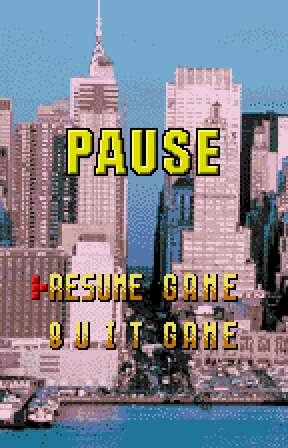
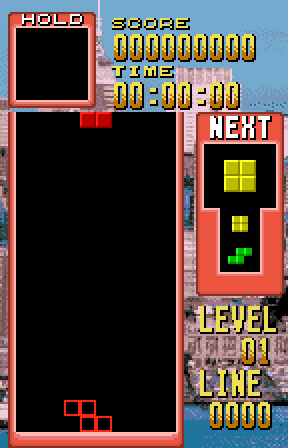
What the cartridge has in place of a story is its presentation. The title screen is red, the music is a light, techno-style arrangement, and a completed row does not simply vanish but breaks apart. The play screen is built around the tall well, with the score, level and other figures packed beside it, so almost none of the background picture shows during play. Pausing reveals the whole of it, a finely drawn scene in the style of the arcade Tetris and its familiar iguana.
The trappings are those of the official licence. The cartridge label prints the title in katakana, the Tetris logo is the one drawn by Roger Dean, and the copyright notice names Alexey Pajitnov for the original concept and design, Elorg and The Tetris Company as the rights holders and Vanguard as the sublicensee.
How it plays
The WonderSwan is held upright for the whole game. Its direction keys are four separate buttons rather than a single pad, so left and right can be pressed at the same time; the two cancel out and the piece stays put, but the auto-repeat that moves a piece quickly sideways stays charged. Pieces can be rotated, soft dropped and hard dropped, though there is no 180-degree turn. The Start button pauses the game, and the pause screen offers Resume Game to carry on.
The rules are the familiar ones. Each piece falls until it lands, and a horizontal row with no gaps disappears, letting everything above it drop down. The game ends when the stack climbs past the top-out line drawn near the top of the well. The screen shows the hold box, the well, up to three next pieces, the score, the level from 1 to 15, the lines cleared and a clock that runs to 99 hours 59 minutes 59 seconds; in the three-minute mode the clock counts down, and in the 40-line mode the line counter shows how many remain.
The game follows the rules The Tetris Company was then setting for modern versions. Pieces turn by the Super Rotation System and are dealt from a shuffled bag of the seven shapes with one extra random piece added, so each set of eight holds every shape at least once. The next piece appears as soon as the last one locks, a cleared row takes about half a second to go, and a piece can slide diagonally into place on a hard drop while the sideways repeat carries over to the next piece. The options set the preview to between zero and three pieces, three being the default, and switch the ghost piece and hold on or off; both are on at the start.
Points for a line clear are a base value multiplied by the current level: 40 for one line, 100 for two, 300 for three and 1,200 for a Tetris of four. T-spins earn nothing extra. Emptying the well completely earns a further million points, a flat bonus that is not multiplied by the level. The line counter adds bonus lines for bigger clears, so a single counts as one line, a double as three, a triple as five, a Tetris as eight and a second Tetris in a row as twelve; the back-to-back bonus goes to the lines only, not to the score.
Marathon is the endless mode. The level rises after five times the current level in lines, so ten lines take the player from level 2 to level 3, and it stops at 15. At level 1 a piece falls one row every 75 frames, and from level 11 it falls a row every frame. The score counter runs to 999,999,999 and the line counter to 9,999, and a tool-assisted run takes about 50 minutes of play to reach the score limit. The 40-line mode times how long it takes to clear 40 lines and the three-minute mode counts the score reached in three minutes. The starting level can be set from 1 to 15 in all three, and the 40-line mode uses the bonus-weighted line counter, so four Tetrises in a row finish it and a tool-assisted run clears it in five seconds.
Versus play needs two consoles, two cartridges and a link cable. A single line sends nothing, two lines send one row of garbage to the opponent, three lines send two and a Tetris sends four. Clearing the well at the same time adds more: two lines and an empty well send two rows, three lines four rows, and a Tetris that empties the field eight rows. A gauge called Enemy shows how high the other player’s stack has grown, so attacks can be timed to land when the opponent is in trouble. Vanguard warned that a loose cable could make a match behave differently from the manual’s description.
There is no ending to reach, so a session lasts as long as the player wants. The long wait before a piece locks in place, which the licence holder’s rules required, makes games run long.
Development and release
Vanguard was a studio whose work was dominated by the SD Gundam G Generation games it programmed for Bandai, and Tetris was a rare release under its own name. Vanguard developed the cartridge and published it itself; it runs on the original WonderSwan as well as the WonderSwan Color. The licence chain ran from Elorg and The Tetris Company down to the sublicence held by Vanguard, and the price of 2,800 yen excluded tax.
Vanguard also ran a small website for the game. It argued that earlier handhelds had squeezed Tetris onto wide, low-resolution screens, while the WonderSwan held upright could give the tall well the shape it needs without wasted space.
Secrets and extras
Vanguard published two hidden features on its own site. Holding the A button while switching on the console, until the WonderSwan logo has gone, starts the game in black and white on a WonderSwan Color, which Vanguard offered for long sessions; nothing else changes. Pressing A on the pause screen steps through the background music, and the chosen track keeps playing when the game resumes.
Reception
The game was well received in Japan, with one review scoring it 75 out of 100. The controls were found unusually pleasant, and it was ranked among the best Tetris versions of its time, with a clear display that suits the upright screen. The complaints were the long delay before a piece locks, which drags games out, and the need for a cartridge per player in versus.
Ports and other versions
Tetris itself began in 1984, when Alexey Pajitnov wrote it on the Soviet Electronika 60 computer, and it had been released on a long line of computers and consoles before this cartridge. The WonderSwan Color game is not a conversion of any one of those versions: Vanguard built its own, programmed for the upright screen, and presented it as an answer to earlier handheld versions that had to fit the tall well onto a wide, low-resolution display. Its rules follow the guideline that The Tetris Company was then introducing, which was largely based on Tetris Worlds; the WonderSwan cartridge reached Japanese shops a few days before the Game Boy Advance edition of that game, and it should not be confused with it or with the Game Boy versions.
This version was released only as a WonderSwan cartridge that plays on both the original WonderSwan and the WonderSwan Color; it was never ported, re-released or offered as mobile phone content.