

A WonderSwan version of the 1993 idol-raising game Tanjou Debut, in which the player manages three girls at a small talent agency for two years.
Screenshots
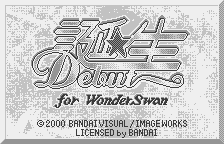
Title screen 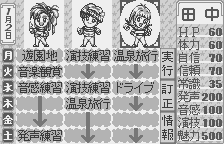
In play 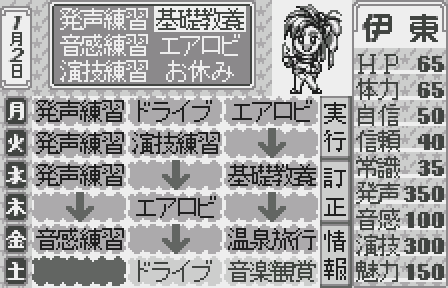

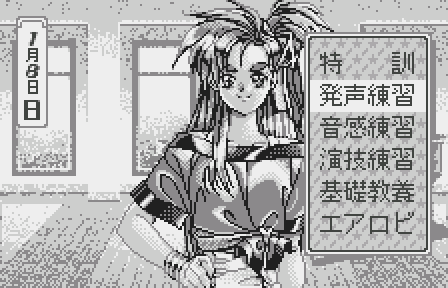
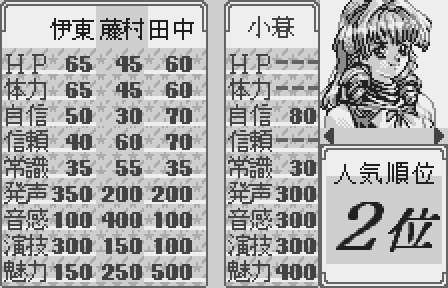
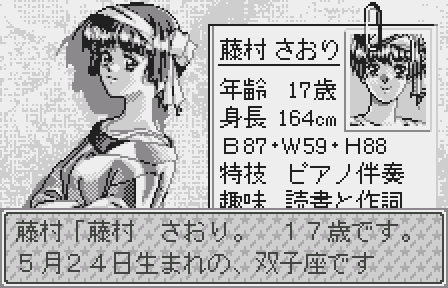
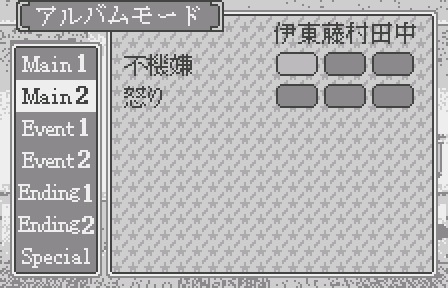
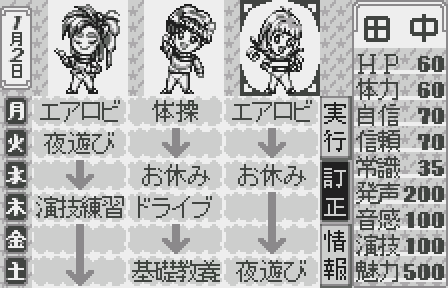
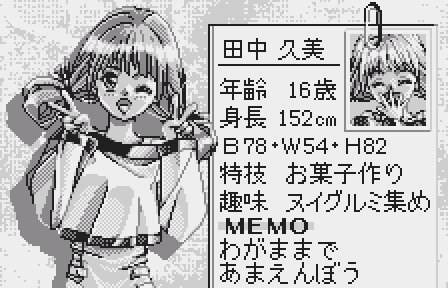
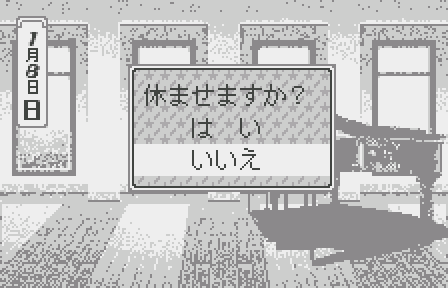
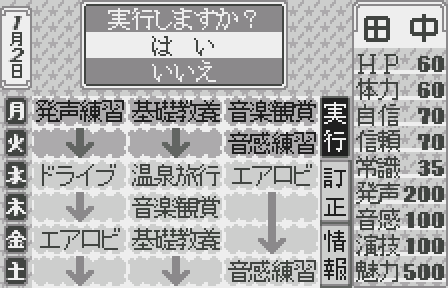
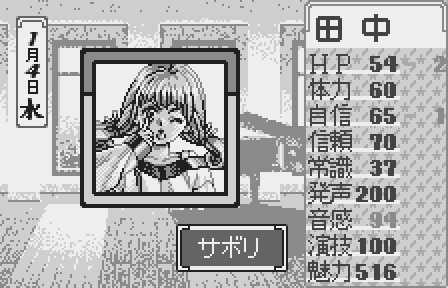
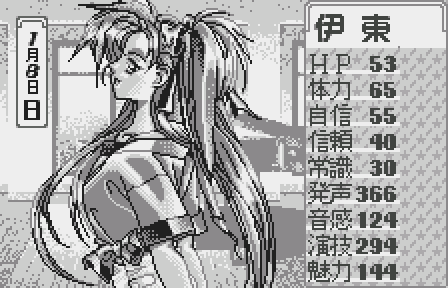
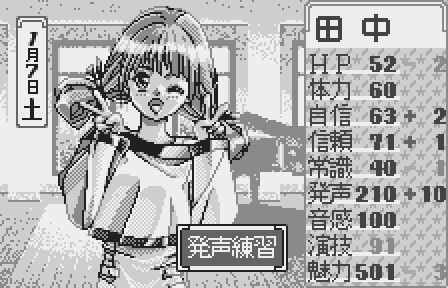
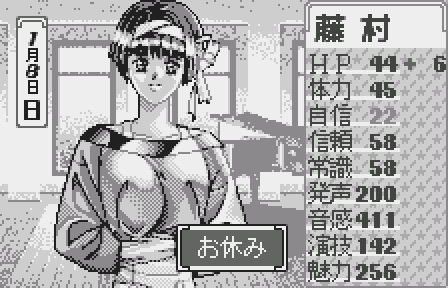
Tanjou Debut is an idol-raising simulation that NEC Avenue first published for the PC-9801 computers in June 1993, as a sister title to Sotsugyou Graduation. It was later carried over to several other systems, the WonderSwan among them. The WonderSwan version went on sale in Japan on 24 February 2000 from Bandai Visual, which also published the Macintosh release, rather than from NEC Avenue. As a game for the original black-and-white console, it also runs on the WonderSwan Color and SwanCrystal.
The player manages a newly formed three-girl idol group at a small talent agency for two years, mostly by planning lessons, jobs and days off, with the Idol Grand Prize as the goal at the end. The WonderSwan version keeps the voiced heroines of the earlier releases and has a new box illustration, and it fixes the name of the group.
The story
The player is the newly appointed manager of Jack Show Production, a tiny talent agency. A new-talent audition has just been held, and the manager scouts three girls who were left over from it and puts them out as a new idol group. From that debut the manager has two years and a limited budget to make them stars, while bigger agencies launch one new idol after another, and the target at the end of the two years is the Idol Grand Prize.
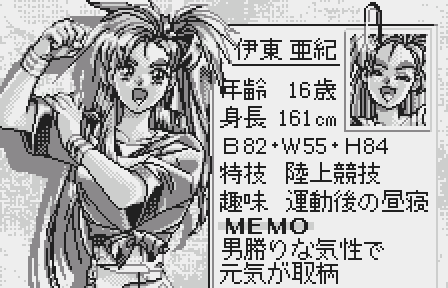
The three heroines differ sharply. Aki Ito, 16, from Yokohama, is a bundle of energy who is good at sport and acting and wants to become a stage actress. Saori Fujimura, 17, from Shimizu in Shizuoka, is the eldest and the demure, old-fashioned one of the three, plays the piano and sings, and dreams of writing and composing her own songs. Kumi Tanaka, 16, from Sapporo, is cheerful and has the most natural star quality, but the least schooling. They are voiced by Mina Tominaga, Hiroko Kasahara and Mika Kanai respectively, and their names are taken from the members of the idol group Candies.
The story unfolds through the weeks of the schedule rather than in chapters: jobs, events and the occasional scandal come up along the way, and rival idols from other agencies compete for the same work and the same prize. At its heart is the relationship between three teenagers and their manager, in which how much the girls trust the manager matters as much as their talent. What becomes of them at the end depends on the result of the Grand Prize and on how they were raised, and the outcomes range from a solo debut to a move into acting. On the WonderSwan the group is always called DEBUT.
How it plays
The game is for one player, with the console held sideways, and it saves to the cartridge. The screens are black and white, but the WonderSwan version reproduces Masaki Takei’s character art closely, and the heroines speak. There is no link-cable play. The system is close to that of the sister game Sotsugyou Graduation: the player draws up the girls’ schedules and watches their statistics change.
The lessons include voice training, musical sense and acting, and they raise the girls’ parameters. The three are moody, though: they skip lessons they dislike and are quickly laid up when worn out. Because the three are judged as one unit, the weak points of every girl have to be brought up, not only her strengths.
Jobs come in along the way, and work gives the group experience and a reputation, while events and scandals test whether the manager has prepared the girls well enough to carry on. Rival idols from bigger agencies are after the same work and the same prize, so the group has to keep up with them over the two years.
A game lasts the full two years and ends with the Idol Grand Prize. The ending each girl reaches depends on that result and on how her abilities and her trust in the manager were built up, so a different plan for the two years leads to a different outcome.
Development and release
The WonderSwan version was the second of two adaptations Bandai Visual made of the sister games: Graduation for WonderSwan had come out on 16 December 1999, and Debut followed about two months later. Both were made by Image Works, whose name appears beside Bandai Visual’s in the copyright lines of both games.
The game came on a 16-megabit cartridge with 256 kilobits of save memory, played with the console held sideways, with mono sound, no link-cable play, and a planned price of 4,200 yen before tax. Bandai pointed out that the three heroines were voiced by the same actresses as in the computer, PC Engine and Saturn versions, Mina Tominaga, Hiroko Kasahara and Mika Kanai, and that Masaki Takei, the original character artist, drew a new illustration for the box.
Ports and other versions
The WonderSwan cartridge is the last of a long run of versions of a computer game. The PC-9801 original from NEC Avenue came out in June 1993, followed by a CD-ROM release by Data West for the PC-9821 and the FM Towns in April 1994, a Super CD-ROM² version for the PC Engine from NEC Avenue that September, a Macintosh version from Bandai Visual in July 1995, a 3DO version titled Tanjou Debut Pure from Hokubu Tsuushin Kougyou in March 1996 and a Sega Saturn version titled Tanjou S from NEC Interchannel that June. The WonderSwan release arrived nearly four years after the Saturn one, and later even than the 1998 PlayStation sequel. A harder PC Engine edition, Gekitou-hen, was given to 20 prize winners instead of being sold.
On the WonderSwan the name of the three-girl unit is fixed as DEBUT, where the other releases let the player choose it. The heroines are voiced by the same three actresses as in the PC-9821, FM Towns, PC Engine and Saturn releases, although the PC-9821 and FM Towns discs give Ito’s and Fujimura’s parts to each other’s actress compared with the cast used from the PC Engine version onwards. The releases up to the PC Engine version are set in 1994 and 1995, while later ones give no particular year. The Saturn version carried a recommendation for players of 18 and over, the 3DO version an all-ages rating.
Later history
The original game was followed by Debut 21, a PlayStation sequel from NEC Interchannel in 1998 about an android idol, in which the three heroines of the first game return as teachers. Around the original the series also had a two-part original video animation in 1994, drama and music CDs, a novel and comics.
Notes
Bandai Visual published both the Macintosh and the WonderSwan releases, the latter on 24 February 2000. The developer’s name is written Image Works in this game’s copyright line and IMAGE WORKS in Graduation’s.