
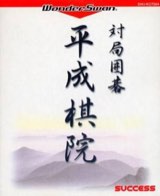
Success's Go program for the WonderSwan: a fast computer opponent by Ken Chen at four levels on 9x9 and 13x13 boards, a beginners' introduction and link-cable play.
Screenshots
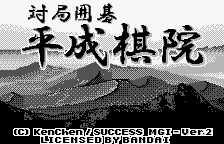
Title screen 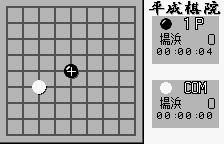
In play
Taikyoku Igo: Heisei Kiin is a Go program for the black-and-white WonderSwan. Success published it, and it went on sale in Japan on 24 February 2000, a little under a year after the console was launched.
It is a plain Go program with no extras around it. One player takes on a computer opponent whose thinking routine is credited to Ken Chen, whose Go software had won competitions between Go-playing programs, at any of four strengths and on the smaller 9-by-9 and 13-by-13 boards rather than the full-sized one. A basic introduction teaches newcomers, and two players can meet over the link cable. As a game for the original WonderSwan, the cartridge can also be played on the later WonderSwan Color and SwanCrystal.
The story
There is no story. Taikyoku Igo: Heisei Kiin is a game of Go and nothing else: there are no characters to meet, no tournament to climb through and no setting beyond the board itself. The only opponent is the computer, which is never given a face or a name and appears on screen simply as COM.
What the game has instead is a look borrowed from the world of traditional Go. The box shows the title brushed in large black calligraphy over a pale ink-wash scene of mountains fading into mist, with only the WonderSwan and Success logos in colour. The title screen repeats the idea in the console’s black and white, with the same brushed lettering set over a range of misty peaks.
The playing screen keeps that quiet, formal mood. The board takes up the left of the wide screen as a plain grid with black and white stones, and a narrow panel on the right carries the name Heisei Kiin in brush-style characters above a box for each side. While the computer is choosing a move, a short note in its box says that it is thinking.
How it plays
The console is held sideways. Before a game, a settings screen sets the conditions of the match. The first line decides who plays Black: the player, the computer, or a second player. The next lines choose the computer’s level from 1 to 4 and the board, 9-by-9 or 13-by-13, and a handicap line sets the terms of the game, with an even game and a komi of five and a half points as the starting choice. A final pair of options confirms the settings or goes back.
During a game the stones are placed on the grid one move at a time. The panel beside the board shows, for each side, its stone colour, who is playing it, how many of the opponent’s stones it has captured and how much time it has used so far, and a line of text announces whose turn it is. The computer answers quickly, so games against it move along without long waits.
The four levels run from 1, the weakest, to 4, and are meant to give everyone from beginners to experienced players a fitting opponent. A near-newcomer to Go can beat level 1, though not without effort. Only the two smaller boards are offered; there is no full 19-by-19 board.
Players who do not know Go can start with the basic introduction, which explains the fundamentals of the game in an easy way before they face the computer. Two players can play each other with two consoles joined by the link cable, on either board. The cartridge also carries 1 megabit of save memory, though what it keeps is not certain.
Development and release
The WonderSwan cartridge belongs to the Heisei Kiin line of Go programs, which began on the PlayStation. The WonderSwan version came out under Success’s own name, and Success listed it on its website among its WonderSwan games beside a hanafuda title.
Bandai promoted the computer opponent’s author as a leading figure in Go-playing programs who had won the International Computer Go Congress among other contests, and promised an engine that was both strong and quick. The game came on a 4-megabit cartridge with 1 megabit of save memory, played with the console held sideways, with stereo sound, at a planned price of 4,680 yen before tax. Its copyright line reads Ken Chen and Success, dated 2000.
Modes and features
The menu offers a game against the computer at four levels, a game between two players over the link cable, and the beginners’ introduction. Both the 9-by-9 and the 13-by-13 boards are available for any game, and the WonderSwan cartridge is the only release in the Heisei Kiin line with a link-cable game between two handhelds.
Ports and other versions
A game with exactly the same title came first on the PlayStation: Taikyoku Igo: Heisei Kiin, released in December 1997 by Game Bank, its copyright shared between Hudson Soft, Success and Ken Chen. It was followed in December 1998 by a second PlayStation game bearing the name of the professional player Yukari Umezawa, published by Daiki with Success as developer. Ken Chen’s engine and the Heisei Kiin name link the WonderSwan cartridge to the 1997 disc, but whether the handheld game is a conversion of it or a new program built for the smaller boards is unknown, and Bandai introduced it without mentioning any earlier version.
The WonderSwan game was never released on another system. What sets it apart in the line is that it offers only the 9-by-9 and 13-by-13 boards and a two-player game over the WonderSwan link cable.
Later history
Success kept the Heisei Kiin name for later Go software, among it Internet Igo: Heisei Kiin 24 for the PlayStation 2, released by Success in June 2002. There was no later WonderSwan game in the series.
Notes
It is not known who programmed the WonderSwan version. The game carries Success’s name as publisher and in its copyright line. The model number SWJ-KGT004 uses the prefix of Kaga Tech, another WonderSwan publisher, and Kaga Tech is sometimes credited beside Success for this release, which suggests that it handled the game’s sale or distribution; Bandai named only Success as the publisher.