
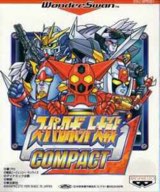
The first Super Robot Taisen game on the WonderSwan and the start of the Compact line, a tactical RPG gathering robots from 19 anime and manga series.
Screenshots
Title screen 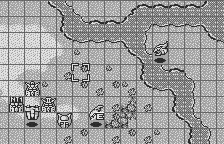
In play 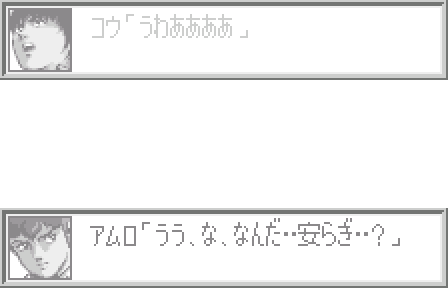
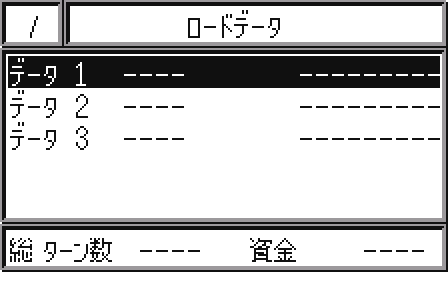
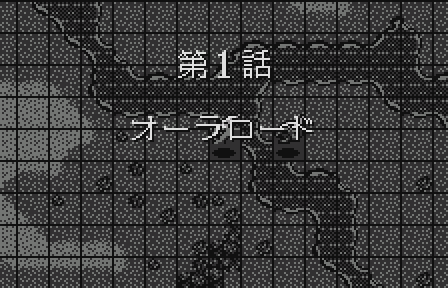
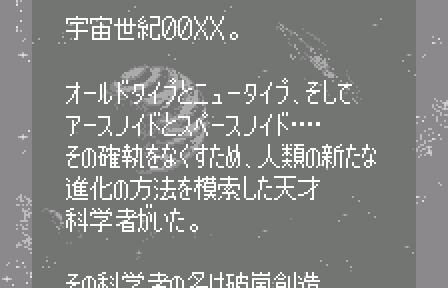
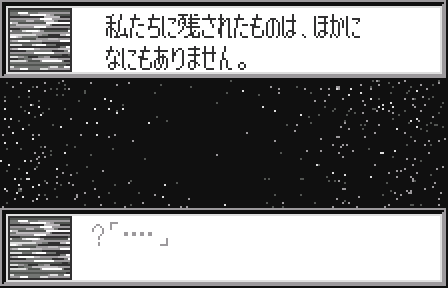
Super Robot Taisen Compact is a tactical role-playing game in Banpresto’s Super Robot Taisen series, in which robots and pilots from many different anime and manga fight side by side. Released on 28 April 1999, it was Banpresto’s first game for the WonderSwan and the first in the Compact sub-series that continued on the system. It was also the first game in the series not made by Winkysoft, which had developed the earlier entries; TOSE made this one. In December 2001 it was released again for the WonderSwan Color in a reworked version.
The cast comes from 19 works, among them several Gundam series, Mazinger Z, Getter Robo, Daitarn 3, Dunbine and Raideen. Ten of them appeared in a handheld game for the first time. Unlike most entries in the series, it has no characters or robots of Banpresto’s own, and even the final enemy comes from a licensed work.
The story has no branching routes and runs through 33 episodes, but it is split into parts, and within each part the player can take the stages in any order apart from the first and the last. Clearing a stage in fewer turns earns a special skill to give to a pilot, and the spirit commands each character learns depend on the personal details stored in the WonderSwan console itself.
The story
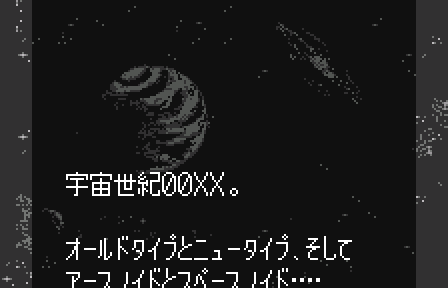
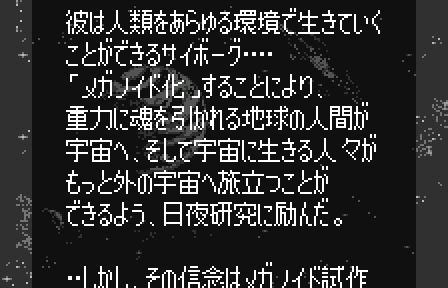
The game is set in an invented Universal Century year. Some time before it opens, the scientist Sozo Haran created the Meganoids, cyborgs meant to help people born on Earth and people born in space live together. His prototypes Zauser and Koros ran out of control and destroyed his laboratory on Mars, and Koros set off a plan to turn humanity into Meganoids at the very moment the Muge Empire invaded. Earth fought the Meganoids while space fought the Muge. The robots of the Saotome Laboratory and the Photon Power Laboratory won the war on the ground, the White Base unit held out in space, and Dancougar went alone into the Muge’s own universe and defeated its emperor.
That victory was not complete. Fragments of the Muge universe are still out there, and no one ever confirmed that Zauser and Koros were destroyed. A year on, Zeon begins its war of independence, the conflict later called the One Year War. The White Base unit, renamed Londo Bell, is given the defence of Earth, and soon a new threat comes from another star system: the people of the planet Baam, who have lost their home world, arrive in Little Baam under their leader Olban to take Earth as a second home.
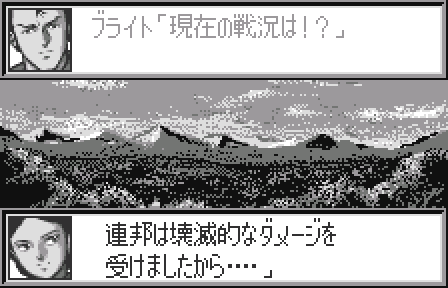
The first episode, Aura Road, opens with Bright, Emma, Amuro, Kou and Chris talking over how badly the Earth Federation was hurt by the Meganoid rebellion. The Federation’s parliament has ordered the robots of the Saotome and Photon Power laboratories frozen, because the top brass are uneasy about power that large. As the crew heads for Jaburo, Koji Kabuto turns up in Mazinger Z, with Sayaka in Aphrodite A and Boss beside him, after Professor Yumi kept the robot ready in secret; flying it is now a serious crime. A strange light then carries the group to Byston Well, where Sho and Marvel are fighting Drake’s forces, and Char is fighting for Drake. Chris can talk Bernie into joining, and Amuro can try to win Char over.
The 33 episodes fall into seven scenes. The first four episodes, in Byston Well, form the first scene; the second scene begins in episode 5, when Londo Bell gets back to Jaburo and Kamille joins with the Zeta Gundam, and its middle episodes, at the Mutron laboratory, the Photon Power laboratory, a city centre and the Saotome laboratory, can be played in any order. Later scenes deal with a colony nation, a final reckoning on the ground, another in space, and the Pentagona world, before a short closing scene of two episodes. The order chosen changes which units and parts the player picks up. With no original characters, the story is carried entirely by the licensed casts, and the game says little about how the many enemy forces relate to one another.
How it plays
The WonderSwan is held sideways. The game follows the series’ usual pattern of turn-based battles on a grid map: the player moves every unit, attacks, and then the enemy takes its turn. Each exchange of fire plays out as a short battle scene drawn in a style close to Super Robot Taisen 4, and the Y buttons give extra functions such as a mini-map. The music is simplified for the handheld, and the console’s screen blurs fast movement in the animations.
Pilots have no terrain ratings of their own in this game; how well a unit fights on land, at sea or in space depends only on the machine. What a pilot can do comes from spirit commands, one-off abilities paid for with spirit points, among them Guts, Hot Blood, Accel, Sure-Hit, Sense, Love, Substitute and Self-Destruct. Each pilot has five possible sets of commands, and the set used is worked out from the owner’s birth date, birth year and blood type in the console, together with values taken from the pilot’s name; a console with no owner details also works. Some sets leave a front-line pilot without a key attack command, so the same character can be very different from one console to another.
After each stage the Skill Coordinate system rewards speed with a skill the player gives to a pilot of their choice. A clear in six turns or fewer gives Concentration, which cuts the cost of spirit commands by a fifth; seven turns gives Fighting Spirit, 5 more Will at the start of a stage; eight gives 10 more spirit points; nine gives 10 more accuracy; ten gives 10 more critical rate; and eleven gives Prevail, which takes effect once a unit is below an eighth of its HP. Twelve turns or more gives nothing, so a player who wants a particular skill may have to wait out an extra turn. Only the turn on which the last enemy falls counts. A pilot has four skill slots, and skills learned naturally cannot be replaced, so pilots with few natural skills gain the most. The fairy characters can take only Concentration and the spirit point bonus.
Pilots also grow on their own. Newtype, enhanced human and Holy Warrior abilities rise to level 9, and shield defence and sword cut are separate skills whose chance of working grows with their level. At a set level, 60 for many pilots and 56 for Chris, a pilot starts acting twice in each turn, and Newtypes do so much more readily. Units can be upgraded, and this is the first game in the series to have V-UP units. An upgrade bug can push a unit’s figures far past normal, to the point of a Hyper Bochun with around 40,000 HP.
Clearing a stage also draws a random prize, which may be an enhancement part or a unit, and the draw happens when the last enemy falls; the usual advice is to save just before finishing a stage and reload until the wanted prize comes up. The units on offer depend on the order in which the stages are played. Many enemy pilots can be brought over by talking to them with the right character: Bernie and Char in the first episode, Todd with Sho in the fourth, and later Gato, Quess and others. Hidden extras are tied to conditions as well; Getter Robo G, for example, becomes Shin Getter if the 27th episode is cleared within 250 turns in total.
The game is known for its high enemy hit rates. Super robots start with low HP and armour but have powerful weapons with long reach, mobile suits in the middle of the game are tough, and enemies that come back late in the game are not upgraded to match. A common tip is to level weak pilots with repair and supply units, and there is a well-known trick that doubles experience: after a MAP attack, opening the mini-map before the result screen shows the experience again, once per attack and without extra money. The pressure to clear stages quickly for skills pulls against the wish to stay longer and gain experience, and most strategy guides plan their routes around fast clears.
Development and release
Bandai presented the game as a new Super Robot Taisen with a story written for the WonderSwan rather than a port of an earlier entry. Its system was built fresh on the foundations of the PlayStation version of the fourth game and the Sega Saturn’s Super Robot Taisen F Kanketsuhen, and Bandai singled out two ideas made for the handheld: choosing the order of stages within each scene, such as the battles on the ground or in space, and character statistics that change with the owner’s details registered in the console. It came on a 16-megabit cartridge with 256 kilobits of battery-backed save memory, at a price of 4,500 yen before tax, with mono sound and no link-cable play.
The in-game credits, written in roman letters, name Soichiro Morizumi as producer and scenario writer, a director credited as IKATARO, and the design studio LAY-UP. The television commercial was built from gameplay footage and narrated by the voice actor Hirotaka Suzuoki. Several publishers brought out strategy guides, and the box art shows Getter-1, Daimos, Raideen, Dancougar and Wing Gundam Zero Custom.
Modes and features
There is no original protagonist, which avoids clashing with the personal data system. Because spirit commands shape how useful a unit is, the balance of the game can shift a great deal from one console to another.
The free choice of stage order has small knock-on effects: an enemy beaten in one stage will not turn up in a stage played later, even though the main story stays the same. The scene system, the turn-based skill rewards and the personal data system all carried over into later games such as Super Robot Taisen Compact 2 and Super Robot Taisen MX.
Ports and other versions
Compact was written for the WonderSwan, and Bandai stressed that it was a new story rather than a conversion of an earlier Super Robot Taisen. The only other version is the one Banpresto made for the WonderSwan Color, which reached shops on 13 December 2001 at 4,800 yen; the game was never released on any other system.
The colour version keeps the 1999 scenario but rebuilds the rules along the lines of Compact 2, bringing in that game’s support attacks. It also adds new units and cut-in illustrations, redraws part of the artwork, strengthens the bosses and the enemy reinforcements and changes how the hidden extras are unlocked; one small visual change is that the SD Gundams no longer have pupils. Its television commercial had the voice actor Akira Kamiya cheering on characters he had played, shown in a sepia tint.
Notes
The game sold 144,059 copies between March 1999 and March 2000, with shipments of about 190,000, against about 40,000 shipped for the colour version. The game is usually credited to TOSE, though this has never been officially confirmed.