
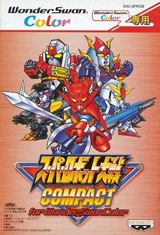
A colour remake of the first Super Robot Taisen Compact from 1999, reworked to play like Compact 2 and given new units, art and tougher enemies.
Screenshots
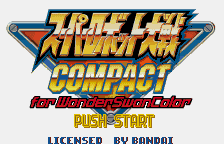
Title screen 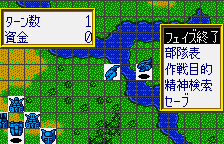
In play 
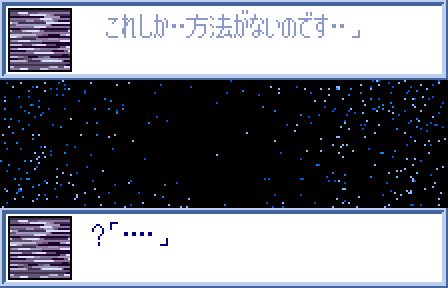
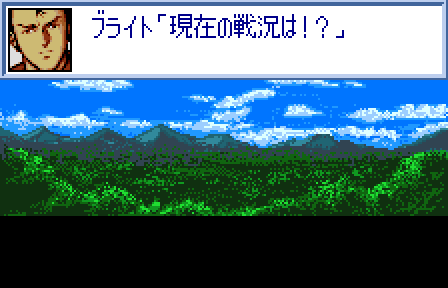
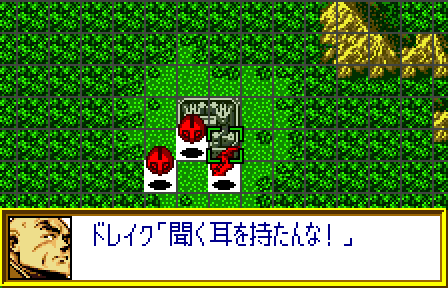
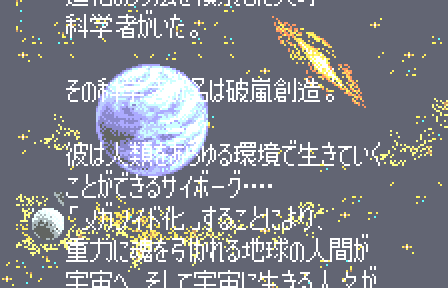
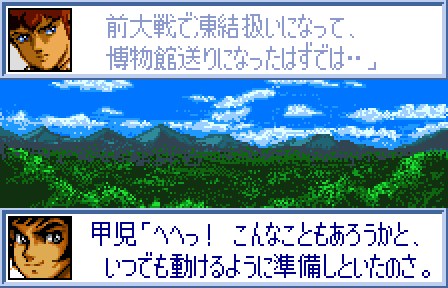
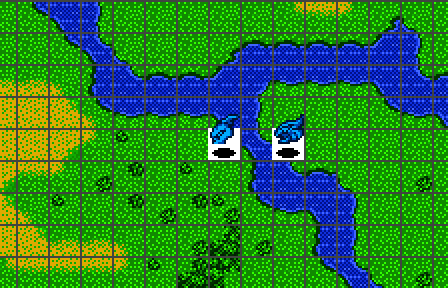
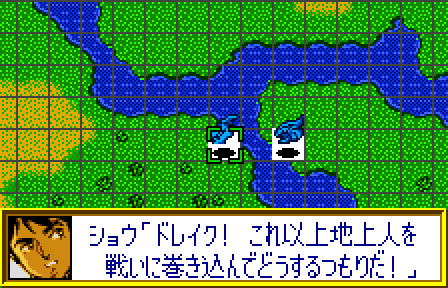
Super Robot Taisen Compact for WonderSwan Color is a remake of Super Robot Taisen Compact, the tactical robot crossover that Banpresto and TOSE released for the black-and-white WonderSwan on 28 April 1999. The new version was published on 13 December 2001, a year after the WonderSwan Color went on sale and after the three parts of Compact 2 had been released on the original console.
The 1999 game set the pattern the remake builds on. Its 33 chapters have no branching routes, but apart from the first and last stages the player picks the order in which the scenes of the story are played. Clearing a stage in fewer turns earns a pilot a stronger special skill, and the spirit commands each character learns depend on the personal details, such as birthday and blood type, entered into the WonderSwan itself.
The remake keeps the story of the 1999 game but rebuilds its rules along the lines of Compact 2, adding the support system that lets neighbouring units attack or defend together. The cartridge needs a WonderSwan Color or SwanCrystal.
The story
The scenario is the 1999 game’s, with its text revised and extended with new lines that make the plot easier to follow. It takes place in an invented Universal Century year, after a war that is already over when the game begins. The scientist Sozo Haran had created the Meganoids, cyborgs meant to bring the people of Earth and space together, but his prototypes Zauser and Koros ran out of control and destroyed his laboratory on Mars. Koros launched a plan to turn humanity into Meganoids just as the Muge Empire invaded, and Earth was fought over on two fronts until the super robots of the Saotome and Photon Power laboratories won on the ground, the White Base unit held out in space, and Dancouga went alone into the Muge’s own universe and defeated its emperor.
The peace that followed is shaky. Pieces of the Muge universe remain, and nobody has confirmed the end of Zauser and Koros. A year later Zeon starts its war of independence, the conflict later called the One Year War, while the White Base unit, now named Londo Bell, guards Earth. Then a people from another star system arrive: the Baam, who have lost their home planet and come in Little Baam under their leader Olban to make Earth their second home.
The first episode, Aura Road, finds Bright, Emma, Amuro, Kou and Chris looking back on the damage the Meganoid rebellion did to the Earth Federation, whose parliament has ordered the Saotome and Photon Power robots frozen because the top brass fear power that large. Koji Kabuto, Sayaka and Boss turn up with Mazinger Z, which Professor Yumi kept in working order even though flying it is now a serious crime. A strange light then carries everyone to Byston Well, where Sho and Marvel are fighting Drake’s army at Drake Castle, with Char on Drake’s side. In this version Bernie joins at once at the start of the battle, and Amuro can talk to Char when he attacks him.
The 33 episodes are split into seven scenes, beginning with four episodes in Byston Well, after which Londo Bell returns to Jaburo and Kamille joins with the Zeta Gundam. Later scenes move to a colony nation, final reckonings on the ground and in space, and the Pentagona world. Within each scene the episodes between the first and last can be played in any order, and the order changes which units and parts the player receives. As in the 1999 game, every character comes from the licensed series, and some events from the Dancouga OVA are acted out.
How it plays
The WonderSwan Color is held sideways, and the game needs a colour console. The X buttons move the cursor in four directions, A confirms a command and opens the menus, and B cancels or shows the data for a unit or a square of terrain. Y2 and Y4 jump to units that have not yet moved, Y3 shows the whole map, and Y1 does nothing. Pressing A, B and Start together resets the game, and keeping Start held after letting go of A and B jumps straight back into a quick continue. Pressing Y2 or Y4 after choosing a unit changes the colour of the menus. Unlike the mono original, the sound is in stereo.
Battles are fought in turns on a grid map, with each attack shown in a short animation; this version adds many new cut-in pictures, mostly for super robots, and gives some MAP attacks lines and cut-ins of their own. The 33 stages follow the same free-order structure as before, and every stage pays out fixed rewards along with some random enhancement parts, so saving and reloading lets the player adjust which parts turn up.
The biggest change is in how units act. Pilots no longer gain a second action per turn at a set level. Instead the support system from Compact 2 lets a pilot with a support skill join in: a support attack during the player’s turn and a support defence, taking the hit, during the enemy’s turn, as many times per turn as the skill’s level. The two units have to stand next to each other at the same altitude. Because of this the gap between Newtypes and Holy Warriors and everyone else is much smaller than in 1999, and since enemies are sturdier, pilots with high support levels become very useful. Shield defence and sword cut are merged into one defence rating.
The spirit commands are Compact 2’s. Substitute and Taunt are gone, replaced by Dedication and Bless, which gives another unit Luck so that its next kill pays double money. Hot Blood now raises damage by half instead of doubling it, Soul gives two and a half times damage instead of three, and few pilots learn Soul at all. The personal data system still picks each pilot’s commands from the owner’s details in the console, but the results are more random than before: depending on the console, Seabook or Rom may never learn Hot Blood or Soul, and the Dancouga team or Banjo may go without Sure-Hit and Sense. Some high-level commands are hard to reach without grinding experience.
Skill Coordinate works as before, giving a skill by the turn on which the last enemy falls: Concentration for six turns or fewer, Fighting Spirit for seven, then bonuses for eight, nine and ten turns, Prevail for eleven, and nothing after that. The spirit point, accuracy and critical bonuses are now 20 rather than 10. Upgrades were trimmed to stop one unit carrying the game: a V-UP unit fitted to a machine with four part slots adds 600 attack instead of 800, and each mobility upgrade beyond the sixth adds 5 instead of 10.
Units that used to be random prizes now depend on the order of stages or on the total number of turns. Finishing episode 11 within 85 turns in total gives the Gundam GP02, otherwise the Gerbera Tetra; episode 22 within 170 gives the Zeong, otherwise the Elmeth; taking the Silent Voice route and finishing episode 26 within 200 gives the Sazabi, otherwise the Hamma Hamma; and the Getter team gets Shin Getter Robo if episode 27 is finished within 230, with nothing in its place otherwise. That works out at about seven turns a stage, or seven and eight in turn. Playing the Byston Well stage Assault last in the first scene gives the Leprechaun, and playing Love on the Battlefield last in the second scene gives the Qubeley Mk-II. Minerva X joins if Koji brings her down to 30% HP and then talks to her, Kamille can win over Four, and Char’s custom Zaku from the original can no longer be won. The random bonus slot is gone, so rare parts such as the Fatima are fewer.
The tuning is tougher than in 1999: enemies take more punishment, some stages have new reinforcements, and bosses are stronger. Super robots still have low HP and armour, and the enemy mobile suits met from the middle of the game are harder to destroy than they should be. A player who does not care about the turn-based prizes can take things slowly and earn money and experience with Luck and Effort, which makes the game easier, while a player chasing the units has to keep every stage short.
Development and release
Bandai presented the game as the hit of two years earlier returning in colour, and stressed that it was more than a recoloured copy: the story text was revised and extended with new lines, the balance was tuned again, and many new cut-in pictures were drawn. Robots from nine series, eighteen works in all, take part, among them Gundam, Mazinger, Getter Robo, Dunbine, Elgaim, Daitarn 3, Daimos, Raideen and Dancouga. Banpresto published the game at 4,800 yen. The box art changed as well, now showing Getter Dragon, Zeta Gundam, Dancouga, Raideen and Daimos. Banpresto’s 2004 press release lists 40,000 copies shipped, against 190,000 for the 1999 original.
The producers were Soichiro Morizumi, Takanobu Terada and Jippa Hitokarage, the director was A. Syou, the scenario was written by Morizumi and Ikataro, and the music was by Miyang and Samurai. The television advertisement was voiced as Getter Robo’s Ryoma Nagare and showed allied robots supporting one another in battle.
Modes and features
The story and the order of its scenes are the same as in the 1999 game, and as before no characters or robots of Banpresto’s own appear. The battle rules, however, were rebuilt along the lines of Compact 2, with support in place of double actions, Compact 2’s spirit commands and smaller upgrade bonuses, so that winning no longer depends on one overwhelming unit.
Secrets and extras
Hidden units are still tied to how quickly the player clears stages, but rewards that were left to chance in the original now depend on the total number of turns used or on the order in which scenes are played. Keeping to roughly seven or eight turns per stage, for example, keeps a prototype Gundam and some later prizes within reach, while a few pilots join only if they are persuaded under the right conditions. The Char’s custom Zaku obtainable in the original can no longer be won.
Ports and other versions
This game and the 1999 Super Robot Taisen Compact are two versions of one game, and both stayed within the WonderSwan family: the original on the black-and-white console and this remake on the Color. It should not be confused with Super Robot Taisen Impact for the PlayStation 2, which reworks Compact 2 rather than this game.
On screen the remake is in colour, some units were redrawn, and many new cut-in pictures were added to the battle scenes, most of them for super robots; in line with the series’ later style, Gundam units lost the pupils they had in the monochrome version. Units, weapons and cut-ins were carried over from Compact 2, enemies are sturdier, some stages gained reinforcements and extra lines of story text, and bosses were made stronger.
The support system and the reworked rules are generally welcomed, though super robots are still thought too fragile and enemy mobile suits in the middle of the game oddly hard to bring down.
Notes
The price is sometimes given as 4,980 yen, but the game sold for 4,800 yen. Because unit acquisition differs, this version calls for a different strategy from the monochrome game, even though the story is the same.