
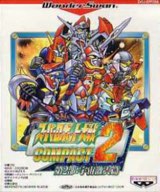
The second of three WonderSwan cartridges of Super Robot Taisen Compact 2: the space side of the story, led by Excellen Browning, in 31 stages that can read a Part 1 save.
Screenshots
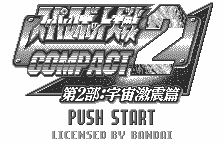
Title screen 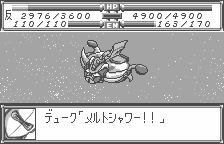
In play 
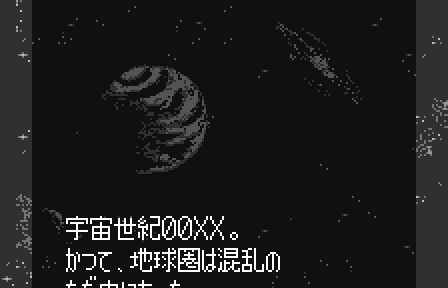
Uchuu Gekishin Hen is the middle chapter of Super Robot Taisen Compact 2, which Banpresto released on the WonderSwan as three separate cartridges, the first time the Super Robot Wars series was split into parts. It came out on 14 September 2000, about six months after the first part, and was developed by TOSE. Like the other Compact games, it brings together giant robots from many anime series, drawn in a small, super-deformed style, in turn-based battles on a grid map.
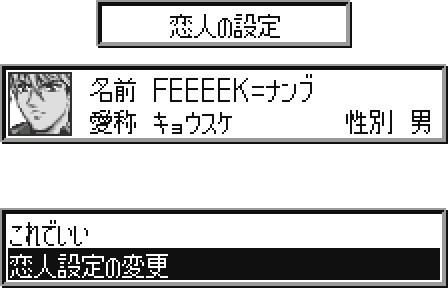
Each part has its own lead character. The first follows Kyosuke Nanbu and his Alteisen; this one is told from the side of Excellen Browning and her Weissritter, and the third brings both together. Machine Robo: Revenge of Cronos joins the roster in this part. The story runs to 31 chapters, or 34 counting branching routes.
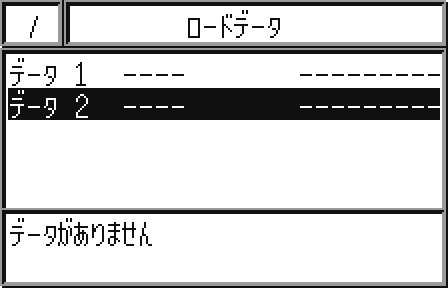
Clear data is passed between the parts through the WonderSwan’s own memory. A save from the first part can be carried into this one to open up hidden units, routes and stages, and finishing this one in turn adds to the final part, although each cartridge can also be started from scratch.
The story
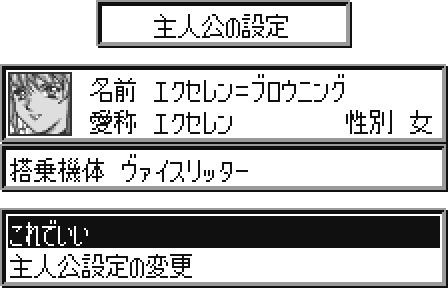
Part 2 covers the same months as Part 1, seen from space. While Kyosuke Nanbu and the ground forces fight on Earth, this part follows the forces in Earth orbit and beyond, and Kyosuke himself appears only in conversation scenes. The lead is Excellen Browning, Kyosuke’s partner and lover, the only female lead in the series to carry a game on her own. She pilots the Weissritter, a prototype machine built for long-range fire.
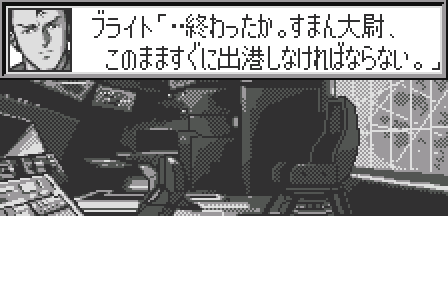
The story opens near the Luna II base, where the first sortie puts Excellen beside the battleship Ra Cailum under Bright Noa, Emma and Quattro in their Gundam Mk II and Hyaku Shiki, Kou in the Gundam GP-01Fb and Duke Fleed in Grendizer. Maria Fleed joins after this first battle. Within the opening scene the team also meets Kenryu, the hero of Machine Robo, together with Blue Jet, Rod Drill and Triple Jim, and the Tobikage cast. In the second scene the robots sent up from Earth at the end of Part 1’s first scene arrive, so the Mazinger pair that joins here is whichever one the player sent to space in Part 1, with Tetsuya and Jun as the default.
The enemies again come from the series, joined by the game’s own mysterious life forms, the Einst. Kenryu’s arrival on the battlefield is staged as in the anime, with his set speech, his own cut-in and his own music. The story of the Dancouga OVA, the backbone of the trilogy, is brought to the screen in the later part of this cartridge.
The part has six scenes and 31 stages. The scenes take in an invasion from outside, a hunt through the space colonies and a scene named after the Stardust Operation, and one scene splits into an A and a B route, the second of which can only be reached with Part 1 data. The part ends with the space forces’ last battle before the two halves of the story meet in Part 3.
How it plays
The game is played with the WonderSwan held horizontally and uses the same system as Part 1. Each stage is a turn-based battle on a map in which units move, attack and use their pilots’ spirit commands, with cut-in pictures in battle scenes and each series’ own theme playing. Between stages, money goes on upgrading the machines. The battlefields here are mostly in space, including the outer surfaces of colonies and the inside of abandoned ones.
Stages are picked with the Free Order system: the first and last stages of each scene are fixed and the ones in between are played in any order. The order changes the story and which units and parts arrive, and the stage played last in a scene gives a bonus item. The B route of the colony chase scene opens only with converted Part 1 data in which a certain stage of that part was played first in its scene.
Support attack and support guard work as in Part 1. An ally at the same altitude next to a fighting unit always joins in or takes the hit when it can, with the weapon chosen by the game. Excellen is suited to this: she is good at support attacks, and the Weissritter has long range, high mobility and good movement, which fits real robots best. Its armour is thin, though. In this game the Weissritter is a ground model that cannot fly, rated S in space and A in the air. Its weapons are the Oxtongue Launcher, with a long-range E mode and a stronger mid-range B mode, and a triple beam cannon usable after moving at a range of 1 to 3. Its low firepower is fixed by fitting a V-UP unit.
Machine Robo brings rules of its own. Once Kenryu’s morale reaches 130 he can merge into Baikanfu, which plays a special scene and restores the unit’s health and energy in full. Tobikage again merges with a partner machine once its morale passes 110, and terrain ratings are as strict as in Part 1.
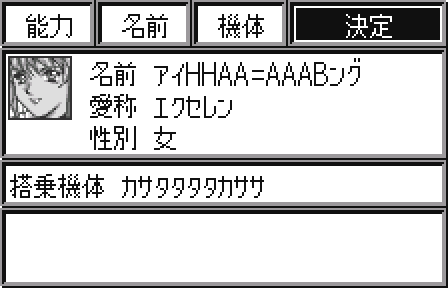
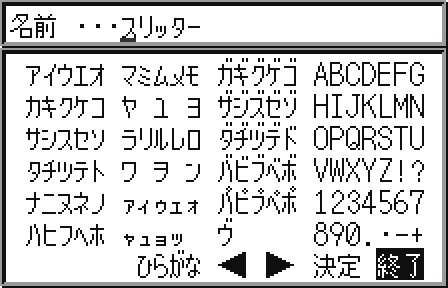
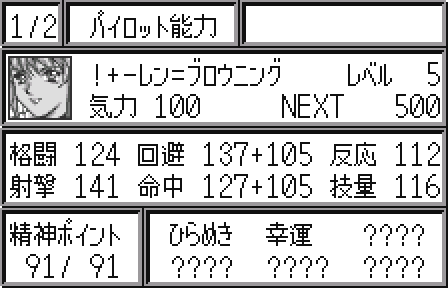
The personal data registered in the WonderSwan sets each pilot’s spirit commands from preset patterns, and the spread is wide enough that main characters can miss important commands; Seabook and Rom, for example, can go without Valor and Soul. Entering seven zeros as the owner’s name with female as the sex makes Excellen stronger. Skills come from the clear turn, decided by the turn the last enemy falls: six turns or fewer gives Concentration, and each further turn up to eleven gives a different skill, with nothing at twelve or more. Skills earned this way do not carry over between parts.
A Part 1 save changes this part in several ways. Defeating Butcher’s Bandock in Part 1 adds a V-UP unit here, and upgrading Dancouga’s stats there opens its stronger form in this part, while Combattler V, pictured on the box, joins only when no Part 1 save is used. The finished save can then be carried on to Part 3, alone or after a Part 1 save, and both are needed for the hidden final scenario there.
Development and release
When Bandai first previewed this part, the first part had sold about 90,000 copies in its first two weeks, and the price of the second was still undecided. It was later set at 4,500 yen before tax, the same as the other two parts. Banpresto presented it as the part where the Flag Convert System could be used for the first time, since it is the first cartridge able to read a save left by an earlier one. The part also has new cut-in pictures, redrawn characters and a wider range of battlefields than earlier games in the series, including fights on the outer surface of space colonies and inside abandoned ones. The television advertisement for this part was narrated by Kazuhiko Inoue, the voice of Machine Robo’s hero Rom Stol, and closed with a speech in that character’s style.
Banpresto’s 2004 press release put shipments of this part at 100,000 copies, as for the other two, but it sold far fewer, around 53,000 copies, about half as many as Part 1.
Modes and features
Besides Machine Robo, this part brings back UFO Robo Grendizer and Mobile Suit Gundam ZZ, neither of which appears in Part 1. No Getter Robo series takes part here, which had never happened before in Super Robot Wars.
Secrets and extras
The box art holds a catch: Combattler V is pictured on the package, but it does not appear in this part when a Part 1 save has been carried over, and that same flag later changes when it joins in Part 3. This part’s own clear data is one of the two saves needed for the hidden Char’s Counterattack scenario in the final part.
Ports and other versions
Compact 2 was made for the WonderSwan, and this middle part, like the other two, was never released on another system in its own form. Its story was told again on the PlayStation 2 in Super Robot Taisen Impact, developed by TOSE and published by Banpresto on 28 March 2002. Impact is a remake in all but name: it keeps the trilogy’s scenario, systems, series and lead characters and joins the three parts into a single game, although Banpresto never announced it as a remake.
Impact runs to 101 chapters on one disc, and the three parts are played in a fixed order, so there are no saves to carry from one cartridge to the next. Two series join the line-up, Martian Successor Nadesico and Mobile Fighter G Gundam, and the script was reworked to fit them; hidden units from the New Story of Aura Battler Dunbine OVA are gone, and an enemy character, Alfimi, was created for the new game. The names of the leads and their machines can no longer be changed, and the personal data system was dropped because the PlayStation 2 could not hold the owner’s details. Maps are drawn in three dimensions, and new rules include combination attacks, support from battleships and shields that wear out with use. In the remake this space story can no longer be started on its own: it follows the Earth story, and the money earned in the two is pooled only when the final part begins.
Impact came to be seen as one of the hardest games in the series, and players disliked its slow saving and loading, its hard-to-read 3D maps and a script that follows Compact 2 with few surprises. It also shipped far more copies than any of the cartridges: it won a Gold Prize at the PlayStation Awards 2002 for shipments of half a million copies or more.
Notes
The game is usually credited to TOSE, though TOSE does not appear in the staff roll and this has never been confirmed. The game is for one player, with stereo sound and no communication features.