
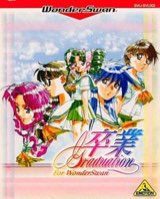
A WonderSwan port of Sotsugyou: Graduation, the raising sim in which a new teacher plans the timetables of five problem pupils through their final school year.
Screenshots

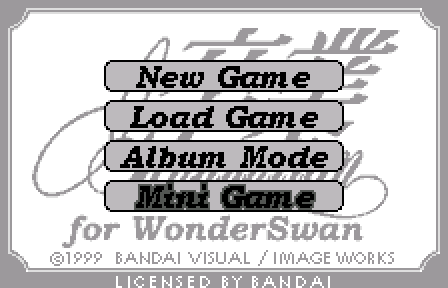
Title screen 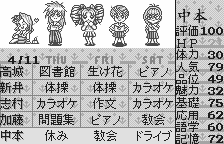
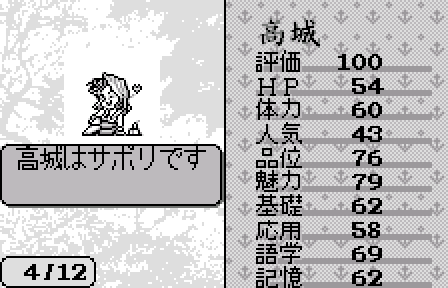
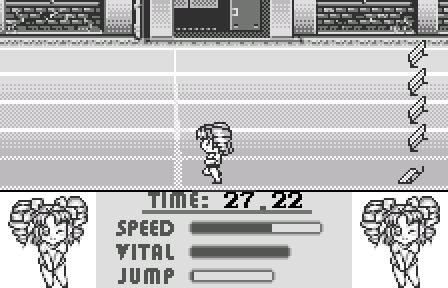
In play 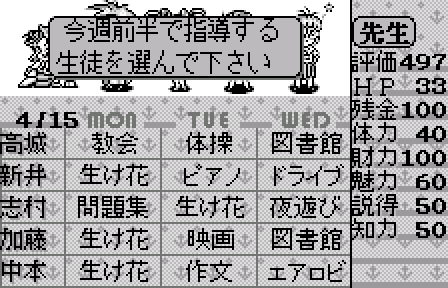
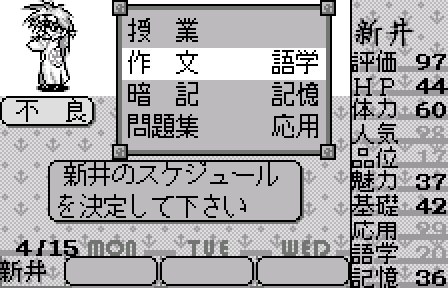
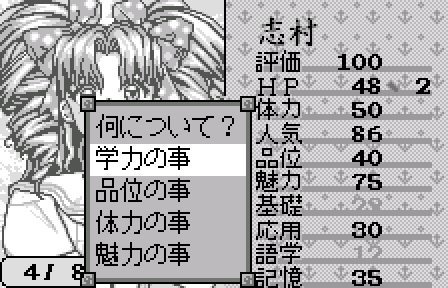
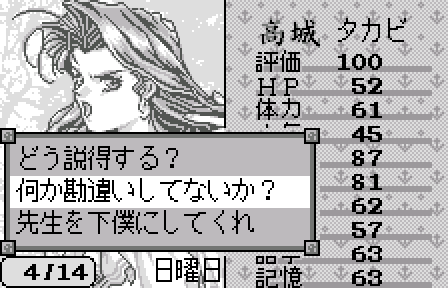
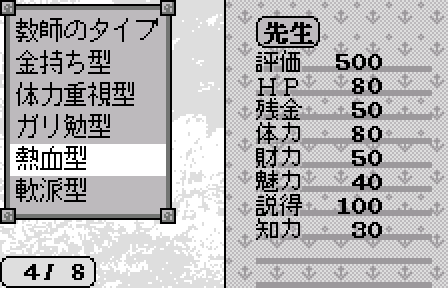
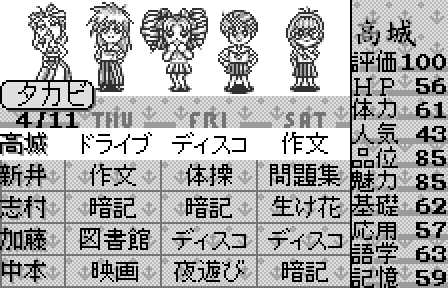
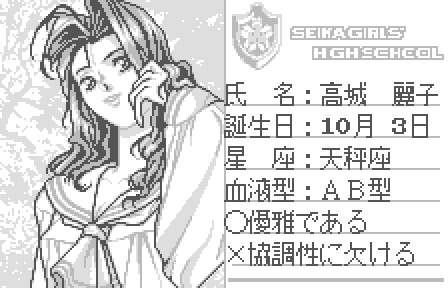
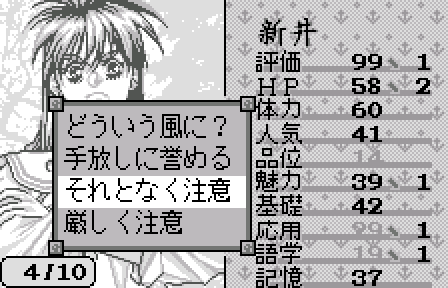
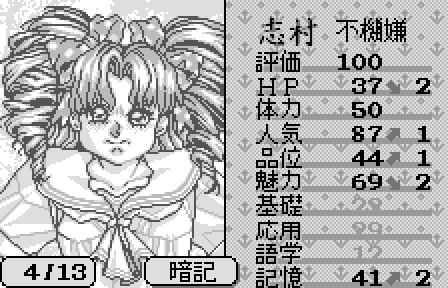
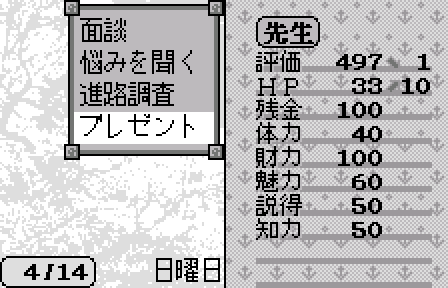
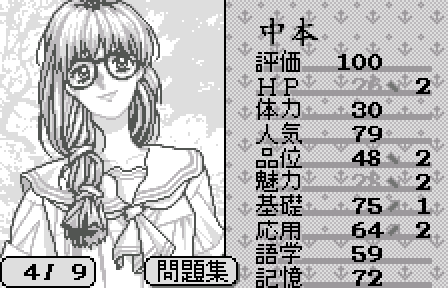
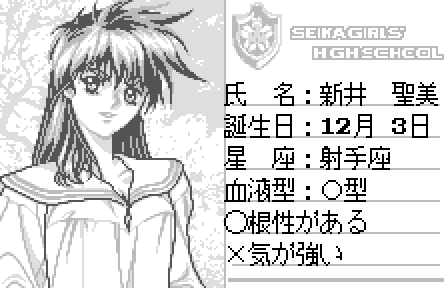
Sotsugyou for WonderSwan is the WonderSwan edition of Sotsugyou: Graduation, a raising simulation first released for the NEC PC-9800 computers in June 1992 by Japan Home Video. The series grew out of the idea behind Princess Maker and was carried to many systems and other media, with sequels, a live-action spin-off and a mahjong game among them. Bandai Visual published this version on 16 December 1999, in the first year of the WonderSwan.
The player takes the part of a newly appointed teacher who is put in charge of five difficult pupils in their final year at a girls’ school. Over one school year the player plans their timetables, deals with their troubles and tries to see all five graduate, and how each girl ends the year depends on those choices.
The story
The game is set at Seika, a private girls’ school, at the start of a new school year. The hero, a young teacher whose default name is Hayato Shinjo and who can be renamed, has just arrived and is made form teacher of class 3-B. The five girls in it are the school’s problem pupils, and his job is to get them through their last year and onto a respectable path in life before graduation day.
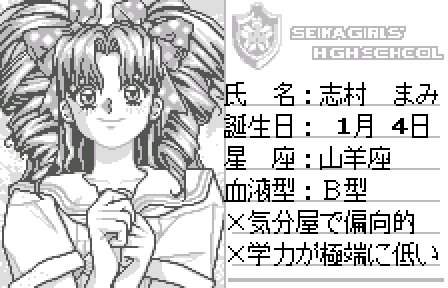
Each of the five comes with her own trouble. Kiyomi Arai is a rebellious delinquent whose family runs a motorbike shop. Mika Kato is the class representative, sporty and quick to rush into things, and her family runs a soba restaurant. Mami Shimura is friendly and childish, a big eater who is poor at her studies and often absent. Reiko Takagi is the proud heiress of a business group who does not work well with others. Shizuka Nakamoto is the best student of the five but is so frail that she misses school often.
There is very little plot beyond that setup. The girls’ personalities are sketched in broad strokes, and the events that make up the year, from chance meetings in town to scandals over part-time jobs or smoking, are triggered by the state of each girl rather than by a fixed script. The year runs through three terms with the school’s festivals and exams along the way, and what each girl does after graduation, and how she feels about her teacher, is decided by how she has been raised. The characters were designed by Masaki Takei, who also drew the WonderSwan package.
How it plays
The game is played with the WonderSwan held sideways, and apart from one cut event it is a faithful conversion of the PC-9801 original. The week is split into two halves, Monday to Wednesday and Thursday to Saturday. At the start of each half the girls hand in timetables they have drawn up themselves, and the teacher rearranges them, choosing what each pupil does on each day. He can coach only one girl in person in each half week, while the other four follow their timetables on their own.
Every activity raises some of a girl’s parameters and costs stamina. If her stamina drops below a certain level she becomes overworked, and if that goes on she falls ill and stays away from school. Pupils also get on better or worse with one another, and two girls who get on well and do the same activity on the same day earn a bonus. The teacher has his own parameters and his own compatibility with each girl.
Sundays and holidays belong to the teacher. He can take a part-time job to earn money, rest, or go out on patrol in town, where he may run into his pupils or follow them to see what they are up to. Behind his back the girls may take dubious part-time jobs, drink, smoke or even move in with someone, and these scandals can come to light at random and lower the girl’s standing. How the teacher deals with each one changes his relationship with her.
The school calendar brings set events. At the sports festival the player picks the order of the relay team, and the result shifts every girl’s parameters. There are two exams in each of the first two terms, each a set of ten quiz-style questions that the girls answer on the strength of their own parameters, not the player’s knowledge. The theatre festival of the original, in which the player chose the play and the lead role, was removed from the WonderSwan version. When the third term ends, each girl’s parameters decide her outcome, which ranges from a good future to being held back a year or expelled.
The five girls start from very different places, and the usual advice follows from their opening numbers. Reiko has low popularity but strong figures elsewhere, while Kiyomi is weak in both popularity and study. Mami’s study is close to hopeless but she is popular. Mika is strong only in stamina, is well liked, and is a reliable last runner in the relay. Shizuka’s stamina is very low, so pushing her hard soon makes her ill.
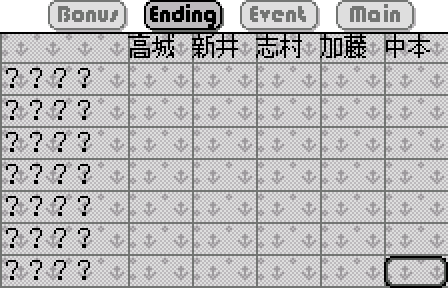
The WonderSwan screen normally shows four shades of grey, and the game overlays two screens to show seven, so the girls’ pictures are in black and white with extra shading. The voices are compressed and played back in real time; they are not full voice and the sound quality is modest, with each girl speaking at changes in her state, such as when she turns delinquent or falls ill. Alongside the main game, the title menu offers an album for viewing the pictures, which are also in black and white, and a set of mini-games made for this edition. Progress is kept in the cartridge’s 256 kilobits of save memory.
Development and release
The game was developed by Image Works, whose name appears beside Bandai Visual’s in the game’s copyright line. Bandai Visual had worked on the series before, publishing the Macintosh version of the original game in 1994 as well as the OVA and the live-action Sotsugyou R. The WonderSwan cartridge holds 16 megabits with 256 kilobits of save memory, is played with the console held sideways and has mono sound and no link-cable play; its planned price was 4,200 yen before tax. Its title is Sotsugyou for WonderSwan, sometimes given with the English Graduation added.
It was Bandai Visual’s second WonderSwan release, after the quiz game Nazo-ou Pocket a month earlier. Bandai Visual and Image Works followed it in February 2000 with Tanjou: Debut for WonderSwan, another raising simulation from Bandai Visual and Image Works.
Modes and features
The title menu leads to the main raising game, the album and the mini-games. Bandai made a point of the WonderSwan’s sound in presenting the game and promised that the girls’ voices are included.
Reception
The WonderSwan version scored a total of 21 out of 40 in Famitsu’s Cross Review. That is the lowest score among the console versions, below the 27 given to both the PC Engine and Sega Saturn releases and the 24 given to the 3DO release.
Ports and other versions
The game began on the PC-9800 series in June 1992 and, before reaching the WonderSwan, had already been converted for the X68000 and the PC Engine Super CD-ROM² in 1993, for the FM Towns later that year as Sotsugyou ’93, for the Macintosh in 1994, for the 3DO the same year as Sotsugyou Final and for the Sega Saturn in 1997 as Sotsugyou S. One more release followed the WonderSwan cartridge, a 2004 Windows reissue from IRI Commerce and Technology, which runs the PC-9800 game under emulation, keeping the original cast’s voices, which the old computer had produced by switching its beeper on and off at speed. A live-action remake, Sotsugyou R: Graduation Real, was published by Bandai Visual for the PlayStation in 1996 and for Windows 95 and the Macintosh, and NEC Avenue released it on the PC-FX in 1998.
The versions fall into two families. The X68000 and 2004 Windows releases follow the PC-9800 original, while most other conversions were built on the PC Engine version, which recast four of the five girls’ voices with different actresses, added many events such as karaoke scenes with a song for each girl, and had the player enter the teacher’s birthday and blood type to set how well he gets on with each pupil. The 3DO edition reworked material from the computer and PC Engine versions and moved the girls’ songs to a new school-festival concert in place of karaoke, the Saturn edition followed the PC Engine game but swapped out some events because of criticism of scenes showing under-age drinking and smoking, and the Macintosh edition has its own summer theme tune.
The WonderSwan cartridge belongs to the PC-9800 family rather than the PC Engine one, so it lacks the console additions. Its pictures are in black and white to suit the screen and it keeps only part of the voice acting, but its title menu adds an album for viewing pictures and a set of mini-games, which Bandai presented as made for this edition.