
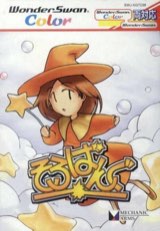
An action puzzle game from Kaga Tech in which blocks are cleared by lining them up on a field whose edges wrap around, released on the WonderSwan Color's launch day.
Screenshots
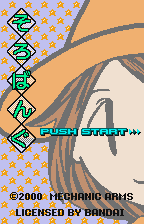
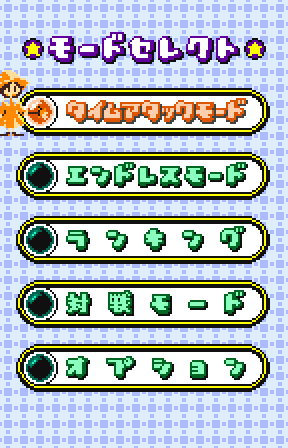
Title screen 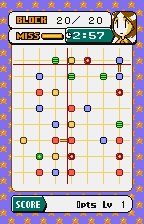
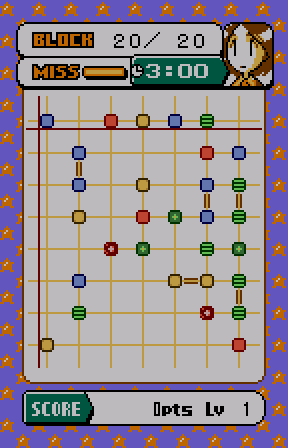
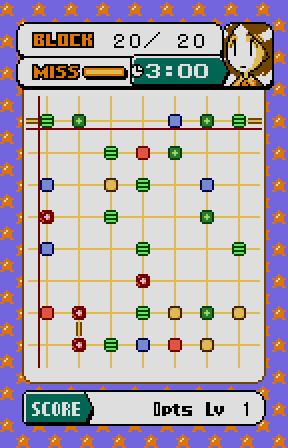
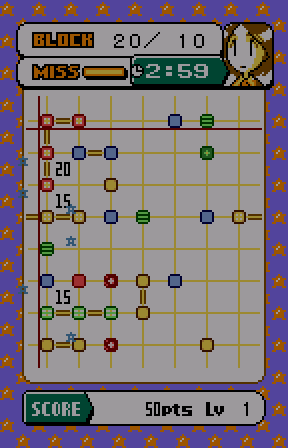
In play 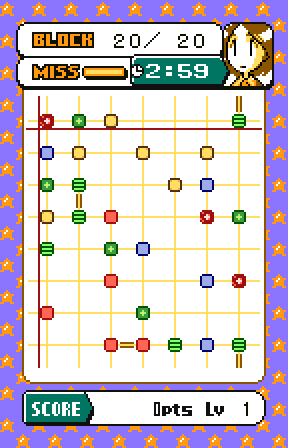
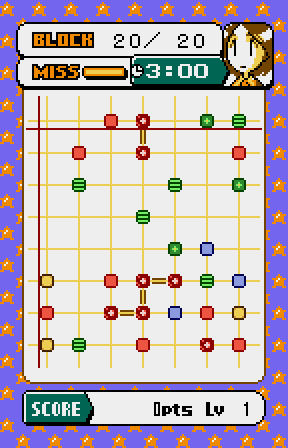
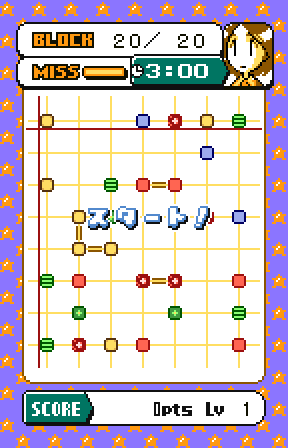
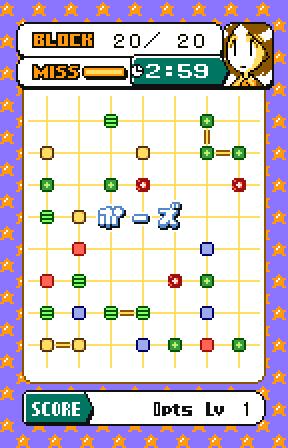
Sorobang is an action puzzle game published by Kaga Tech and released in Japan on 9 December 2000, the day the WonderSwan Color went on sale. It is sometimes romanised as Soroban Gu. It was developed by Mechanic Arms, the Tokyo branch of the game studio Konan Denki Seisakusho, whose copyright appears on the game.
Blocks arrive on a grid one after another, and the player clears them by sliding whole rows and columns until three or more matching blocks sit in a line. What sets the game apart is that the field has no hard edges: it wraps around on all four sides.
Besides the single-player modes there is a battle mode in the style of competitive action puzzles, with three difficulty settings so that players of different strengths can be matched against each other. The cartridge supports the link cable, which joins two consoles for play between two people. It is made for the Color but also runs on the original black-and-white WonderSwan.
The story
Sorobang has no story. There is no plot, no cast of heroes and no world to travel through; each game is a single board of blocks played until time or the miss gauge runs out.
The one character is Majoko-san, whose name is built on the Japanese word for witch. She is the source of every new block: she marks the squares she is about to fill and then throws the blocks onto the board. She also stood for the game outside it, on the folder icons that the official website offered for download and as the plush figure promised to the winners of its online ranking.
The title calls up the soroban, the Japanese abacus, but the game has nothing to do with counting; the link is only in the look of a board divided into lines that slide back and forth. The presentation is light and cute, and much of its character lies in the fourteen sets of block pictures, which run from plain shapes, letters and numbers to playing-card suits, weather symbols, cats, apples and rabbits with carrots. Mechanic Arms presented the upright screen, a feature of the WonderSwan, as central to the game’s speed and feel, and the cartridge plays its music in stereo.
How it plays
The console is held upright. The Y buttons move a red cursor around the grid, and the row and the column that cross at the cursor are marked in green. The X buttons slide those lines: X1 and X3 move the row left and right, and X2 and X4 move the column up and down, each press shifting every block in that line by one square. A second control setting puts line movement on one X button combined with the Y buttons instead.
When three or more matching blocks end up in a straight line they are cleared. Because the board wraps around, a block pushed off one edge comes back in on the opposite one, and lines can join across the borders, so a match often appears where it was not expected and random sliding sometimes clears blocks by accident. Moving whole lines rather than single blocks means keeping track of how a full row or column will look after each shift, which takes steady concentration.
New blocks come from Majoko-san. At regular intervals markers appear on the board with a countdown, and when it reaches zero she drops a new block onto each marked square. Markers can land on squares that already hold a block, and any block still sitting on a marker when the count ends costs one point from the miss gauge, so several covered markers cost several points at once. The game ends when the gauge is empty. Every turn is therefore two jobs at once: building matches and clearing the squares that are about to be filled.
Cleared blocks do not vanish at once but fade out over a moment, and sliding another matching block against them while they are fading carries the clear on into a chain worth far more points. Chains can be added one after another in this way, and they also happen by accident fairly often. Whatever is left of the miss gauge at the end counts as bonus points, so a high score depends on taking as few misses as possible.
The difficulty setting changes the number of block kinds in play: three on easy, four on normal and six on hard. Time attack is a fixed three-minute run with no difficulty choice, while endless mode climbs through levels until the gauge runs out and can last a long time; the staff roll is the reward for ending an endless game at a high level. High scores and the option settings are kept in the cartridge’s save memory.
The battle mode needs two consoles joined by the link cable. Each player picks a level with the Y buttons and can see the level the other has chosen, and the opponent’s miss gauge and level are shown at the bottom of the screen. The rules are those of the other modes, but cleared blocks fill a block stock gauge, and from it the A button sends one block and the B button sends from one up to eight to the other player, to fall alongside their next delivery. No more than eight can be sent at a time even when nine or more are stocked, and at most twelve blocks fall together. The player is free to choose the moment of each attack. The match ends when either player’s gauge runs out.
Development and release
Konan Denki Seisakusho was set up in July 1997 around staff who had worked at Naxat, the game brand of Kaga Electronics, and it took the name and corporate shell of a company that belonged to its president’s father; its Tokyo office worked under the name Mechanic Arms. Kaga Tech’s own games had been sold under the Naxat name, so the publisher and the studio shared roots. The game carries a 2000 copyright of Mechanic Arms. The cartridge is an 8-megabit ROM with 256 kilobits of SRAM, playable on both the colour and the monochrome WonderSwan and on the later SwanCrystal, and it was priced at 3,980 yen before tax.
Mechanic Arms ran a dedicated website for the game with rules, hints and a message board. On launch day it posted an apology for a misprint in the manual, whose page on the controls described two of the X-button directions as moving a horizontal row when they in fact move a vertical column. From March to the end of July 2001 the site ran an internet ranking for the time attack and endless modes, in which players registered their scores online. The prizes promised to the top entrants were a plush figure of the game’s character Majoko-san, and a battle-only edition of the cartridge whose menu offered nothing but the versus mode and the options, both described as not for sale.
Modes and features
There are three modes: time attack, endless and the two-player battle mode. The options let the player choose between the two control settings and fourteen block designs, pick the background music for endless mode from fifteen choices including silence, and listen to the music and sound effects.
Secrets and extras
The game has three hidden features. The staff roll plays only when an endless game ends at level 70 or higher on easy, 65 on normal or 60 on hard. Holding Y2, Y4, X2 and X4 while switching on erases the high scores and settings. On a WonderSwan Color, holding A and B while switching on switches the game to a look meant to recall the monochrome console.
Ports and other versions
Sorobang was made for the WonderSwan Color and was never ported, remade or re-released on another system; its only other editions are the battle-only cartridge offered as a ranking prize and the monochrome-style display hidden in the game itself. It is not part of a series. Konan Denki Seisakusho, the studio behind Mechanic Arms, later made mostly study and training software for the Nintendo DS and Wii, and this puzzle stands apart from that work as a fast block game built around a field whose four edges join up.