
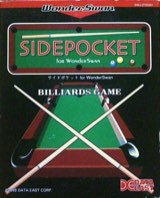
Data East's WonderSwan version of Side Pocket, its pocket billiards series that began in the arcades in 1986, played against a line of computer opponents or a friend.
Screenshots
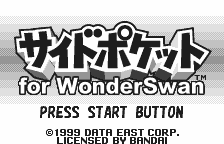
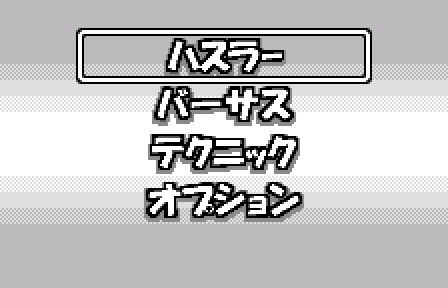
Title screen 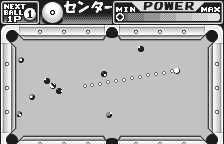
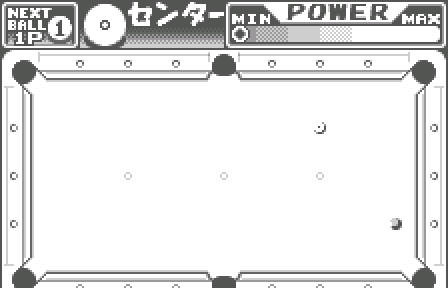
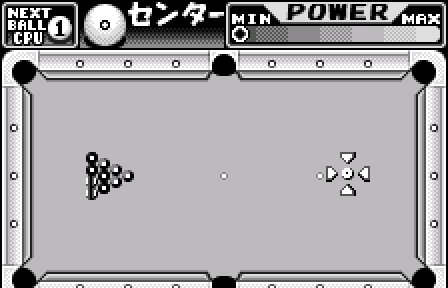
In play 




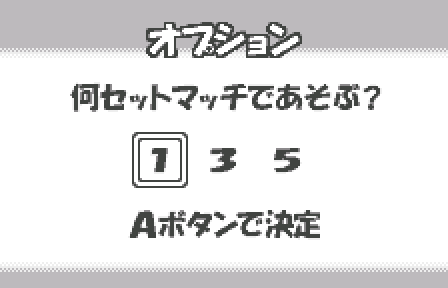

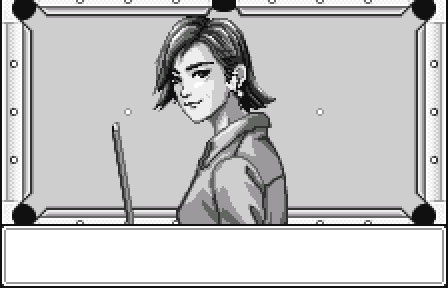


Side Pocket for WonderSwan is a pocket billiards game made and published by Data East, released in Japan on 25 November 1999. Side Pocket began as a Data East arcade game in June 1986 and has appeared on many systems since. The WonderSwan cartridge is the series’ only release on Bandai’s handheld.
The player picks a character and plays through the rest of the cast at the table, and two people can also play each other on one console. The cartridge arrived in the WonderSwan’s first year on sale, almost nine months after the console’s launch on 4 March 1999.
The story
The single-player Hustler Mode has a short premise: Lost Paradise, a legendary cue said to bring victory to whoever holds it, has drawn four hustlers, and they fight one another for the right to track down and challenge its owner, a mysterious figure known as Cue. Bandai sold the game as billiards that could be played anytime and anywhere, a game that would let the player become a hustler.
What stands in for a plot is the cast. The player chooses one character as an avatar and then meets the others one at a time as opponents across the table. Each character has lines of their own, and the character art is drawn in a different style from the earlier games in the series.
The look as a whole is brighter and more cartoon-like than in the older Side Pocket games. The table at the centre of it is modelled on a real one, with the cloth, the width of the pockets and the positions of the spots all following an actual billiards table.
How it plays
The WonderSwan is held sideways, and the game is pocket billiards with stereo sound. Bandai stressed that the balls behave as they would on a real table, so that follow shots, draw shots and massé shots all work as they should.
In the single-player game the player chooses a character from a menu and then has to beat each of the remaining opponents in turn. The computer picks each opponent, a lag shot decides who breaks, and every match in this mode is nine-ball; losing a match ends the game. The options set the number of sets in a match to one, three or five.
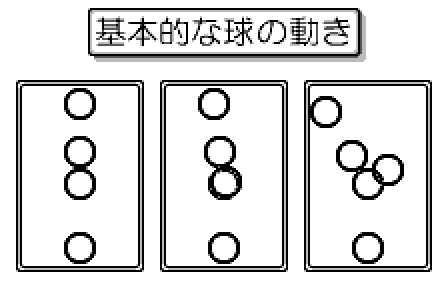
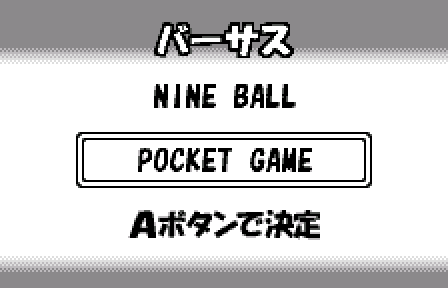
The Versus Mode is played against the computer or against a second player passing the one console back and forth, and offers nine-ball or a points game with ten balls; there is no link-cable play. The cartridge also has a section that demonstrates how the balls move on basic shots, which Bandai suggested could serve as a primer before a visit to a real pool hall. There is no save memory on the cartridge.
Development and release
Bandai welcomed the game as billiards finally arriving on the WonderSwan. It was listed at a planned price of 3,800 yen before tax, on a 4-megabit cartridge played with the console held sideways and with stereo sound, with no save memory and no link-cable play. The copyright line names only Data East.
Reception
The billiards itself is generally thought well done. The range of modes is rather thin, though, and although the characters each have their own lines, they seem to play no differently from one another.
Ports and other versions
The WonderSwan cartridge is one of the many home versions of Data East’s 1986 arcade game. It followed the Famicom version of 1987, the Game Boy version of 1990, the Mega Drive version of 1992, the Super Famicom version of 1994 and a Game Gear version released only in North America. Whether the WonderSwan game was converted from one of these or built anew for the handheld is unknown, and no later release is based on it.
The series went on after the WonderSwan, with an i-appli version for mobile phones in 2005, a Nintendo 3DS release in 2011 based on the Game Boy version, and a Nintendo Switch release in 2025 based on the i-appli version, as well as later re-releases of the Mega Drive and Super Famicom versions through Project EGG and, for the Super Famicom game, through Super Famicom Nintendo Classics in 2023.
The WonderSwan version’s presentation is brighter and more cartoon-like than in the earlier games, with character art drawn in a different style, and it lacks the trick-shot mode of the Super Famicom and Mega Drive versions, a set of 19 trick-shot levels added in those two versions, which also brought new graphics and music.