
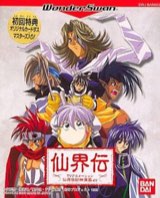
A role-playing game based on the Houshin Engi anime, set just before the story begins, in which an original hero and a partner from the cast search for a sage's scroll.
Screenshots
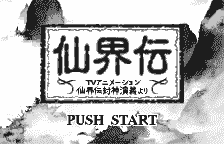
Title screen 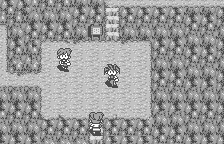
In play 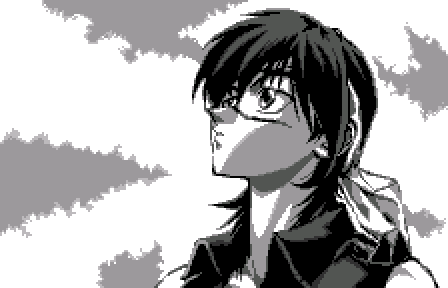
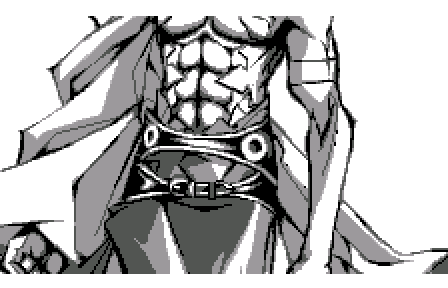
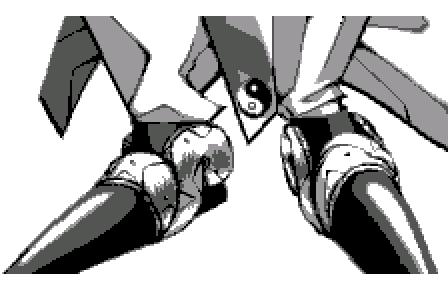
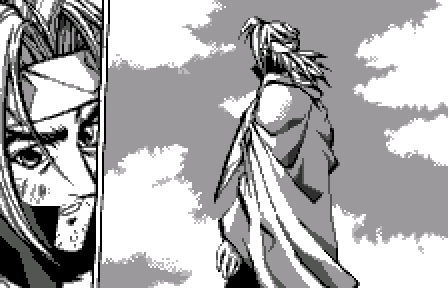
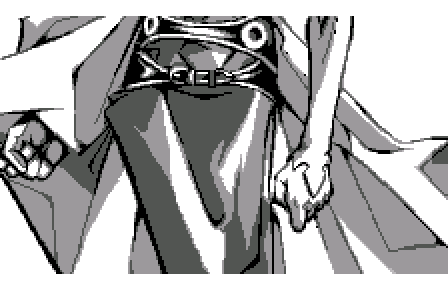
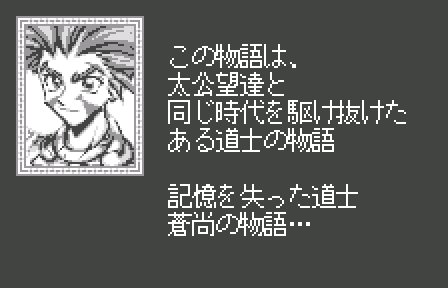
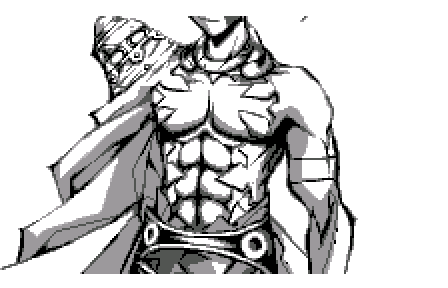
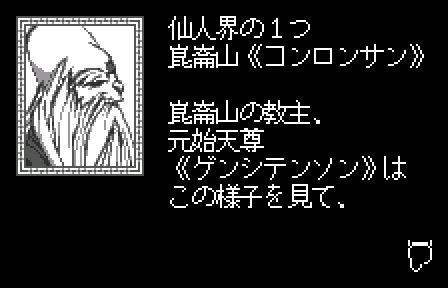
Senkaiden is a role-playing game that Bandai released for the WonderSwan on 24 February 2000, developed by Graphic Research. It is based on Senkaiden Houshin Engi, the television anime of Ryu Fujisaki’s manga Houshin Engi, which was running in Weekly Shonen Jump at the time. Although the title names the anime, the game follows the setting of the original manga closely. It was the first of two Senkaiden games on the WonderSwan, followed by Senkaiden Ni in December 2000.
The story takes place shortly before the manga’s Houshin Project begins, and its hero is an original character drawn for the game by Fujisaki, who travels with a partner from the series. The game uses the console itself in an unusual way: the hero’s starting abilities are set from the personal data the owner stored in the WonderSwan, while how they grow afterwards depends on the partner chosen. The stages include randomly generated dungeons and dungeons full of traps.
Through the link cable two players can team up to fight strong enemies together, which Bandai advertised as the first cooperative battle system over a link on a handheld console.
The story
The game is set in the world of Houshin Engi a short time before Taikoubou is sent down to the human world to start the Houshin Project. Its hero is a young Taoist training on Mount Kunlun to become an immortal under Genshi Tenson, which makes him a fellow disciple of Taikoubou. He has no fixed name: the console’s personal data gives him one of four, Ryo-yu among them.
The adventure opens with the hero at his training when Hakkaku calls him away and sends him to the audience hall, where he is presented to the immortals of Kunlun. His goal is the sage’s scroll, the certificate that marks a Taoist’s training as complete, and he works towards it by rising through the ranks of Taoist one step at a time. Bandai presented the game as a journey in search of this scroll alongside a partner, chosen from eight popular characters of the series with Taikoubou among them.
The story is told through missions. Each time the hero earns a new rank, Genshi Tenson gives him a task that takes him down to the human world, and the first sends him to Fengyi to collect Leizhenzi from Ji Chang. As the missions go on, towns open up one after another, among them Tai, Huaili, Fengyi, Chentang Pass, Jiepai Pass, Zhaoge and Donglu, and the hero comes to know the cast of the manga before its own story begins. Taikoubou himself can be met early, before he has received his paopei, when he can fight only with a drunken fist.
The partner shapes the story as well as the battles. Several characters can be recruited through optional side events in the towns, and which partner is travelling with the hero changes some scenes and some of the opponents in event battles. The game keeps closely to the manga’s setting, and its own original characters and events are fitted into it.
How it plays
Progress runs through the Genshi Cave, a dungeon sixty floors deep whose layout is generated anew each time a floor is entered. A boss waits on every fifth floor, and each victory raises the hero’s rank, from the first rank of Taoist earned on the fifth basement floor through nine Taoist ranks to the title of immortal on the fiftieth. Once a boss has been beaten, the hero can warp back out of the dungeon from that point. Below the title of immortal the cave goes on down to the sixtieth floor, where Shen Gongbao waits.
Between ranks the hero carries out Genshi Tenson’s missions in the towns and in story dungeons. Some town events can be seen only for a limited period, some story dungeons cannot be left once entered, and some must be cleared without a partner. Early recruits such as Taikoubou, Yang Jian, Huang Tianhua and Huang Feihu each have an optional event, in a sealed cave maze, a well, a mine and a tunnel, and each joins automatically later on if the event is skipped.
The party is always the hero and one partner. Sixteen characters can be recruited in all. Eight can join before the hero becomes an immortal: Taikoubou, Yang Jian, Huang Feihu, Huang Tianhua, Nezha, Leizhenzi, Wu Ji and Tu Xingsun. The other eight, among them Puxian Zhenren, Taiyi Zhenren, Princess Longji and Taishang Laojun, join only after he becomes an immortal and brings each one a gift. Every partner leans towards certain statistics, Taikoubou towards intelligence and skill and Huang Feihu towards strength and defence, and the hero’s own growth follows the partner he travels with. Travelling together raises friendship, and events at friendship 300 and 500 open new skills.
Characters have hit points, energy points, strength, skill, speed, defence and intelligence. Every attack has one of five elements, neutral, earth, water, fire or wind, and a range of long, middle, close or none, so the choice of partner and skill matters in each fight. Fights in the early floors of the Genshi Cave soon become one-sided, while the event battles of the story stay demanding throughout.
There is no money. Defeating enemies earns virtue as well as experience, and virtue is spent in the towns: 50 for a night at the inn, which restores hit points and energy, 100 at a medicine shop that cures ailments, more at food shops, and 1,000 for a weapon blueprint. Healing comes from food, from steamed buns that restore 100 hit points and 25 energy up to abalone that restores 5,000, and meat and fish dishes can be eaten only by natural-born Taoists. The hero can carry only a few items, so the bag fills quickly.
Weapons are paopei, and Taiyi Zhenren upgrades them from level 1 to level 5 using earth, water, fire, wind and iron stones. Higher upgrade levels open as the hero reaches certain ranks, and the last needs particular skills. Nezha’s and Leizhenzi’s weapons are upgraded by Taiyi Zhenren and Yunzhongzi. The hero starts with the Entenki and gains further skills through paopei-hunting events.
Development and release
Graphic Research handled the planning, specification, programming, sound and graphics, and developed the game for Bandai. The cartridge is SWJ-BAN022 at 3,800 yen. The game was made for the original WonderSwan only, and it plays in black and white even on the WonderSwan Color and SwanCrystal.
Modes and features
The personal data stored in the console decides a great deal about the hero. The month of the owner’s birthday picks one of four names, Ryo-yu among them; the first letter of the owner’s name sets his attack range; the last digit of the birth year gives his element; the last digit of the day sets his starting statistics; and a female owner raises his energy, skill and intelligence at the cost of the rest. The owner enters these details on the console’s own settings screen, reached by holding Start while switching it on. In the cooperative link mode each player sends one character from the party into six levels of six battles each; no experience is earned and stealing and escape skills cannot be used, but some pairs of characters can combine their attacks, health and energy are restored after each level, and some skills and items can be obtained only this way.
Secrets and extras
The most demanding recruit is Taishang Laojun. He joins only after the hero has become an immortal and defeated Shen Gongbao on the sixtieth basement floor of the Genshi Cave dungeon, and a special item is needed each time he is brought back into the party.
Reception
Fans regard it as a game made for fans by staff who clearly loved the manga: the system is an ordinary RPG, but the story and characters are built with great care, and the original elements fit naturally into the setting. Its weak points are that the player must descend the same dungeon again and again, that saving is possible only in a few places, and that the hero can carry few items, all of which the sequel improved.
Ports and other versions
Senkaiden was made for the WonderSwan and was never ported or re-released; the cartridge also runs on the later WonderSwan Color and SwanCrystal. Bandai released several other games drawn from the same anime around the same time, all of them separate games: Senkai Taisen, a role-playing game for the PlayStation released on 29 June 2000 that follows a rearranged version of the manga’s story with very little freedom; Senkai Ibunroku Juntei Taisen for the Game Boy Color on 24 November 2000; and Senkai Tsuuroku Seishi for the PlayStation on 29 March 2001, which retells the story as a sound novel. Senkaiden differs from them in telling a story of its own set before the manga begins, around a hero shaped by the owner’s console data.
Notes
Corrupted save data is common with this series. The hero’s name, like his abilities, comes from the console’s personal data, so the same cartridge can produce a different hero for a different owner.