
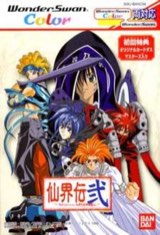
The second Houshin Engi role-playing game on the WonderSwan, an original story set years after the manga with a new hero, combination attacks and colour graphics.
Screenshots
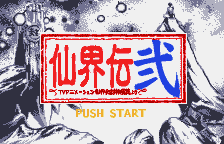
Title screen 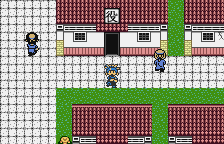
In play 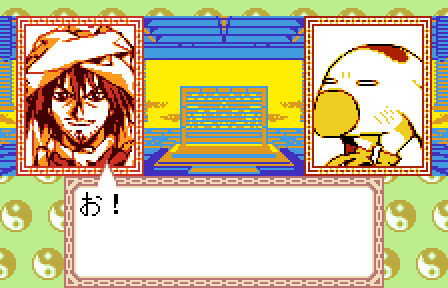
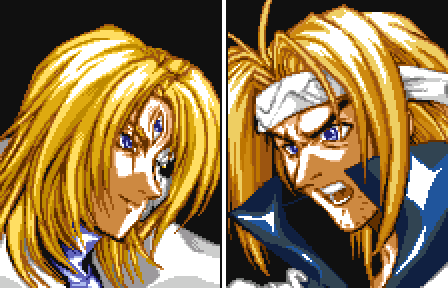

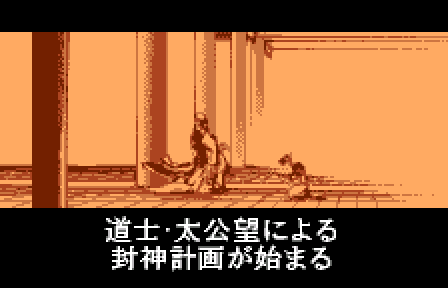
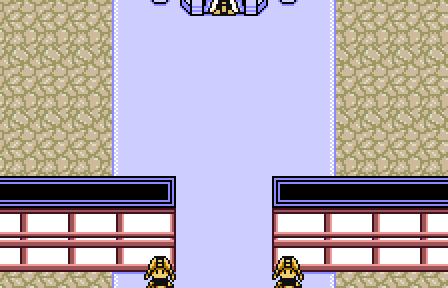
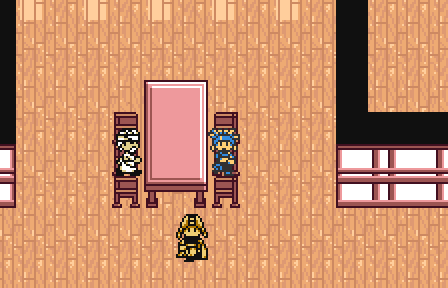

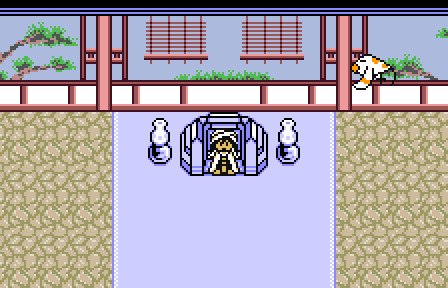
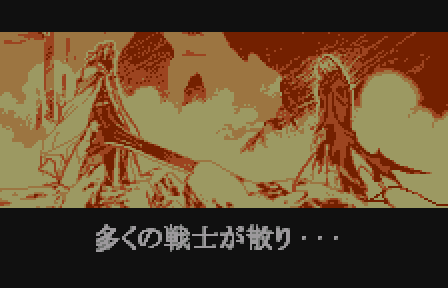
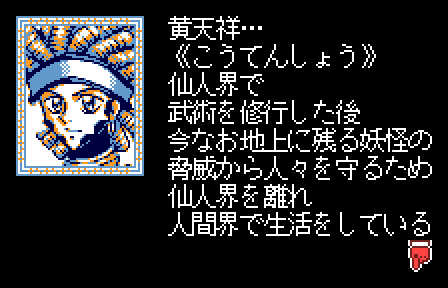
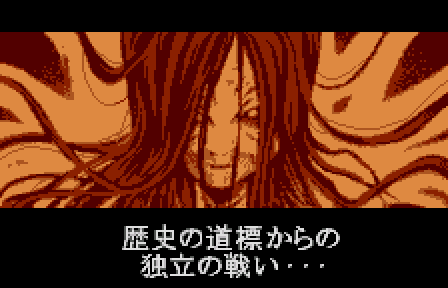
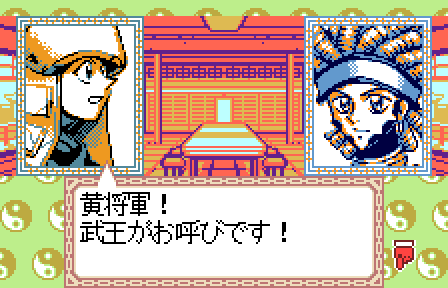
Senkaiden Ni is the second of Bandai’s role-playing games based on Senkaiden Houshin Engi, the television anime of Ryu Fujisaki’s manga Houshin Engi. Developed by Graphic Research like the first Senkaiden, it was released on 21 December 2000, less than two weeks after the WonderSwan Color went on sale. The cartridge works on both the original WonderSwan and the Color, and shows its graphics in colour on the newer console.
Where the first game starred a hero Fujisaki drew for it, this one tells a completely new story set some years after the events of the manga. Its hero is a character who appears in the manga as a boy and has now grown into a young general serving the Zhou dynasty. As before, he travels with characters from the series, raises his friendship with them and sees special events, but the party can now take in two companions instead of one, and more characters can join than in the first game. New to this game are combination attacks whose effect depends on which companions fight together, and an item whose effect changes with the place where it is used.
The game can be played by one or two players and supports the link cable. Bandai offered a poster to customers who reserved the game, and announced a rare Carddass card packed with the first print run.
The story
The game takes place some years after the end of the manga, in the human world that Taikoubou’s Houshin Project has left behind, a world no longer ruled by immortals. The Zhou dynasty now governs under King Wu from the castle of Xiqi, but demon immortals are still at large and causing trouble.
Its hero is Huang Tianxiang, the youngest son of Huang Feihu, who appeared in the manga as a small boy. He has since trained in the immortals’ world and come back down as a grown man, now a Zhou general known as General Huang who calls himself Zhou’s demon exterminator. He is a natural-born Taoist, still innocent and cheerful, with a new head of spiky hair. He fights with a flying knife, which talks with him and serves as his partner on the road.
The adventure begins at Xiqi castle, where Tianxiang speaks with King Wu, collects 500 wen for his expenses and sets off for the southern forest. From there he reaches an ancient ruin whose walls not even a paopei can scratch, where he picks up a strange stone and a familiar face, the hero of the first game, joins him. Soon afterwards he is tricked by someone in disguise into using his tremendous strength to break a dragon vein that held the Houshin Platform in place, and the souls sealed inside it are set free. To put his mistake right he goes up to Kunlun and then travels from place to place to mend the veins, while the four Mo brothers, who bear a grudge against Zhou, attack the town of Fengyi.
The journey leads through Fengyi, the southern forest, the ancient ruins, Kunlun, Mount Wuyi, the Sishui Cave, the forbidden castle, Muye, Taoyuan, Penglai Island and Mount Qi. The Houshin Platform itself opens as a dungeon whose stations, reached by a demon train, are home to the sealed immortals, some of whom can join the party. Under the adventure runs a quieter question: in a world without immortals, Tianxiang, who is neither an immortal nor an ordinary human, wonders where he belongs.
How it plays
The party holds Tianxiang and two companions, and twenty characters can be recruited. In some parts of the story the party is fixed or a guest joins for a while; on Mount Wuyi, for example, Nezha and Yang Jian must be in the party. Some recruits depend on how earlier events turn out: Leizhenzi challenges Tianxiang to a fist fight on Kunlun and joins later only if Tianxiang wins.
Exploration rewards searching. Items are hidden not only in chests but in shelves, pots and empty corners, and unlike the first game most dungeons keep the same layout when the party moves between floors, apart from certain places. The dungeons are built with a twist in their structure, and their difficulty is moderate. Many field enemies share reused graphics.
Companions also act outside battle. While walking, the Y2 to Y4 buttons call on the companions’ active commands: Huang Tianhua digs through earth walls, Huang Feihu breaks doors and rocks, Nezha and Leizhenzi carry the party over damaging floors, Puxian Zhenren freezes rivers, Yuding Zhenren lowers the encounter rate and Daode Zhenjun raises it, Taiyi Zhenren shows the map, and the first game’s hero wakes allies who are stunned.
The afterglow stone is the game’s most unusual item. Pressing Y4 in a place makes the stone absorb its light, and its colour and effect depend on where this was done. Silver light taken in front of Hakkaku summons him to heal the party, and orange light from the entrance of the ancient ruins raises strength by 35 percent. One colour can be obtained only after setting the console’s personal data to a particular code.
Money is counted in wen. Shops buy as well as sell, and some characters trade items. Selling a technique book to a shop adds a new line to its stock, up to four, and holding certain amounts made of a single repeated digit, such as 11,111 wen, opens rare items. Special items are kept in a separate slot. The item limit is higher than in the first game, but the list still fills quickly.
Battles are turn-based. Combination attacks depend on which companions fight together, such as the one Tianxiang performs with the first game’s hero, and they cannot be used while a buff to all statistics is in effect. Taiyi Zhenren on Kunlun upgrades weapons using stones, and Tianxiang’s own skills open as his flying knife reaches levels 2, 3 and 4 and as friendship with companions passes 200. Friendship tops out at 255.
The story has two endings, decided by the answers chosen at certain moments. After clearing the game, companions whose friendship is at the maximum can be talked to for extra conversations.
Development and release
Graphic Research handled the planning, specification, programming, sound and graphics of both Senkaiden games, and developed this one for Bandai. The model number is SWJ-BANC04 and the price 4,500 yen. The copyright line names Tsutomu Ano before Fujisaki, followed by Shueisha, TV Tokyo and the anime’s production committee.
Modes and features
The hero is Huang Tianxiang (Kou Tenshou). The system is a compact, ordinary turn-based RPG whose strength lies in its story and characters, with sprites that reproduce Fujisaki’s drawings closely. The party holds three characters, and twenty can be recruited, some only under strict conditions; most have friendship events that open new skills. The first game’s hero also appears, and his name and abilities are again worked out from the owner’s personal data stored in the console. Over the link cable two players each send one character from their party into a cooperative battle across six levels, the first a single fight and the rest five fights each; experience is not earned there, health and energy are restored after each level, combination attacks can be used and some skills and items can be obtained only this way. The game has two endings, decided by choices made during play, and it keeps only one save. The title screen plays the anime’s opening song.
Secrets and extras
A character in the second Kunlun area plays the game’s music, with 48 tracks that become available as the story advances. Messages from the development staff are hidden at about ten places on the maps and appear when the player stands still on certain spots or reloads a save there. After the ending, raising friendship to the maximum unlocks further conversations, and a long chain of conditions must be met before Taikoubou himself agrees to join. Shen Gongbao can be met as a hidden boss, appearing rarely at random near the entrance to one late area when Taikoubou is in the party, and he can be fought again and again.
Reception
Japanese fans regard it as one of the better licensed games. It is seen as close to a semi-official epilogue to the manga, praised for the way it resolves bonds left unfinished in the original and fills in vague parts of the setting, and considered a well-balanced RPG. Fans rate it above the first game and recommend playing both, and the detailed pixel portraits in conversations are admired. The hero’s spiky adult look on the box divides opinion, as does the final villain’s treatment, and lost save data is remembered as the game’s biggest flaw.
Ports and other versions
Senkaiden Ni was made for the WonderSwan, playable on both the original console and the Color, and was never ported or re-released. The other Houshin Engi games Bandai released in the same period, Senkai Taisen for the PlayStation and Senkai Ibunroku Juntei Taisen for the Game Boy Color in 2000 and the sound novel Senkai Tsuuroku Seishi for the PlayStation in 2001, are separate games. The PlayStation titles retell the manga’s own story, whereas Senkaiden Ni carries the setting forward with an original story set years after the manga ends.