
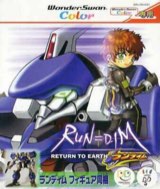
A six-stage scrolling shooter for the WonderSwan Color based on Run=Dim, the fully computer-animated TV anime broadcast in Japan in 2001.
Screenshots
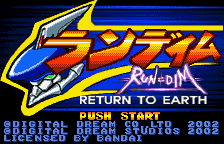
Title screen 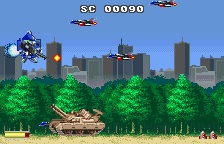
In play 
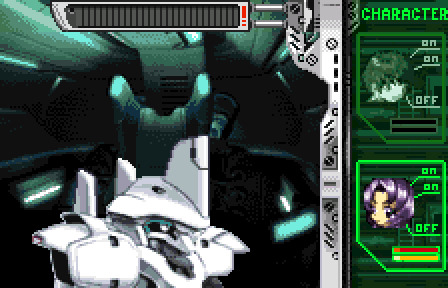
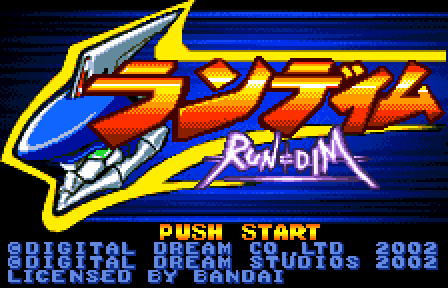
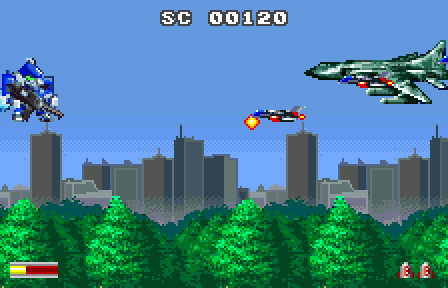
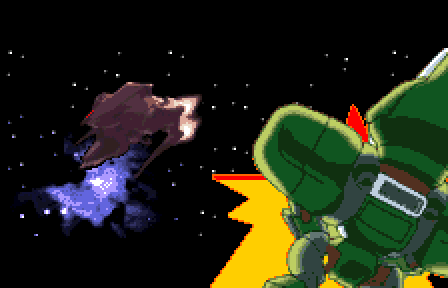
Run=Dim: Return to Earth is a shooting game for the WonderSwan Color based on Run=Dim, a Japanese television anime that ran for thirteen episodes on TV Tokyo and its affiliates from April to June 2001. The series was made entirely in 3D computer graphics, which was still rare for broadcast television at the time, and was produced by Idea Factory together with the South Korean studio Digital Dream Studios. The WonderSwan game was released in Japan on 7 February 2002 under the Digital Dream name. The subtitle is written both as Return to Earth and as Return of Earth.
The player fights for the Green Frontier organisation as one of two pilots from the series, in a side-scrolling shooter played over six stages. It was made for the Color and does not run on the original black-and-white WonderSwan.
The story
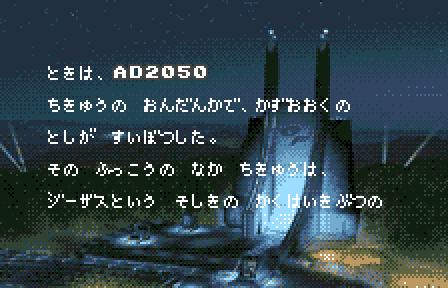
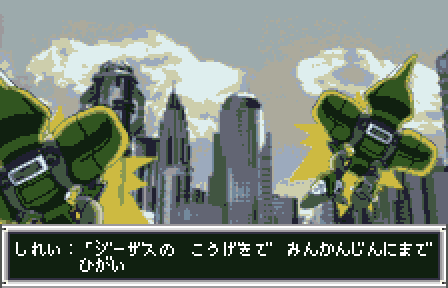
The game takes its setting from the anime. Early in the 21st century, global warming that had been speeding up since the end of the previous century has drowned a large share of the world’s land, sinking many great cities beneath the sea and wrecking the world economy. Half a century on, in 2052, a new order has formed around two huge organisations, each born from repeated mergers of the world’s largest companies: the space development body Jesus and the international civil organisation Green Frontier. Rivalry over who will lead the push into space raises the tension between them until a surprise attack by Jesus starts open war.
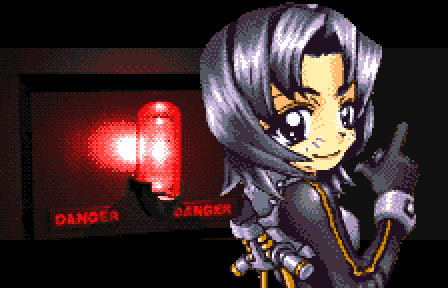
The player belongs to the Green Frontier side and chooses between its two pilots. Kazuhito Moriguchi, called Kazuto, flies the Run=Dim machine, and Kanna Aso flies the I=Ra. In the series the fighting robots are known as RBs and are piloted by young people whose abilities have been artificially strengthened; Kazuhito dreams of flying the machines his father builds, and Kanna, who went through training alongside him, is his constant sparring partner in arguments. The anime starts both of them out as Jesus pilots, while the game places both on the Green Frontier side from the start.
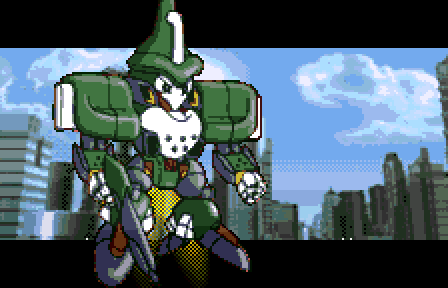
The story is told between the action. Each stage opens with a short scene before the fighting starts, and the dialogue in these scenes is shown as text alone, without portraits of the speakers. The stages are framed as a run of missions that the chosen pilot works through towards the ending.
How it plays
After choosing a pilot, the player clears the six stages one after another, and each stage cleared opens the next. The screen scrolls sideways while enemies come in from every direction, and stages end with large boss machines. Both the player’s craft and the characters are drawn in a small super-deformed style, and although the source is a robot anime, most of the action involves fighter aircraft.
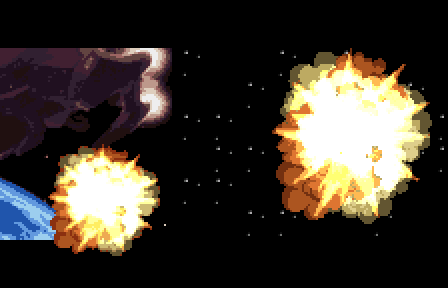
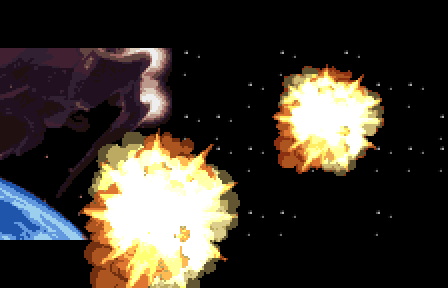
The arsenal is small. There are only two kinds of weapon to power up and a single type of bomb. Setting off the bomb brings up its own special graphic and briefly freezes the screen. The two pilots appear to play the same way.
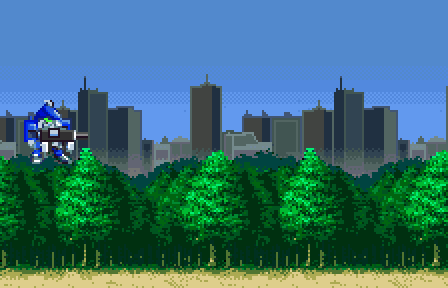
The game is not especially hard. The WonderSwan Color’s DSTN screen leaves little sense of speed, and obstacles are hard to tell apart from the background art; much that looks like an obstacle turns out to be scenery.
The game is for one player and has no link-cable support. Its sound is mono, and its music and sound effects are generally thought of as weak.
Development and release
The anime behind the game was a joint production between Japan and South Korea. The Seoul studio Digital Dream Studios started work on the series in October 2000 together with Idea Factory, with the Japanese broadcast set to begin on 1 April 2001 and a Korean broadcast and a film version planned to follow. The WonderSwan Color game was published by the Japanese company Digital Dream, and its copyright line names both Digital Dream Co., Ltd. and Digital Dream Studios; which of the two did the programming is unknown. Bandai’s WonderSwan site promoted it as the first shooting game for the WonderSwan Color.
The cartridge went on sale on 7 February 2002 at 4,950 yen before tax, with the model number SWJ-DDJC01. Every copy came packaged with a figure of the Run=Dim machine, and the price includes the figure.
Ports and other versions
Return to Earth was made for the WonderSwan Color alone and was never ported or re-released. The franchise has two other games, and neither is a version of this one. The Mechsmith: Run=Dim for the PlayStation 2, released in August 2000, has the player design and tune mechs and then send them into battles they cannot steer directly, while Run=Dim as Black Soul for the Dreamcast, an Idea Factory release of September 2001, is a tactical role-playing game fought on a grid. Against these two the WonderSwan Color game is the only one built as a straightforward scrolling shooter.
Notes
The subtitle is usually written Return to Earth, as on Bandai’s own page, but Return of Earth also appears in lists of the anime’s games.