
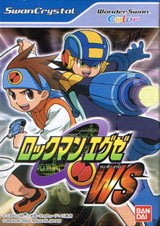
A side-scrolling action game in the Rockman EXE (Mega Man Battle Network) series, following the first season of the anime, with MegaMan.EXE using Battle Chips in real time.
Screenshots
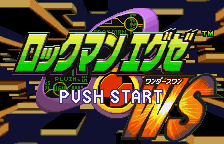
Title screen 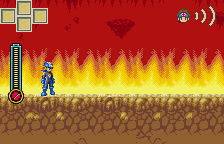
In play 
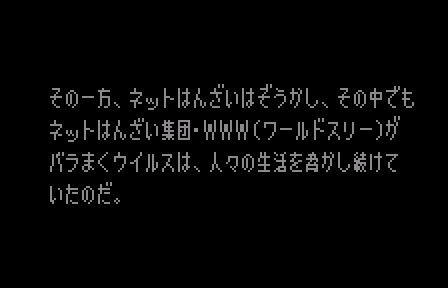
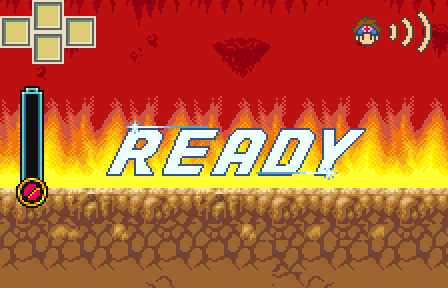
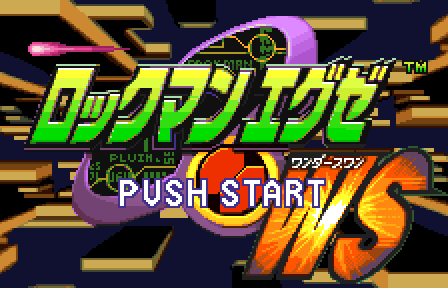
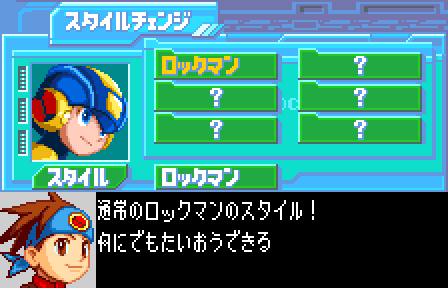
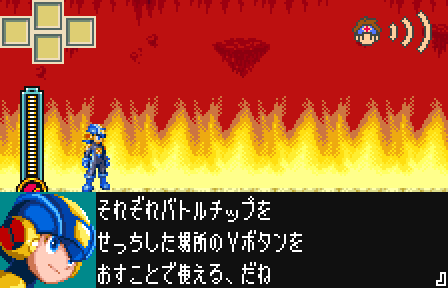
Rockman EXE WS is an action game for the WonderSwan Color, released by Bandai and based on Capcom’s Rockman EXE series, known in English as Mega Man Battle Network. Where the main series is made up of role-playing games, this entry is a side-scrolling platformer. Its story retells much of the first season of the Rockman EXE television anime, and it is the only game made as a tie-in to the show.
The player controls only MegaMan.EXE, while his operator Lan Hikari appears in conversations, menus and calls. MegaMan fights in real time with his buster and up to four Battle Chips, which are used up as they are fired instead of being drawn from a folder as in the main series.
The story is told in six chapters, and some stages split into different routes. A seventh chapter opens only after the game has been played through more than once, and finishing it unlocks a boss rush mode.
The story
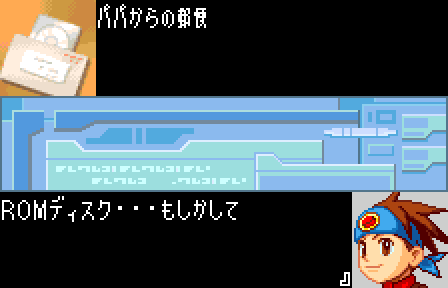
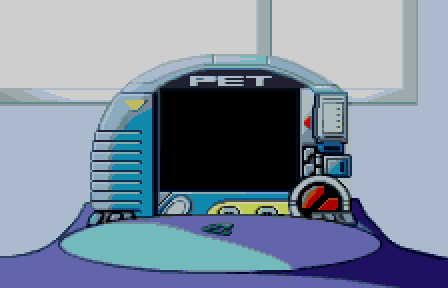
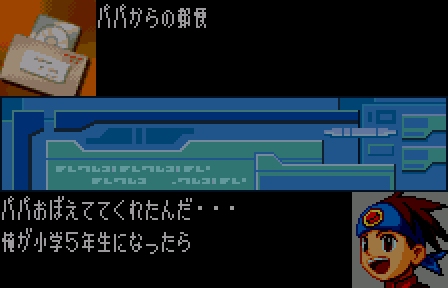
The game is set in Akihara Town in a world where NetNavis, programs that act as their owners’ partners, can be plugged into the computers of homes, trains, traffic systems and television stations. A string of fires has broken out around the neighbourhood when Lan Hikari, a fifth-grader, receives a mail from his father Yuichiro. His father had promised him a custom navi once he reached the fifth grade, and the mail delivers it. Lan installs it and meets his new partner, MegaMan.EXE, known in Japan as Rockman.
The next day the Hikari family’s own oven catches fire, a day after a repairman called round about the fires in the area. MegaMan offers to go into the oven’s computer and look, and this first case leads the pair into a run of incidents on the network. A subway train is hijacked and races out of control with Lan on board, the town’s traffic lights go haywire, and a television yoga show starts to hypnotise the town. In each case Lan plugs MegaMan into the system, and MegaMan fights his way through the viruses to delete the navi causing the trouble.
Behind the crimes stands the WWW, a group led by Dr. Wily that is out to take over the world, and the pair set out to find out more about it. Its members and their navis, such as FireMan, ElecMan and MagicMan, are the bosses of the stages.
Each of the first five chapters loosely adapts an episode of the anime, and in chapters 2 to 5 the player picks between two routes that adapt different episodes and end with different bosses. The plot is not connected directly to either the games or the anime, and from the sixth chapter on the story is the game’s own. The tone follows the children’s anime, and the opening scenes are set at home with Lan and his mother Haruka.
How it plays
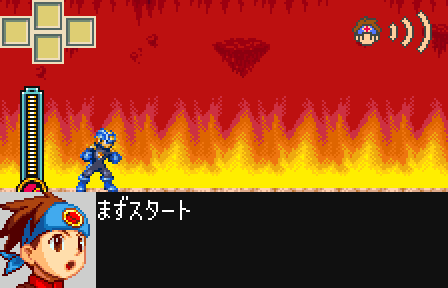
The four X buttons move MegaMan, the A button jumps and the B button fires the Rock Buster, which charges when held. He can slide, as in the original Rockman games, and the slide is needed to get under some enemy attacks. He also climbs ladders. The four Y buttons each hold one Battle Chip, so a chip can be used in the middle of a jump or a boss fight. His health bar is on the left of the screen and a boss’s on the right.
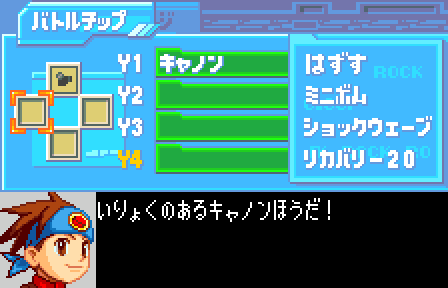
Chips are dropped by defeated viruses or found lying in the stages. Most can be used once, and up to nine of each can be carried. A few can be used any number of times: Guts Punch, Cold Punch, Dash Attack, Burning Body, the sword chips and three support chips, Area Steal for speed, Air Shoes for a higher jump and Undershirt for defence. The others include cannons, bombs, shock waves, earthquakes, Recovery 20 and 60 and Attack +20 and +40. Chips are listed with a text description only, without pictures. Equipping three chips in the right order highlights them, and pressing down twice fires them together as a Program Advance; Cannon, Hi-Cannon and Mega Cannon make one, and Sword, Wide Sword and Long Sword another. Some items are hidden behind walls that only particular chips or Program Advances can break.
Lan changes the equipped chips through the pause menu, and that depends on the signal between him and MegaMan. An icon of Lan’s face in the top right corner shows up to three waves. With three or two, everything works. With one, MegaMan can still use the chips he has on but cannot be sent new ones or change style, and with none he cannot use chips at all. The signal drops in parts of a stage and sometimes seemingly at random, so it pays to choose the chips before entering a dead zone. When the gauge is full Lan and MegaMan can trade information, which can open hidden routes, and the icon flashes and beeps when a rare chip is nearby.
MegaMan starts with no element, and the elements Heat, Aqua, Elec and Wood give advantages over one another. Style Changes come from beating particular bosses and set his element, charge shot and other abilities, with no choice of combination. Heat Guts Style fires a mid-range flame, Aqua Custom Style a bubble shot, Elec Brother Style an electric ring and Wood Shield Style a short-range whirlwind, and there is a fifth, the Saito Style. Wood Shield, earned from SnakeMan in chapter 4, cuts the damage MegaMan takes and helps in several later boss fights.
The stage order is fixed. There are six stages; stage 1 has no split, stages 2 to 5 each branch soon after the start into two versions with their own boss, and stage 6 is twice as long as the others, with a boss halfway through. Each stage gives MegaMan nine lives, refilled every stage, and many stages have continue points after their worst parts. There are no passwords. The game asks to save when it is finished, and loading that save starts again from the beginning with all chips and styles kept, so the other routes can be played. Many chips cannot be reached on the first run, and it takes at least two runs to see the full ending and collect every style.
The game is hard. Stages are full of blind drops, hidden enemies and awkward jumps, and bosses punish the wrong equipment, so much of the challenge is learning each stage. Ladders are easy to miss while moving, and a charged shot cannot be released for a moment after MegaMan is hit. ColoredMan in stage 2 has an easier pattern than ElecMan. PharaohMan in stage 3 is the most notorious regular boss, because his giant coffin reflects buster shots, but Burning Body drives straight through it. Sword chips work well against SnakeMan, and taking his route first gets Wood Shield early.
Development and release
Bandai published the game under licence from Capcom, and for this reason it does not appear in Capcom’s own list of its works. Bandai’s announcement presented it as a WonderSwan entry in the Rockman series, which had reached its fifteenth year since the 1987 Famicom original, at a time when the Rockman EXE anime was on television. It went on sale on 8 February 2003 at 4,500 yen before tax, with the model number SWJ-BANC35, and it runs only on the WonderSwan Color and SwanCrystal. The studio that made it has never been named; only Bandai and Capcom are credited.
Modes and features
Bandai described the game as a partnership between the two heroes. Netto supports Rockman by slotting in battle chips, while viruses and traps in each stage cut the link between them; some obstacles must be cleared by Rockman so that Netto can get through, and others are removed by Netto for Rockman.
How many chips and styles have been collected is shown as a completion rate. The game is for one player and supports the link cable.
Secrets and extras
Starting again from a save that has finished the game opens a hidden seventh stage, and clearing that stage adds the EX Mode to the title screen, a boss rush offered at practice, extra and hard settings. Bringing the completion rate to 100 per cent unlocks a further EX Hard setting, which adds one more opponent at the very end. The colour of the star beside the continue option on the title screen shows how much has been unlocked on that cartridge, and one style change, the Saito Style, can only be earned by beating a particular boss on a second playthrough.
Reception
Weekly Famitsu’s Cross Review gave the game 26 out of 40. Players have found it demanding, and its generous supply of lives has been read as a sign that the designers expected players to learn each stage by trial and error.
Ports and other versions
Rockman EXE WS was made for the WonderSwan Color and was never ported, remade or re-released on any other system; it was sold only in Japan. Its closest relative is Rockman EXE Transmission, a side-scrolling action game in the same series that Arika developed for the GameCube and Capcom released a month later, in March 2003. The WonderSwan game is a 2D action game in the same vein, but with battle chips and the behaviour of viruses and navis reworked for its own rules, and with a story of its own. 1UP.com’s Jeremy Parish saw the two as alike in concept and judged the WonderSwan game far weaker.
Notes
The story is only loosely tied to the anime. The plot does not connect directly to either the games or the anime, but the background of each of the first five stages is modelled on an anime storyline, while the sixth stage and beyond are original. The development is sometimes credited to Tose, though this has never been confirmed.