
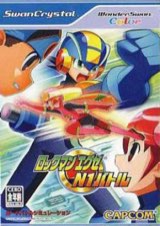
The WonderSwan Color counterpart of Rockman EXE Battle Chip GP, a card battler in which a deck of battle chips fights automatically, released by Capcom in 2003.
Screenshots
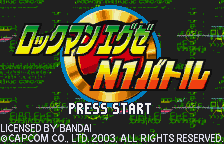
Title screen 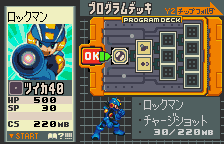
In play 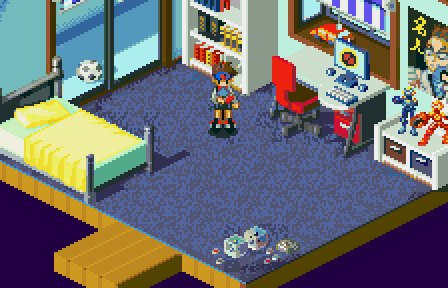
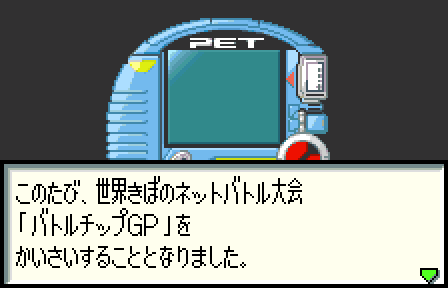
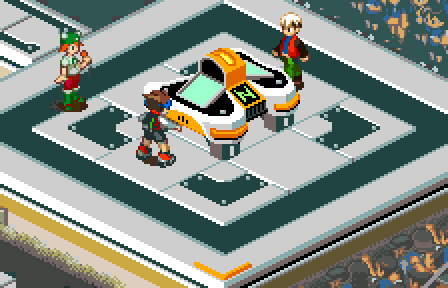
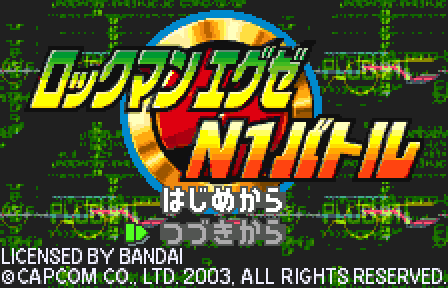
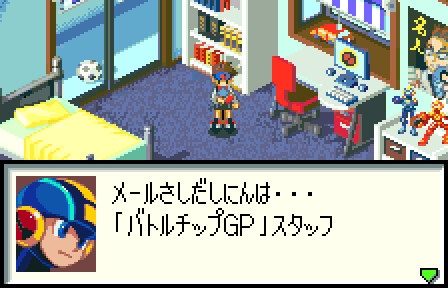
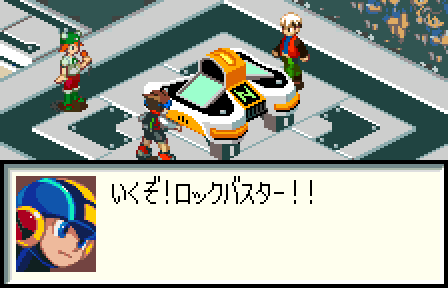
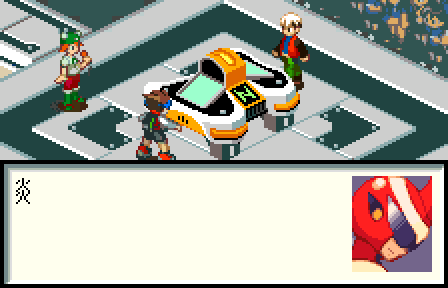
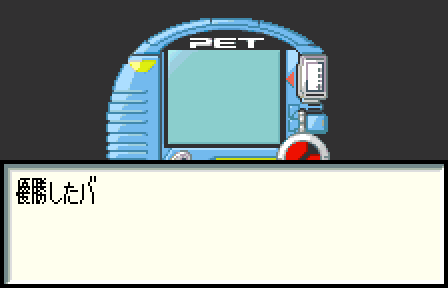
Rockman EXE: N1 Battle is a card battle game in Capcom’s Rockman EXE series, known in English as Mega Man Battle Network. It came out for the WonderSwan Color in Japan on 8 August 2003, the same day as Rockman EXE Battle Chip GP for the Game Boy Advance, and the two games share their developer, Inti Creates, and their design. N1 Battle was the only WonderSwan game that Capcom published itself, and the cartridge does not run on the original black-and-white WonderSwan.
Instead of controlling the hero’s navi directly, the player builds a program deck of battle chips around a navi chip and watches the battle play out, aiming to win the Master Tournament. The WonderSwan Color game is a smaller version of its Game Boy Advance sibling, with fewer chips and navis and a simpler deck.
The story
The game is set a few months after the N1 Grand Prix, the tournament held in the main series to find the strongest net battler in the world. The net battlers are not satisfied with that result and want to settle once more who is really the strongest. A new tournament, named the Battle Chip Grand Prix, is announced, and an invitation reaches Netto and his navi Rockman.
Netto is the operator and Rockman is the navi he sends into battle, as in the rest of the series. The Game Boy Advance game lets the player take the part of several different operators, but N1 Battle has no character select and follows Netto’s story only.
The story is a frame for the tournament. Netto enters the Battle Chip Grand Prix and battles his way towards the top of the competition. Navis familiar from the series, such as Roll, GutsMan and Blues, appear in the game as navi chips.
How it plays
The player never moves Rockman during a battle. All the work is done beforehand in the program deck, a system modelled on the decks of card games and made so that players who are new to programming or weak at action games can still compete. Battles play out on their own and come down to planning and reading the opponent, and they can be fast-forwarded.
A deck is built around one navi chip, which sets the navi’s hit points and its capacity in megabytes. Battle chips go into nine slots, arranged in a front row and a back row, and the total size of the chips must fit inside the navi’s capacity. Rockman has 500 HP and 220 MB, GutsMan 700 HP and 190 MB, Roll 400 HP and 200 MB, and MagicMan 350 HP but 250 MB, so the choice of navi is a trade between staying power and room for chips. The WonderSwan Color deck also has no slot-in spaces, the two extra one-use slots of the Game Boy Advance game.
Each turn the game picks three of the nine slots by itself as the action plan, and the chips in them act. An empty slot means a lost action. In N1 Battle the chosen chips act in order of their speed, whatever order they were picked in, and the speed value is shown on every chip. Each chip has its own hit points and is deleted from the deck when they run out, so a deck wears down over a long fight. At the end of the turn the navi on the navi chip makes its own attack.
There are 108 chips: 88 battle chips and 20 navi chips, against 243 chips in the Game Boy Advance game. A chip shows its attack, hit points, speed, size in megabytes, an accuracy rank and a rarity in stars. A basic Cannon, for example, has 60 attack, 150 HP and takes up 20 MB. Most chips have no element, and the rest are Fire, Aqua, Elec or Wood. Chip effects include recovery, extra hits on the opponent’s front row, piercing, stunning, counters and auras. The battlefield has a single row of panels that cannot be changed during a fight, and whether a navi dodges an attack is down to chance, with the navi chips’ dodge values hidden from the player.
The 20 navi chips are Rockman, Roll, GutsMan, Blues, Forte, IceMan, FireMan, ElecMan, SkullMan, NumberMan, AirMan, QuickMan, ShadowMan, SnakeMan, MagicMan and five Normal Navis. None of the navis introduced in Rockman EXE 3 are in the game. Forte has 800 HP, Blues 600.
A battle ends when one navi runs out of hit points or after ten turns, when it goes to a judgement in favour of the side with more chips left. Winning tournament battles moves Netto up towards the Master Tournament, and free battles allow practice outside the tournament. Navi codes are compatible between N1 Battle and the Game Boy Advance game. Fan sites collected players’ codes so that others could enter them as opponents.
Development and release
Famitsu previewed the game in April 2003, presenting it as a card battle version of Rockman EXE in which the player arranges chips into a program deck and sends a navi into the ring. The story is set a few months after the N1 Grand Prix of the main series, when a new tournament called the Battle Chip Grand Prix is announced and Netto and Rockman receive an invitation. Capcom published the cartridge under its own name with the model number SWJ-CPCC01, and Bandai’s WonderSwan site carried it in its section for other publishers’ titles. Inti Creates developed it, one of the Rockman EXE titles it made for Capcom on commission. It sold for 4,800 yen before tax and works only on the WonderSwan Color and SwanCrystal.
Modes and features
The game has three modes: the Battle Chip GP tournament itself, free battles, and a versus and tournament mode. It is for one player, but friends’ navi codes, which work as passwords, can be typed into a single console one after another, so that a tournament of up to 100 players can be run on one machine. The game also supports the link cable. A navi code is 24 characters long, and there are two save files.
Reception
Weekly Famitsu’s Cross Review gave the game 23 out of 40. In the same set of scores the Game Boy Advance version received 27, so the reviewers rated the WonderSwan Color game a little lower than its sibling.
Ports and other versions
N1 Battle was not converted from a game on another system. Inti Creates made it for Capcom in parallel with Rockman EXE Battle Chip GP for the Game Boy Advance, and the two cartridges reached Japanese shops on the same day. The two share their design, but the WonderSwan Color cartridge has fewer chips and navis, and it is treated as one variation of the Battle Chip GP work. Only the Game Boy Advance version was localised: it came out in North America and Europe in March 2004 as Mega Man Battle Chip Challenge, while N1 Battle stayed in Japan.
The clearest difference is the cast. The Game Boy Advance game lets the player enter the tournament as any of six operators, each with a navi, whereas the WonderSwan Color game keeps to Netto and Rockman. The 24-character navi codes are shared, so a navi set up on one console can be typed in as an opponent on the other.
The Game Boy Advance version was later sold as a download for the Wii U Virtual Console, in Japan from 30 July 2014 and in North America and Europe in August of that year. The link features of the original cartridge cannot be used there. The WonderSwan Color version itself was never re-released.