
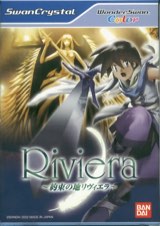
Sting's fantasy RPG about an angel of death sent to the island of Riviera, with one-press exploration and shared, breakable item-weapons. WonderSwan Color, 2002.
Screenshots
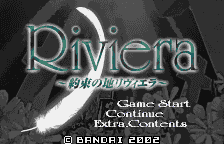
Title screen 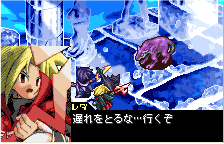
In play 
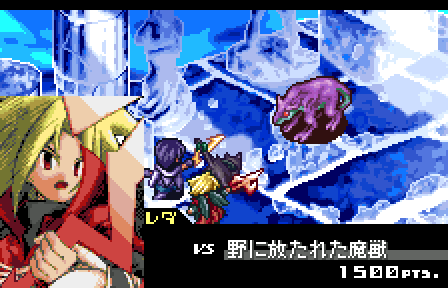
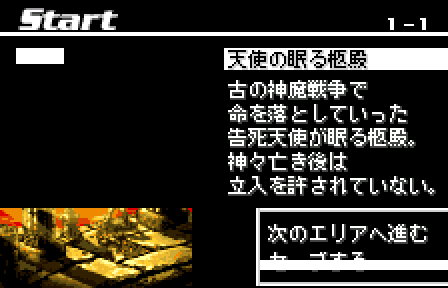
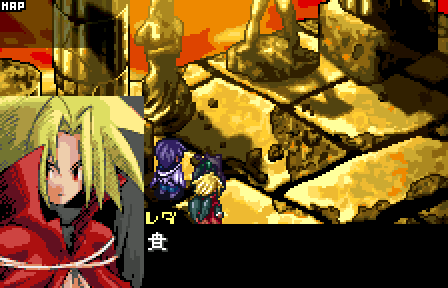
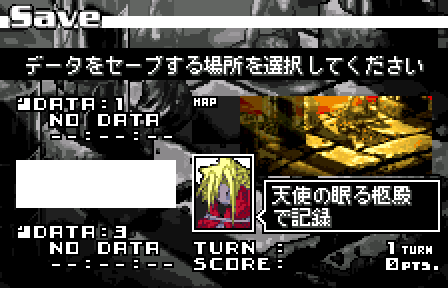
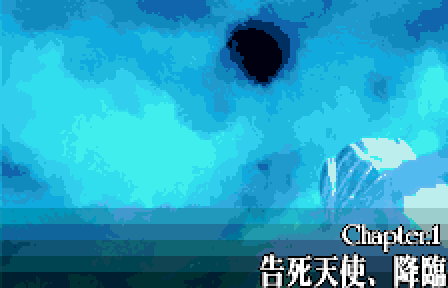
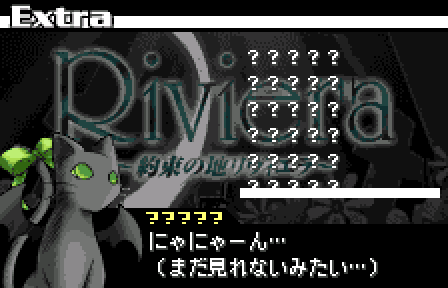
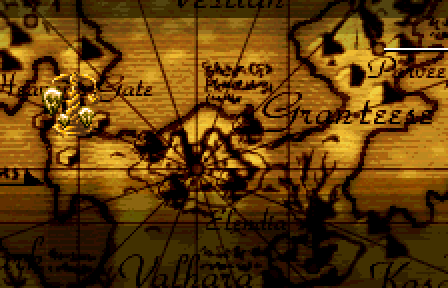
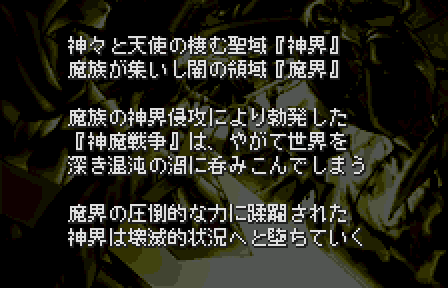
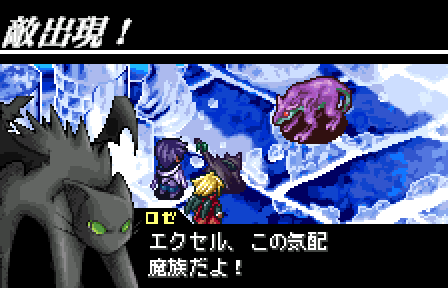
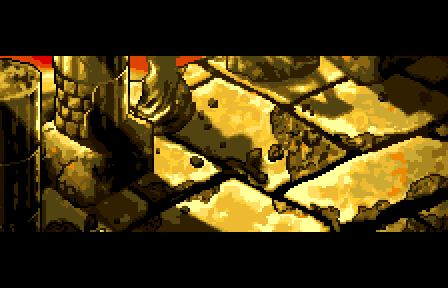

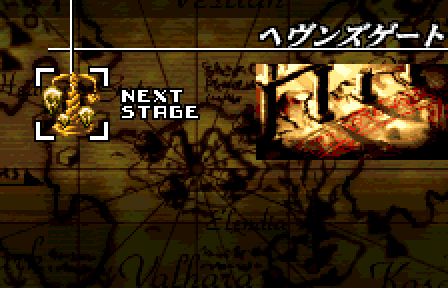
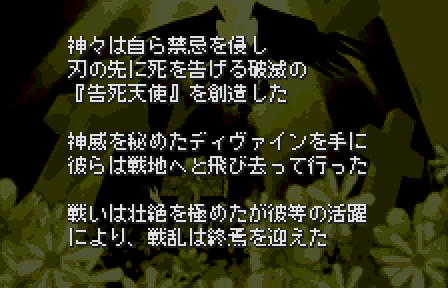
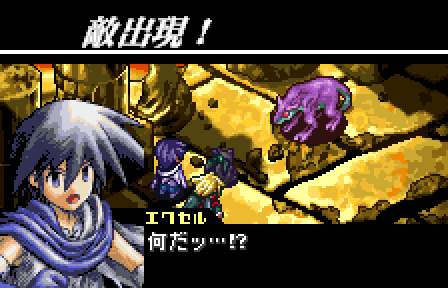
Riviera: The Promised Land is a fantasy role-playing game developed by Sting and released for the WonderSwan Color in Japan on 12 July 2002. It is the first game in Sting’s Dept. Heaven series. The player is a young angel of death sent from the world of the gods to Riviera, who ends up defending that land alongside the spirit girls who live there.
The game does away with free movement: the party moves from screen to screen by picking prompts, and nearly every action takes a single button press. Battles are fought with a shared pool of breakable items rather than fixed equipment, and there are no experience levels.
The WonderSwan Color version has no voice acting, five endings and a gallery and music mode. The cartridge does not run on the original black-and-white WonderSwan. The game was later rearranged for the Game Boy Advance in 2004, with some voices added, and remade for the PlayStation Portable in 2006.
The story
About a thousand years before the game begins, the demons of the underworld invaded the world of the gods. The gods drove them back, but the war cost them their own existence, and their authority passed to the Seven Magi, who act in their place. The gods also left behind the angels of death, black-winged warriors who each carry a divine weapon. Riviera is an island at the edge of the gods’ world, a promised land left in the care of spirits, and hidden there is a power called divine punishment that the gods kept back for use against the demons.
When signs appear that the demons are stirring again, the Magi order two angels of death to Riviera to set the divine punishment off. Ecthel, the hero, is wingless and has little experience as an angel of death, but he carries Excelion, said to be the strongest of the divine weapons. His partner Ledah is a solitary veteran who wields the spear Lorelei and is one of the strongest fighters in the gods’ world. Ecthel’s familiar Rose, a winged creature that looks like a cat but is not one, comes along and explains how things work. Ecthel has doubts about a punishment that would also strike the people living on the island.
Early on, Ecthel is separated from Ledah and wakes up with no memory, among strangers in the spirits’ forest of Elendia, a village known for its magic near the world tree. He is looked after by Fia, a calm girl who fights with a rapier and casts healing magic, and Lyuri, a lively, curious girl who shares Fia’s home, uses ranged weapons and often causes trouble. Rumours that evil creatures are returning to Riviera send them out to investigate, and along the way they meet Serene, a cheerful girl of the winged Arc people who swings a great scythe, and Cierra, a witch with powerful attack magic who came to some ruins to gather materials and lost track of her best friend. Apart from Ecthel and Ledah, the whole cast of companions is female. The English releases of the later versions call Ecthel Ein and Lyuri Lina.
The story is told in seven chapters, each a stage with its own boss, set in places such as a demon castle, a sunken city and ruins in a forest, and broken up by visits to Elendia. Much of it comes through the chatter of the party as they explore, which is friendly and warm, set against the heavier question of what the divine punishment would mean for Riviera. Conversations offer choices that change how much each of the four girls trusts Ecthel, and that decides which ending is reached. The manual describes the girls as members of twelve spirit tribes, but that background barely appears in the game itself.
How it plays
Outside battle Ecthel cannot walk freely. Each area is drawn as a fixed scene in a three-quarter view, and windows called triggers are always on screen. In Move mode the player presses the direction shown on a trigger to go on to the next screen or back to the last one. Pressing A switches to Quest mode, in which the triggers point at things in the scene to examine, such as chests, signs and places to jump. Bandai and Sting called this the Easy Trigger System and built it so that almost every action takes one press.
Many Quest triggers cost trigger points (TP), shown at the top left of the screen. Triggers marked in white are free, while those marked in red use up TP, and the spots the story needs are always free. TP is limited: it is earned in battle, the total is wiped at the end of each chapter, and the results screen then hands out a new amount based on how well the chapter went. Some triggers are action triggers, which ask for a timed button input and change the event depending on whether it succeeds; most chests are trapped and test the player this way. Hidden triggers appear only once certain conditions are met. Since TP cannot cover everything, choosing which spots to search is a large part of the game, and some chests give little back.
There are no random encounters. Enemies wait at set places in the field, and the player can choose to fight, although some battles are forced. Before each battle the player picks three of the available fighters, and up to four items from the bag. Those four items are the party’s only weapons and spells for that fight. All three fighters share them, and what an item does depends on who uses it: a witch’s broom is a plain swing for most of the party but a spell in Cierra’s hands, and a piece of fruit can be eaten or thrown. Turns come round on a timed order, and each turn the character uses one of the four items.
Every item has a durability count that drops by one with each use, and at zero it breaks and is gone. If all the items brought into a battle break, the game is over. The bag holds at most fifteen items in this version, so new finds often mean throwing something away, and it pays to use an item up before discarding it. New weapons and magic come from chests, battle rewards and the village of Elendia.
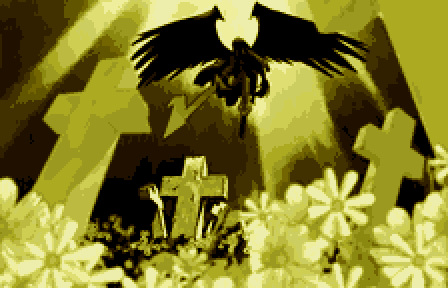
There are no experience levels. Instead, each item builds experience for the character who uses it, and once enough has built up, the character learns that item’s Over Skill, a powerful move with a full-screen cut-in that is paid for from the Overdrive gauge at the top left. The gauge fills as the party attacks and drains over time unless it is full, and enemies use the same kind of moves, so holding back can be worthwhile. Learning an Over Skill also raises the character’s stats for good, but the uses spent learning it shorten the item’s life, which forces a choice between growth and keeping a strong weapon. Every win is graded: quick victories rate higher, and finishing the last enemy with an Over Skill counts most, while losing a fighter along the way matters less. A higher grade brings more TP and better items.
Each chapter is divided into numbered areas, usually nine of them, with the boss in the eighth and the ninth area hidden. Between chapters the party splits up in Elendia, where Ecthel can talk to the villagers and stock up on weapons and magic. Practice battles can be started at any time while exploring; items are not worn down in them, they can be quit at any point and still count as a win, and they still give rewards, which makes them the easiest way to build up Over Skills and stats. That leniency keeps the difficulty low. Many choices cannot be undone, so items and pictures are easy to miss on a first play. Names cannot be changed, and there is a message skip but no auto mode or scene replay.
Modes and features
Conversations show bust-up portraits with more than a hundred expressions between them, and full-screen pictures mark key story scenes, some of which appear only when certain conditions are met. There are three save slots plus a suspend save.
Secrets and extras
The official site promised hidden triggers that lead to rare items and events, and rare event pictures that only appear when certain conditions are met. The six entries of the extras menu are unlocked by finding particular items. A strategy guide advertised on the official site promised the conditions for every hidden extra and for the branching endings, along with the heroines’ trust ratings.
Reception
In recent years it has come to be seen as a rare original RPG on a system crowded with conversions and licensed games. Players have praised a classic, likeable story, party banter that makes the journey feel shared and battle scenes with strong presentation; the difficulty is low, and irreversible choices and a fifteen-item limit make it a poor fit for completionists. The pixel art and the simple handheld-friendly controls are also liked, though some feel that the story leans too heavily on its many heroines.
Ports and other versions
Riviera was made for the WonderSwan Color, and every later edition grew out of it. The Game Boy Advance version came out in Japan on 25 November 2004, with new character designs by Yoshi Tobe, and Atlus released it in North America in June 2005. The PSP version followed in Japan on 22 November 2006 and in North America in July 2007, and a Japanese Special Edition appeared in October 2007. Versions for Japanese mobile phones followed from 2007. In 2024 Sting released an HD remaster on Nintendo Switch in February, on iOS and Android in May and on Steam in July; The Steam release is worldwide, with English and Japanese text.
The editions differ in several ways. The handheld original has no voices, the Game Boy Advance version has some and the PSP version is fully voiced. Tobe redrew the characters and monsters for both later versions, mostly following the first designs. The count of endings rises from five to six, the background story of how Riviera came to be is changed, the setting of the twelve spirit tribes is dropped, and small things are softened or removed, such as a sun-like object behind one boss and a few harsher lines of dialogue. The Game Boy Advance edition also brought slightly better graphics and music, voice clips in battle, new pictures, bug fixes and balance changes, and the PSP edition rearranged the whole soundtrack and added still more pictures, but merely enlarged and filtered the old backgrounds and sprites, with a final chapter first added for North America and later carried into the Japanese Special Edition.
The remaster is based on the 2002 WonderSwan Color game. It adds high-resolution illustrations, an easier standard mode with hints, play at up to five times speed with event skipping, a boost to skill learning, autosave and a log, and a choice of sound sources for the music, along with an option to bring the colours of the pixel art closer to the original.
Famitsu scored the WonderSwan Color game 31 out of 40, the Game Boy Advance version 32 and the PSP version 30, and the Metacritic averages are 76 for the Game Boy Advance edition and 68 for the PSP one. Hardcore Gaming 101 praised the new PSP portraits while finding its stretched characters ugly, and some players prefer the WonderSwan pixel art to that of the later versions.
Notes
Some copies carry the SwanCrystal logo on the top of the box, a mark of the system’s late releases. Bandai listed the game in Japanese as Riviera Yakusoku no Chi, a different word order from the official title.