
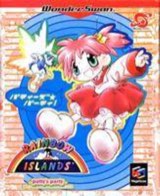
A WonderSwan follow-up to Taito's Rainbow Islands, starring Putty, a trainee rainbow magician, in vertically scrolling stages played with the console held upright.
Screenshots
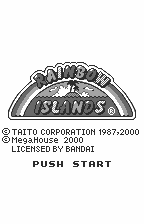
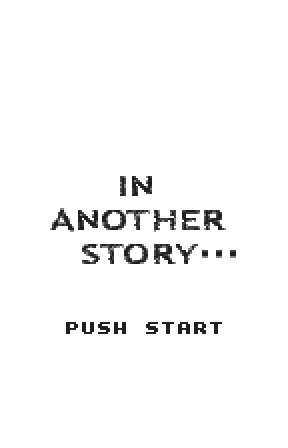
Title screen 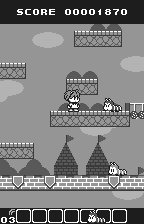
In play 
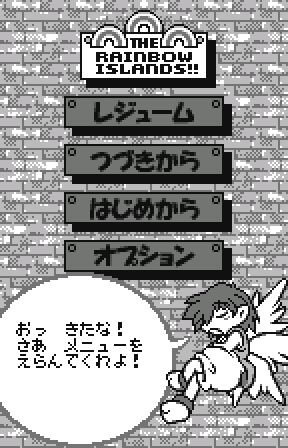
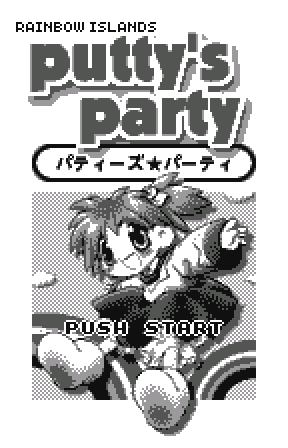
Rainbow Islands: Putty’s Party is a WonderSwan game built on Rainbow Islands, Taito’s 1987 arcade sequel to Bubble Bobble. In the arcade game the brothers Bubby and Bobby, back in human form, climb a chain of islands, casting rainbows that serve both as weapons against enemies and as bridges and platforms, racing upwards to the goal at the top of each stage. MegaHouse published the WonderSwan game in Japan on 29 June 2000.
Rather than a straight port, it is a new game that continues the story. Bubby and Bobby appear, but the lead is Putty, a girl training as a rainbow magician who calls herself their apprentice, accompanied by the fairy Naughty. The rainbow-casting climb of the original remains, but much was changed: the console is held upright for a tall screen, there are fewer islands (five, one of them hidden), and some stages also scroll from side to side. Characters speak during the story scenes, with voice actresses for Putty and the fairy.
The main theme of the arcade game is used in this version. The game was developed by Digitalware and published by MegaHouse.
The story
The game is set on the Rainbow Islands, where Bubby and Bobby, the twin heroes of the earlier games, now live in peace. That peace is broken when several of the islands suddenly vanish, and Bubby sets off straight away to find out what happened. This time, though, the story belongs to someone else: a girl staying in the brothers’ house, who takes the lead while the twins look on from the side.
She is Putty, an energetic girl who has moved in with Bubby and Bobby as their apprentice so that she can learn to use rainbow magic properly. Ever since she was small she has been able to cast rainbows without being taught, just as the twins can, and she came to them partly to find out what that power of hers means. She is also unusually fond of cake, so much so that people whisper she only goes adventuring for the sake of it, and the sweets she collects for points suit her well. Her adventure begins when Naughty, a wandering fairy, arrives with some news about the vanished islands.
Naughty is a boy fairy and an odd one: most fairies stay rooted in one place, but he loves to travel and roams from land to land in search of magic items. He acts cool but is kind at heart, and he helps Putty out with his wide knowledge, mostly while teasing her. He is in fact the youngest son of a noble royal family, and he gets angry if anyone mentions it. Bubby and Bobby were once rowdy boys but have grown calm and dignified. They still love adventure, yet they care just as much about the everyday lives of the islanders, and although they found it a nuisance when Putty pushed her way into their home, they are secretly glad to have her around, a little like a younger sister. The cast is completed by the King of Darkness, ruler of a world of darkness, whom the twins beat long ago, or so everyone believes, and who has returned again and again to cover the peaceful world in chaos.
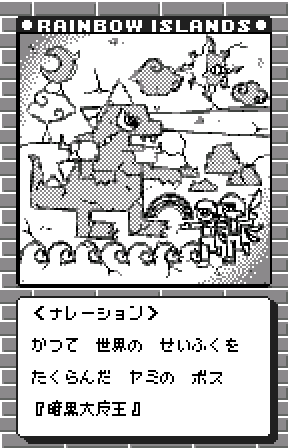
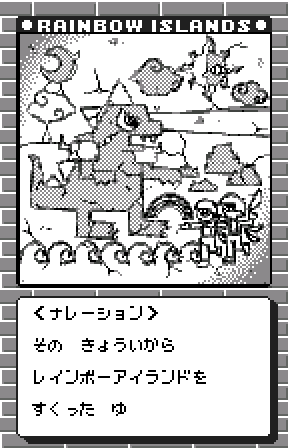
Each island is a world of four stages, and the story is told in event scenes between them, with drawn pictures, text and some spoken lines. The tone is light and comic, a side story in which the heroine does her best while the series’ original heroes keep an eye on her. Collecting the coloured diamonds of each world ties into the plot, because the big diamonds they produce are what will let Putty send the magic laid on the islands back at whoever cast it. How Putty handles the story changes the ending she reaches.
How it plays
The game has three parts. In the action part Putty climbs the stages; the event part tells the story; and the system part is a menu screen where she chooses which world to play, equips items and saves. The WonderSwan is held upright the whole time. In the action part the Y buttons move Putty, X1 or X3 casts a rainbow, X2 or X4 jumps and Start pauses. In the event scenes X1 or X3 turns the page and Start skips the scene.
Each stage is a climb to the goal at the top. Putty casts arched rainbows that knock out enemies and also serve as bridges and steps. An enemy struck directly by a rainbow turns into a score item. Touching an enemy or falling into the sea costs a try, and if Putty misses with no tries left she is thrown off the island and back to the map screen.
The rainbows can be used in several other ways. Standing or jumping on a rainbow breaks it, and the falling pieces knock out any enemies underneath; enemies beaten this way leave behind diamonds. Putty can walk up her own rainbows and cast new ones from the top to keep climbing, although if she chains too many the oldest one disappears. Holding the jump button while jumping on a rainbow stops it from breaking, so she can keep bouncing on it. Casting a rainbow at an empty spot can make a hidden item appear, a trick called the rainbow search, and Putty can also cast rainbows while jumping or put one in the way of an enemy’s shots to block them.
Every third enemy beaten produces an ordinary item, and the 24th produces a special one. Ordinary items last until Putty misses, and they are also lost when she clears a world. The shoes improve her running and jumping, the black pot lets her cast two rainbows at once, the white pot makes rainbows form faster, and the white and black stars make her fire star-shaped shots, in a fan or in every direction. Special items last only for the current stage. Thunder brings lightning down from the top of the screen onto the enemies, wings let her fly by tapping the jump button, and the fairy item sends Naughty circling around her to ram enemies.
Diamonds come in seven colours, and seven slots along the bottom of the screen show which ones Putty has picked up in the current world. The colour depends on where on the screen the diamond appears, and a slot blinks when the diamond that just appeared is a colour she still needs, so she can aim for the colour she is missing. If she has all seven when she beats the world’s boss, a big diamond appears from a treasure chest. Hyper items are rarer finds hidden on the islands; unlike the other items they keep working after a miss. Only one can be equipped at a time, and it is changed in the system menu.
There are four main worlds plus a hidden one, and each world has four stages. Most stages are plain climbs to the goal. In the sinking stages (1-3 and 3-3) the island keeps going under, so Putty has to race up before the sea catches her. In the loop stages (2-3 and 4-3) the screen wraps around from side to side to form a maze, and the door to the goal is hidden somewhere, to be found with the rainbow search. The fourth stage of every world is a boss fight at the top of the island, won by hitting the boss with rainbows until its gauge at the top of the screen runs out.
Progress is saved by world, with a save file chosen from the system menu, while the resume option suspends play in the middle of a world and picks up from the same area later. The options set the difficulty of the action part and the speed of the event text. A bonus menu on the title screen appears once every ending has been seen. With the WonderGate, Putty can download one hyper item, chosen at random and sometimes a rare one, or a title illustration, with twelve in all to collect and the one offered depending on the current score.
Development and release
Bandai presented the game as a WonderSwan original arrangement of the arcade classic, explaining that several islands that had been hidden in the original Rainbow Islands, among them the stages modelled on Arkanoid and Darius, had become main stages here. Putty was designed by the illustrator Kaizoku Santa, then drawing for the magazine Monthly Famitsu Bros., and Bandai announced that her voice actress would be picked through an audition held on Anige Master, a programme on the radio station Bunka Hoso. Putty’s voice went to Mayako Nigo, in her debut role. The fairy who travels with her was voiced by Atsuko Enomoto.
MegaHouse sold the game for 4,200 yen before tax under the model number SWJ-MGH003. First copies came with a card-sized “rainbow battery checker” meant to be carried around with the console. The game is credited to MegaHouse and Digitalware, with Taito named alongside them.
Modes and features
The game is billed as a multi-scenario action puzzle game for one player, with no link-cable play and stereo sound. The 16-megabit cartridge has 256 kilobits of battery-backed memory for saving. The game also works with the WonderGate: before release Bandai said that items and extra data available only through the WonderGate could be downloaded into it. The rainbow attacks, item effects and techniques of the original carry over almost unchanged, and sweets serve as the score items.
Secrets and extras
Clearing a stage through the door at its end earns a special item, called a hyper item; another can be earned by losing several times, and how the rest are obtained is unknown. As in the earlier versions, the colour of the rainbow diamond an enemy drops depends on where on the screen it is defeated. There are three different endings, which depend on how the final island is handled.
Reception
Players single out the many voiced lines in the story scenes and the appeal of the new heroine, and making the lead a girl has been praised as an excellent idea.
Ports and other versions
Putty’s Party was made for the WonderSwan as one of the sequels and remakes of Rainbow Islands, and it was never ported to another system or re-released. The arcade game it builds on was converted to many machines, and its other handheld appearances took different forms: a Game Boy Color version that came out only in Europe in 2001, a touch-pen remake for the Nintendo DS in 2005 and a 3D sequel for the PSP in 2007. The Rainbow Parasol Collection for Nintendo Switch, announced for October 2026, gathers six home versions of the original game, from the Famicom to the Mega Drive, but the WonderSwan game is not among them. What sets this one apart is that it is a new story with its own heroine and voiced scenes, played on an upright screen, rather than a conversion of the arcade stages.
Notes
The title is written in more than one way: with an exclamation mark after Putty’s Party, with the subtitle between wave dashes, and, in Bandai’s preview, with the subtitle spelled slightly differently again.